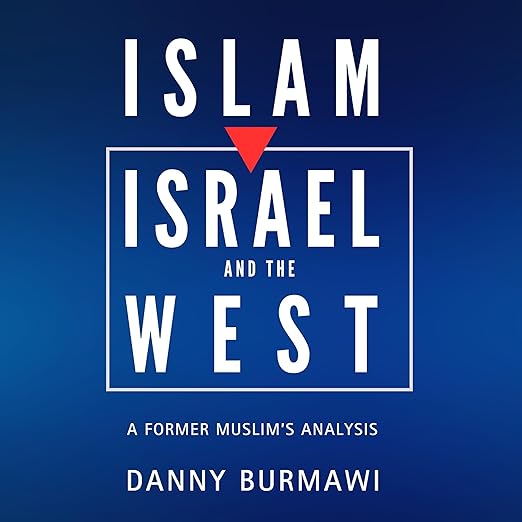
‘A former Muslim who left the Middle East for freedom in the West’ is how Danny Burmawi describes his own vantage point in this audiobook, and he doesn't pretend to be presenting a balanced survey. Islam, Israel and the West argues, across seven hours and seventeen minutes, that understanding Islam correctly is the key to understanding the Arab-Israeli conflict, Western immigration debates, and what Burmawi frames as a broader civilizational contest. Jim Vann narrates, and this is explicitly advocacy nonfiction with a stated thesis, not a neutral historical survey, which shapes everything about how it's worth approaching as a listener.
Vann Reads Burmawi's Case Without Editorializing
Burmawi's argument, in his own framing, is that Islam functions as ‘not simply a private religion, but a political-theological system with global ambitions.’ He builds the book's case for that claim across chapters covering the Arab-Israeli conflict, immigration, and Western political alignment. He explicitly rejects the framework of ‘Abrahamic religions’ as, in his telling, misleading, and argues that terms like ‘Islamism’ function to shield the broader religion from scrutiny. This places the book within a recognizable intellectual tradition of civilizational-conflict argument, one readers of Samuel Huntington's clash-of-civilizations thesis will find familiar in structure even where Burmawi's specific claims diverge.
Vann's narration is worth noting on its own terms: it's a clean, professional, unembellished read that doesn't editorialize or add dramatic emphasis beyond what the text itself supplies. That matters for a book this argumentatively charged, since a narrator leaning into the material's more inflammatory passages could easily tip an already polemical text into something more strident still. Vann instead lets Burmawi's own words carry the weight, which is the right choice regardless of where a given listener lands on the argument itself.
Weaving Historical Chapters into Campus Politics
Burmawi extends his argument into contemporary Western politics directly, not just historical or theological analysis. The synopsis describes him addressing what he calls ‘campus radicalism’ and what he terms ‘the unholy alliance of Islam and the radical Left.’ Both, in his framing, are extensions of the same underlying civilizational conflict he traces back centuries. That move, connecting ancient religious history directly to present-day domestic political disputes, is characteristic of the civilizational-conflict genre this book belongs to, and it's worth knowing that Burmawi treats these as continuous rather than separate arguments, weaving historical chapters and commentary on current immigration and campus politics into one sustained case rather than keeping them in clearly separate sections.
Reviews Uniformly Enthusiastic, Timed to October 7
The reviews attached to this audiobook are uniformly enthusiastic, and that uniformity is itself worth noting as a signal about who the book is reaching. One reviewer calls it ‘the single most informative, cogent, and painfully necessary book I have ever read in my entire life.’ The same review goes on to call it scholarly and credible ‘on every level.’ Another reviewer frames the book's central thesis in a single line: ‘Islam is a political ideology masquerading as a religion.’ These aren't measured, qualified endorsements; they're the responses of readers who came in already largely persuaded and found their views confirmed at length.
One reviewer situates the book's release date, October 7, 2025, as the two-year anniversary of the Hamas attack on Israel, noting they had followed Burmawi's writing on Substack for months before the book's release and pre-ordered it in advance. That detail is useful context for understanding the book's intended audience and moment: it's positioned deliberately, by both author and publisher timing, to speak directly into an ongoing, highly charged public argument about Islam, Israel, and Western immigration policy, not as a work of detached historical scholarship written with distance from current events.
One Reviewer's Contested Read on Early Conquests
A third reviewer frames the book's historical argument in stark terms, describing it as detailing ‘a brutal political campaign that began in the 6th and 7th centuries’ that, in the reviewer's telling, erased peoples and cultures across the Middle East. That characterization of the early Islamic conquests as fundamentally a story of cultural erasure rather than religious expansion is, again, Burmawi's contested framing rather than settled historical consensus, and listeners should weigh it as argument rather than as uncontested background fact, however confidently both author and reviewers present it.
No Debate with the Other Side's Case
This is advocacy writing, not comparative religious scholarship, and it doesn't claim otherwise, but it's worth being explicit about what that means for a listener. Burmawi presents one side of a deeply contested set of arguments about Islam, Israeli-Palestinian history, and Western immigration, without engaging counterarguments from mainstream comparative religion scholars or historians who would dispute major elements of his framework. Nothing here is presented as a debate with the other side's strongest counterarguments included, and it isn't trying to be; listeners should know that going in rather than mistaking confident delivery for scholarly balance.
The genuinely uniform five-star reception in the available reviews reinforces this: no visible range of critical response shows up here, positive, mixed, or negative, which is unusual for a book making claims this sweeping and contested. That pattern suggests a listener base that largely arrived already aligned with Burmawi's conclusions rather than one persuaded by the book from a position of prior skepticism, which is worth weighing against any expectation of a balanced, first-encounter introduction to these topics.
The book's own opening framing is worth citing directly given how sweeping it is: Burmawi writes that without understanding Islam correctly, a listener will be ‘blind to how the greatest civilization ever created is slowly being erased and replaced.’ That's about as unambiguous a statement of the book's civilizational-anxiety thesis as exists anywhere in the synopsis, and it sets expectations accurately for the seven-plus hours that follow. Listeners uncomfortable with replacement-framed rhetoric applied to demographic and religious change should know this isn't an incidental turn of phrase buried in a later chapter; it's the book's own stated premise from its opening lines.
Burmawi's Substack Following Moves into Audio
Civilizational-conflict arguments in the Huntington tradition already resonate with the honest audience for this one, listeners specifically seeking a case made from a former Muslim's personal and political perspective on Islam, Israel, and the West. Burmawi's own Substack following, referenced directly by one reviewer, suggests an existing readership that this audiobook is extending into audio rather than converting from scratch, and that audience will likely find exactly what they came for: a confidently argued, unapologetic case delivered without hedging.
Anyone looking for a neutral introduction to Islamic theology, comparative religion, or Middle Eastern history should look elsewhere; this book's value depends entirely on wanting the specific argument it makes, not on wanting a balanced survey of the debate. Listeners who would find its central claims, about Islam's compatibility with Western civilization and the nature of the Arab-Israeli conflict, personally objectionable or academically unsupported are, by the book's own uncompromising framing, simply not the audience it's written for.
Before You Press Play
- Performance: Jim Vann delivers a clean, professional reading that doesn't editorialize or add dramatic weight beyond the text itself, a fitting choice for material this argumentatively charged.
- What it covers: Islam as political ideology, the Arab-Israeli conflict, Western civilizational identity
- Feel: Urgent, argumentative, unapologetically one-sided
- Our call: A confidently delivered advocacy audiobook for listeners already sympathetic to its civilizational-conflict framework, not a balanced or scholarly introduction to Islam or the region's history.
Is this audiobook a neutral historical or religious-studies overview of Islam?
No. It's explicitly advocacy nonfiction arguing a specific, contested thesis about Islam and the West, written from the perspective of a former Muslim, rather than a balanced comparative-religion survey.
Do the reviews for this audiobook include any critical or mixed perspectives?
No, the available reviews are uniformly five-star and strongly aligned with the book's thesis, suggesting an audience that largely arrived already persuaded rather than a range of critical response.
Is this audiobook likely to persuade a skeptical listener, or is it aimed at an already sympathetic audience?
Based on its uncompromising framing and its reviewers' own testimony of following the author beforehand, it reads as written for an audience already receptive to its civilizational-conflict argument.