Quick Take
- Narration: Wade Stotts reads both participants’ arguments with measured neutrality, which suits the debate format and avoids editorializing through vocal performance.
- Themes: atheism and Christian morality, evidential reasoning vs. faith, the social consequences of religion
- Mood: Brisk, intellectually pointed, with more civility than the premise implies.
- Verdict: A compact introduction to Hitchens and Wilson’s respective positions, more useful as a starting point than as a definitive statement of either side’s best arguments.
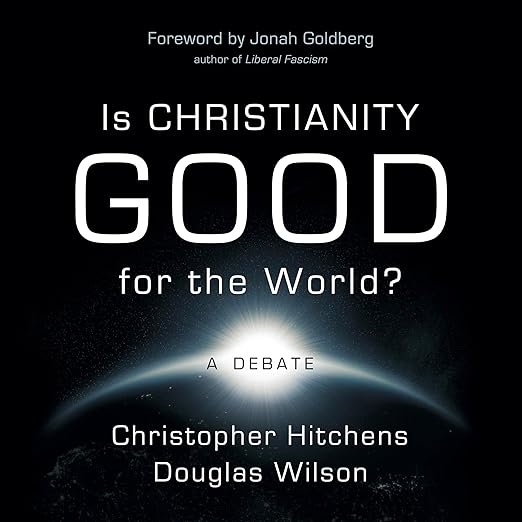
I have a weakness for debates between people who fundamentally disagree but respect each other enough to argue properly. Is Christianity Good for the World? is that kind of exchange, originally hosted by Christianity Today and later expanded into the documentary Collision, which filmed Hitchens and Douglas Wilson debating across a book tour. This audiobook represents the written foundation of that ongoing argument, and at one hour and twenty-four minutes, it is one of the more concentrated listening experiences I’ve come across.
Christopher Hitchens needs little introduction to anyone who has spent time in the territory of religion-atheism debates. His book God Is Not Great was a broadside against religious belief that generated enormous controversy and considerable admiration depending entirely on where you started. Douglas Wilson, the Christian apologist responding here, is perhaps less familiar to a general audience, but he is not a soft target: he is a trained philosopher and a skilled debater, and he understood that debating Hitchens required something other than the standard apologetics playbook.
Our Take on Is Christianity Good for the World?
The question the debate addresses is deliberately specific. Not “Does God Exist?” or “Is the Bible True?” but whether Christianity, as a historical and ongoing force, has been good for the world. That specificity is strategic. It shifts the ground from metaphysics to consequences, from the question of belief to the question of effects. Hitchens is on firmer territory when arguing consequences than when arguing first-cause metaphysics; Wilson chose the terrain wisely, hoping to draw Hitchens onto questions of morality and meaning where Christian theology has more to say than pure empiricism.
Whether it worked depends on who you ask and what you came in wanting to see. One reviewer who analyzes discourse professionally went through the exchange tallying the compelling points: they found Hitchens winning most rounds decisively, with Wilson taking one. Several other reviewers found Wilson holding his own more successfully than Hitchens’s usual opponents managed to do. This disagreement in reader assessment is itself informative: the debate is genuinely contested rather than being the walkover that Hitchens’s fans might expect.
Hitchens’s wit and rhetorical precision are present, though as one reviewer noted, he was not at his most incisive here. Compared to some of his longer debates and written work, this exchange shows him in a more constrained format. The written epistolary structure, letters back and forth rather than a live speaking format, suits Wilson better than it suits Hitchens, whose oral performance quality was a major part of his debating advantage.
Why Listen to Is Christianity Good for the World?
The audiobook is brisk enough that it functions as a genuine introduction to both thinkers’ positions rather than a deep dive into either. For listeners who have seen the documentary Collision or watched either participant extensively on YouTube, there may not be much new material here; the book tour debates that followed develop these arguments considerably further. But for someone coming to either Hitchens or Wilson without much context, this exchange provides a useful baseline.
Wade Stotts’s narration handles the debate format with appropriate neutrality. He is not performing advocacy for either side, which is the correct call for material this contested. The read is clear and well-paced for a text this compressed.
What to Watch For in Is Christianity Good for the World?
Several reviewers made a point worth echoing: this debate is unlikely to change anyone’s mind. The audience for this audiobook is polarized before they start. Hitchens fans will read it as a victory for their side; Wilson’s readers will find more substance in the Christian apologist’s arguments than the other camp acknowledges. One reviewer described the book as a concession by Hitchens in its very title, noting that why the debate should have such a teleological framing is itself a question. The framing does favor Wilson by presupposing that the relevant measure is social utility, which is not the terrain where atheist critique is typically strongest.
At eighty-four minutes, there is genuinely not much room for either participant to develop their strongest possible argument. Think of this as an appetizer rather than a meal.
Who Should Listen to Is Christianity Good for the World?
Listeners curious about the Hitchens-Wilson dynamic who want an efficient entry point before committing to the longer debate footage or either man’s written work will find this worthwhile. It is also a reasonable choice for anyone teaching or studying rhetoric who wants a compact example of two distinct argumentative styles in direct exchange. Avoid it if you expect closure or resolution; neither side lands a knockout blow, and both will leave their respective fans wanting more.
Frequently Asked Questions
Is this audiobook connected to the documentary Collision?
Yes. The documentary filmed Hitchens and Wilson debating each other on a book tour for this written exchange. If you have seen Collision, the audiobook covers the original written arguments that prompted the tour rather than the evolved debates captured in the film. They complement each other, but the audiobook covers the foundational text.
Does this debate give Douglas Wilson a fair hearing, or is it effectively a Hitchens showcase?
Wilson gets a genuinely fair hearing, and several reviewers with backgrounds in formal debate assessment found him to be a more competitive opponent than Hitchens’s usual adversaries. The written format also suits Wilson better than a live performance setting would, since Hitchens’s oral style was a significant part of his debating advantage.
Is this a good introduction to Christopher Hitchens for listeners unfamiliar with his work?
As a starting point, yes, with caveats. Hitchens at this length is operating below what several reviewers identified as his usual incisiveness. God Is Not Great or any of his longer debates would give a better picture of what he was capable of at full stretch. This exchange shows his approach and style but not necessarily his strongest arguments.
At just 84 minutes, is this audiobook long enough to develop either argument substantially?
Not substantially. Both participants make their central points clearly but neither has room to develop the most sophisticated version of their position. This is accurately described as an introduction to the debate rather than a comprehensive treatment of it.