Quick Take
- Narration: Mike Lenz reads with appropriate gravity for the subject matter, neither editorializing toward the deconstructors nor against them, which is essential for a book that needs both audiences to trust it.
- Themes: Faith deconstruction and reconstruction, institutional Christianity’s failures, prophetic dissent within the church
- Mood: Earnest and challenging, directed inward at Christian communities rather than outward at critics
- Verdict: A useful listen for anyone navigating the space between leaving institutional Christianity and losing faith entirely, and for church leaders willing to hear what their departing members are actually saying.
I listened to Invisible Jesus over two evenings, which felt like the right pace for a book that is asking its primary audience to slow down and consider something uncomfortable. I came to it from outside evangelical Christianity, which meant I was reading as an observer of a conversation I have watched from a distance for some years, the exodus of people who describe themselves as deconstructing. The book gave me a more precise vocabulary for what I had been watching happen.
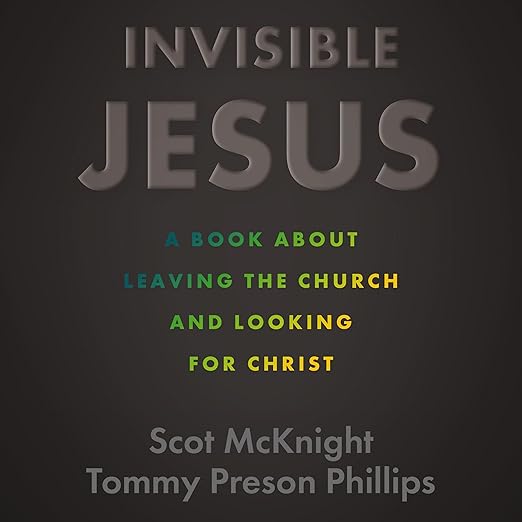
Invisible Jesus is coauthored by Scot McKnight and Tommy Preson Phillips and released in October 2024. McKnight is a prolific New Testament scholar and author; this book emerges from his long engagement with how Christianity is actually practiced in American institutional settings versus what the New Testament describes. The central argument is that the wave of deconstruction happening in evangelical Christianity is not primarily a rebellion against God but a prophetic response to specific institutional failures: renewed fundamentalism, toxic leadership, and legalistic thinking.
Our Take on Invisible Jesus
The book’s intellectual honesty is its most valuable quality. McKnight and Phillips could have written a crisis-management manual for anxious church leaders worried about declining attendance. Instead, they have written something that validates the deconstructors’ diagnosis while still pointing toward a Jesus-centered faith as the destination rather than away from faith entirely. The distinction they draw between losing religion and losing Jesus is genuinely careful rather than rhetorical. They are not simply telling departing Christians that they are deconstructing toward a purer form of what they were already doing. They are saying that what the deconstructors are rejecting is often not Jesus but what has been done in his name.
Mike Lenz reads the material with appropriate restraint. This is not a book that benefits from performative passion. The arguments need to land as reasoned rather than urgent, and Lenz maintains that register through the more emotionally charged sections without going flat. For a six-hour audiobook on a topic that could easily generate either defensive posturing or inflammatory rhetoric, the even-handed tone of the narration is genuinely important to how the book functions.
Why Listen to Invisible Jesus
The audiobook format suits this book particularly well for its intended primary audience: church leaders. Reading a book that challenges your institutional practice requires a different cognitive mode than listening to one, and the listening mode tends to lower the defensiveness that can prevent new information from landing. Several reviewers who are current or former church leaders described the book as something they wish they had encountered years earlier, which suggests it is achieving the perspective shift it is designed to create.
For listeners who have themselves been through a deconstruction process, the book functions differently. It validates the experience without requiring listeners to return to a specific institutional form. Several reviewers who are in the process of leaving or have already left fundamentalist churches described finding the book helpful as a stepping stone rather than a resolution. That flexibility of application is one of the book’s practical strengths.
What to Watch For in Invisible Jesus
One reviewer noted honestly that the book does not provide much theological or doctrinal substance for those who want specific answers about what a reconstructed faith should look like. This is accurate. McKnight and Phillips are diagnosing the problem and pointing toward Jesus as the reference point; they are not providing a systematic alternative theology. Listeners hoping for a detailed positive vision of what post-deconstruction Christianity should look like will need to supplement this with other reading.
The book also will not satisfy readers on either extreme. Those who believe deconstruction is simply apostasy will find the validation of deconstructors’ critiques uncongenial. Those who have moved beyond any interest in institutional Christianity will find the book’s Jesus-centered endpoint assumes a starting point they have already left behind.
Who Should Listen to Invisible Jesus
Church leaders who want to understand rather than simply retain their departing members will find this the most honest available diagnosis of what those members are responding to. People in the middle of questioning their institutional faith who are not ready to leave Jesus along with the church will find a companion that validates their experience without requiring them to choose between full departure and full return. Scholars and observers of American religion who want a practitioner’s account of the deconstruction wave will find it usefully grounded in data from Pew and Gallup rather than anecdote alone. At under seven hours, the commitment is modest for the clarity it provides.
Frequently Asked Questions
Is Invisible Jesus written primarily for people deconstructing, or for church leaders trying to understand them?
Deliberately both, which is part of what makes it unusual. McKnight and Phillips address both audiences within the same text, though the prophetic call in the final sections is directed more squarely at institutional leaders than at individual deconstructors.
Does Mike Lenz’s narration take a position on the deconstruction debate?
No. Lenz reads with consistent neutrality that serves a book requiring both skeptical church leaders and grieving former members to trust its even-handedness. The performance does not editorialize toward either audience.
How does McKnight use the Pew and Gallup data, and is it current as of 2024?
McKnight and Phillips cite the research to ground their claims rather than to build a statistical argument. The data is used as supporting evidence for observations about why people are leaving churches, and the 2024 publication date means it draws on recent survey waves rather than older trend lines.
Does the book address toxic leadership in specific denominations or institutions, or does it speak in general terms?
The book identifies patterns rather than naming specific churches or denominations. This is a deliberate choice that makes the critique applicable across institutional contexts but means that readers looking for accountability around specific organizations will need to look elsewhere.