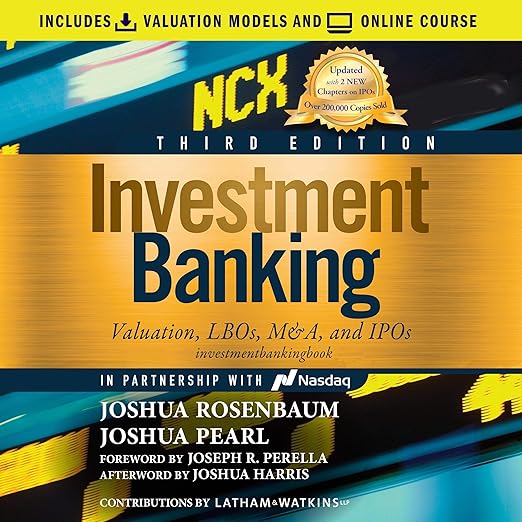
Quick Take
- Narration: Mike Chamberlain delivers the dense technical content with consistent clarity, a professional narrator handling professional content, which is exactly what this material requires.
- Themes: Valuation methodology, financial modeling, Wall Street career preparation
- Mood: Technical and methodical, pitched at serious learners
- Verdict: The definitive technical primer on investment banking valuation, valuable for anyone breaking into the field, though the audio format requires supplementing with the visual materials.
I’ll be straightforward about my relationship to this kind of book: I came up through literary criticism, not finance, and my grasp of discounted cash flow analysis is not intuitive. But I’ve reviewed enough professional and technical nonfiction to know the difference between a book that genuinely teaches and one that merely performs expertise, and Investment Banking by Rosenbaum and Pearl firmly belongs to the former category. I listened over several sessions, pausing frequently to let the explanations settle, and emerged with a substantially clearer understanding of how investment bankers actually value companies than I had before. That’s the test for a technical audiobook, and this one passes it.
The Rosenbaum and Pearl textbook has become something close to an industry standard since its first edition. Banking analysts and associates have trained on it; finance students use it to prepare for interviews; professionals refresh their understanding of methodology against it. The third edition, released in 2020, added the most comprehensive set of problem-solving ancillaries the authors had produced and updated the methodology chapters to reflect current Wall Street practice. The decision to produce an audiobook version is an interesting one, valuation is a deeply visual discipline, built around tables, models, and comparative matrices, but Rosenbaum and Pearl have written explanatory prose clear enough that the audio works better than you might expect.
Our Take on Investment Banking (3rd Edition)
The book is organized around four core valuation methodologies: comparable companies analysis, precedent transactions analysis, discounted cash flow analysis, and leveraged buyout analysis. This is the actual sequence in which investment bankers approach a valuation assignment, and the authors are explicit about why each method exists, what it measures, and where its limitations lie. That last piece, the honest accounting of what each methodology cannot tell you, is what separates this from a pure technical manual into something closer to genuine professional training.
The comparable companies analysis section is where many listeners will spend the most time. The authors walk through the logic of selecting appropriate comps, the process of spreading financial statements, and the interpretation of multiples in ways that are consistently grounded in the practical reasoning that bankers actually use. One reviewer described it as a compendium of process and nomenclature, which is accurate, this is a book that teaches you not just what the numbers mean but how professionals talk about them, which matters enormously for anyone entering the industry.
Why Listen to Investment Banking (3rd Edition)
Mike Chamberlain is a reliable choice for this kind of content. He reads with appropriate gravity and pacing for dense technical material, never rushing through passages that require the listener to follow a logical sequence, and his articulation of financial terminology is clear and precise. For fourteen-plus hours of valuation methodology, the narration needs to be steady and clear rather than dramatically engaging, and Chamberlain delivers that consistently.
The reviewer who noted that the third edition is not significantly different from the second edition in its fundamental content was being honest rather than critical. The core of investment banking valuation has not transformed between editions, the methodologies Rosenbaum and Pearl teach are stable because they reflect genuine financial logic rather than trend-driven innovation. The updates that matter are in the worked examples and the ancillary problem sets, which the audiobook format cannot fully replicate. Listeners serious about mastering the content should supplement the audio with access to the print edition’s financial models and worksheets.
What to Watch For in the LBO Chapter
The leveraged buyout analysis chapter is where the audiobook format faces its most significant limitations. LBO modeling is inherently visual, it involves building a capital structure, projecting financial performance, and solving for an internal rate of return across a range of scenarios. The authors explain the logic clearly, and listeners who already have some modeling background will follow the reasoning. Complete beginners to financial modeling may find this chapter less penetrable on audio than the earlier ones and will need the companion Excel models to make the concepts fully concrete.
That said, the conceptual explanation of what an LBO is and why it creates value under the right conditions is one of the book’s clearest passages. Rosenbaum and Pearl understand their audience well enough to know that most readers need to understand the economics before they can learn the mechanics, and the audio works well for that higher-level conceptual introduction.
Who Should Listen to Investment Banking (3rd Edition)
Finance students preparing for investment banking interviews, junior professionals looking to formalize self-taught knowledge, and career changers making the move into banking. One reviewer described picking it up at the start of college to prepare for recruiting and finding it directly applicable to interviews, which is the book’s core use case and a case it handles well.
Be realistic about the format’s limitations. This is a book built around financial models and visual exhibits. The audio works as a conceptual introduction and as a reinforcement tool for people already working through the print edition, but it is not a substitute for engaging with the actual models. Listeners who treat the audiobook as their primary learning tool for the technical content will miss the most practically useful dimension of what Rosenbaum and Pearl have built. But as one part of a comprehensive study approach, it is among the clearest and most efficiently organized technical audiobooks in the finance category.
Frequently Asked Questions
Can the audiobook replace the print edition for someone seriously studying investment banking valuation?
No, not as a standalone. The book’s most valuable technical content, the financial models, the worked examples, the comparable company and LBO templates, is visual in nature and cannot be fully conveyed in audio. The audiobook works well as a conceptual reinforcement and as a way to move through the methodology overview efficiently, but serious students should pair it with the print edition and the Excel models available through the authors’ companion resources.
Is this accessible for someone with no prior investment banking background?
It assumes some familiarity with financial statements and basic accounting concepts. Listeners who can read an income statement and understand what EBITDA represents will be able to follow the methodology. Complete beginners to corporate finance may need to build some foundation first, the authors recommend prior familiarity with financial modeling basics, and that recommendation is honest.
How has the third edition been updated compared to the second? Is it worth upgrading?
The core valuation methodologies are substantially similar. The third edition’s meaningful updates are in the problem-solving ancillaries and worked examples, which reflect current market conditions and practices. One experienced reviewer assessed the fundamental content as largely unchanged. For someone new to the book, the third edition is the obvious starting point; for someone who studied the second edition thoroughly, the upgrade is a judgment call about how much the ancillary updates matter for your purposes.
Does Mike Chamberlain’s narration maintain clarity through the most technical passages, such as the DCF and LBO sections?
Yes. Chamberlain’s pacing is appropriately unhurried through the dense passages, and his articulation of financial terminology is precise. The narration never becomes a barrier to following the logic, which is the essential criterion for technical content narration. Listeners with no prior exposure to DCF modeling will still need to pause and work through the logic, that’s the nature of the content, not a narration issue.