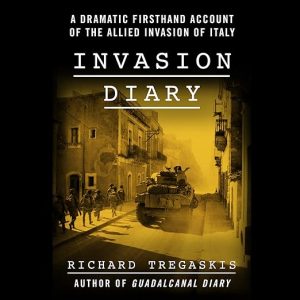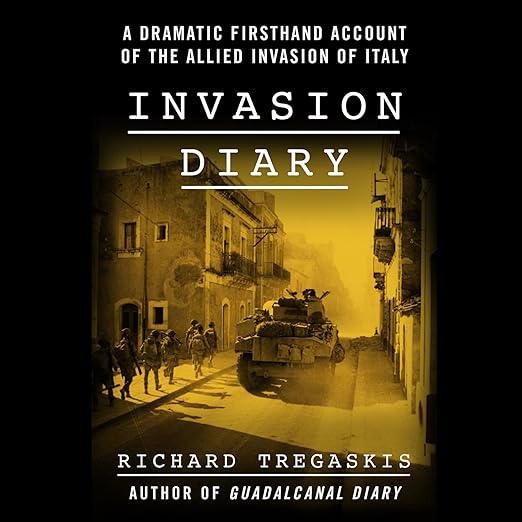
Bomb-bay doors over Rome frame one of the most vivid images in this audiobook, Richard Tregaskis flying alongside the bombardiers he would soon be writing about from the ground, before a shrapnel wound very nearly ended his war correspondence altogether. Invasion Diary covers the Allied invasions of Sicily and Italy in 1943, campaigns that secured the Mediterranean, capitalized on Mussolini's overthrow, and pinned down German troops that would otherwise have reinforced the Russian front or France after D-Day. Tregaskis moves through the material as both participant and chronicler, soldiers and officers, bombardiers and drivers, doctors and generals, each rendered with the specific, ground-level detail of someone who was actually there rather than reconstructing events from official records after the fact.
Grimes' Restraint Suits This War Correspondent's Voice
Pat Grimes narrates with a restrained, matter-of-fact delivery that suits field journalism exactly right, resisting any temptation to inject retrospective drama into events that were harrowing enough in their original telling. War correspondence from this era carries its own period voice, direct, observational, occasionally understated even when describing genuinely traumatic events, and Grimes preserves that voice rather than modernizing it into something more emotionally overt for contemporary ears. That choice pays off especially in the passages covering Tregaskis's own shrapnel wound, where a more theatrical narration could easily have tipped into melodrama that the original prose never asks for.
Reviewer Fireman721 offered a useful, if slightly critical, comparison, titling the review 'Not quite Ernie Pyle,' invoking the benchmark WWII correspondent whose column-based reporting remains a touchstone for the genre. That comparison is fair as a calibration point rather than a dismissal: Tregaskis's prose is more procedural and less lyrical than Pyle's famously humane, small-detail focused style, tracking troop movements between front lines and rear echelons with a reporter's structural discipline rather than Pyle's gift for the single unforgettable human image. Listeners who come in expecting Pyle-level intimacy should adjust expectations slightly, though Tregaskis's version of the genre has its own real, distinct value.
The Italian Campaign That History Undersells
Reviewer keetmom made a point worth foregrounding here: the Italian campaign remains seriously under-reported in popular WWII history compared to the Pacific and European theaters, despite being, by her account, among the most agonizing and brutal of the entire war, rivaled only by the Eastern Front's scale of suffering. That relative obscurity is exactly what makes this audiobook valuable as a historical corrective rather than a rehash of already-familiar territory. Listeners who have absorbed the standard popular narrative of the European war, D-Day forward through France and into Germany, will find in Tregaskis's account an entire brutal campaign that rarely gets the same narrative attention, despite its direct strategic connection to everything that followed after Normandy.
Tregaskis arrived at this project with real credibility already established: his earlier book, Guadalcanal Diary, published in 1943, became a huge commercial success and one of the earliest well-regarded accounts of the Pacific war, as reviewer Avery Abernethy notes directly. That same day-to-day diary approach, recording whatever he personally experienced as a correspondent rather than constructing a top-down strategic narrative, carries directly into Invasion Diary, and listeners who appreciated the earlier book's immediacy will recognize that same instinct for capturing ordinary soldiers' daily experience carried into a very different theater. The throughline between the two books also gives this one useful context: Tregaskis was not a novice finding his voice here, he was an established war correspondent working at the height of his craft.
The strategic stakes Tregaskis was covering in real time deserve more emphasis than a casual listener might initially give them. The Sicily and Italy campaigns were not a sideshow to the war's main events; German divisions tied down in Italy were divisions unavailable to reinforce the Eastern Front against Soviet advances or to strengthen French defenses ahead of the Normandy landings the following year. Tregaskis was reporting from inside a campaign whose outcome shaped decisions on fronts thousands of miles away, even though his own vantage point stayed resolutely local, a single correspondent's view of bombardiers and rear-echelon logistics. That tension between the campaign's outsized strategic importance and the book's necessarily narrow, personal lens is part of what makes the listening experience feel both intimate and consequential at once.
Tracking Front Lines and Rear Echelons by Ear
Tregaskis moves between the front lines and the rear echelons fairly often throughout the book, following the US Army and, to some degree, British allied forces, and reviewer Fireman721 specifically noted this back-and-forth structure as a real feature of the reading experience. In print, shifting datelines and location headers help orient a reader through those transitions; in audio, listeners need to track those shifts by ear alone, which asks for slightly more sustained attention than a more linear battlefield narrative would. This is not a structural flaw exactly, it reflects how a working correspondent's actual movement through a campaign really happened, but it is worth knowing before you start.
This is direct, ground-level war reporting from someone who was shot and nearly killed during the reporting itself, and the book does not sanitize the physical and psychological toll of that experience for easier listening. Listeners sensitive to detailed combat description, or to the specific texture of a correspondent's own near-death experience recounted in his own words, should know that going in. The reward for sitting with that difficulty is a genuinely rare kind of historical document: not a historian's later reconstruction, but a participant's real-time account, filed while the danger was still immediate rather than safely processed with decades of hindsight.
Ground-Level History in Under Eight Hours
WWII history readers looking to fill in an under-covered theater, and fans of correspondent-journalism war writing generally, Ernie Pyle readers included, despite Fireman721's comparison landing as a mild critique rather than outright dismissal, will find real value here. Anyone who already enjoyed Guadalcanal Diary and wants more of Tregaskis's ground-level reporting, this time trained on the Mediterranean instead of the Pacific, has an easy case for moving straight to this one. At seven hours and fifty-three minutes, it is a manageable, focused listen for anyone wanting ground-level WWII history without the multi-volume commitment that a comprehensive strategic account of the entire Italian campaign would require.
Skip this one if you are looking for a top-down strategic overview of the Sicily and Italy campaigns, troop movements, command decisions, the broader war-room picture, since Tregaskis's diary format stays close to ground-level personal experience throughout rather than zooming out to that altitude. Readers hoping for Ernie Pyle's specific gift for the single humanizing detail should also moderate expectations slightly, per Fireman721's comparison. For listeners who want direct, procedurally honest reporting from someone who lived through the events firsthand, though, Pat Grimes's understated narration makes this a genuinely worthwhile addition to any WWII listening list.
- Performance: Pat Grimes's restrained, matter-of-fact delivery matches the period's correspondent voice exactly.
- What it covers: WWII's Italian campaign, war correspondence, ground-level survival.
- Feel: Direct, unsentimental, and quietly harrowing.
- Our call: A valuable corrective for WWII listeners who know the Pacific and European theaters better than Italy.
Is this audiobook connected to Richard Tregaskis's Guadalcanal Diary?
They are separate books by the same war correspondent, and listeners who enjoyed Guadalcanal Diary's immediacy will recognize the same day-to-day approach applied to the Italian campaign here.
How does the narration on this audiobook compare to the tone of the original war reporting?
Pat Grimes preserves the period's direct, understated correspondent voice rather than modernizing it with added dramatic inflection.