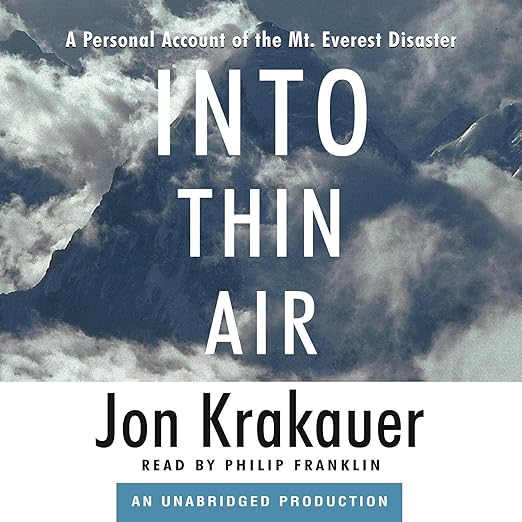
In Brief
- Read by: Philip Franklin delivers Krakauer's direct, technical prose with appropriate steadiness; he communicates the narrator's unresolved anguish without overplaying it.
- At its heart: Survival and loss, the ethics of guided adventure, human judgment at extreme altitude
- Vibe: Urgent, unflinching, and deeply uncomfortable in the best possible way
- Short version: One of the defining works of adventure journalism; the audiobook narration matches the material's commitment to clarity over comfort.
Jon Krakauer reached the summit of Mount Everest at 29,028 feet on May 10, 1996, after fifty-seven hours without sleep. Into Thin Air, narrated by Philip Franklin, begins at that moment of arrival and immediately establishes what makes this account different from standard adventure writing: Krakauer himself was present at the deadliest disaster in the mountain's history, and he knew it was a disaster before he was safe. This audiobook is nine hours of a journalist interrogating his own decisions while accounting for the deaths of people he climbed with.
Two Guides Dead, and Krakauer Among the Survivors
Krakauer was on Everest on assignment for Outside Magazine, covering the commercialization of guided Himalayan expeditions. He was a client of Rob Hall, described in the book as the most respected high-altitude guide in the world, a New Zealander who had summited Everest four times and brought thirty-nine clients to the top. Hall's client next door, in mountain terms, was Scott Fischer, an American with legendary strength who had climbed without supplemental oxygen. Neither Hall nor Fischer survived the storm that struck on May 10, 1996. Five climbers died. A sixth lost his right hand to frostbite.
Reviewer Thomas Erickson calls this 'a top notch survival story,' and the description is accurate but slightly incomplete. Into Thin Air is also a survival failure story, and Krakauer does not insulate himself from it. He was on the summit when the weather turned. He descended while others were still climbing. He was in his tent, freezing and hallucinating from hypoxia, when the storm that killed his guides and fellow clients reached its worst. The question he cannot fully answer, and does not pretend to, is whether anything he did or failed to do contributed to what happened.
That honesty is the book's most valuable quality. Reviewer Luciano describes it as 'more than a report, a legacy.' That captures it. Krakauer is writing toward an accounting of human decision-making at the extreme edge of physical capacity, and he does so with the discipline of a journalist and the anguish of someone who was there.
Philip Franklin Keeps the Technical Detail Steady
Philip Franklin's narration is well-suited to this kind of first-person account. Krakauer's prose is direct and economical, built for clarity rather than literary ornamentation, and Franklin delivers it without embellishment. The passages describing the summit day and the storm are among the most technically detailed in adventure writing, full of oxygen-flow rates, altimeter readings, and weather observations, and Franklin handles them with the steadiness required to keep listeners oriented in rapidly shifting conditions.
The audio format serves this book well because Into Thin Air is fundamentally a story told by voice. Krakauer's first-person narration is not reflective distance. It is someone talking through something they cannot entirely comprehend, even years later. Franklin communicates that quality without dramatizing it. The book doesn't need drama. The events supply more than enough.
At nine hours and eight minutes, Into Thin Air takes its time with the buildup to the summit attempt. The early chapters establishing the commercial expedition industry, Rob Hall's team, Fischer's team, and the mountain's logistical demands, are not preamble. They are necessary context for understanding why the tragedy unfolded the way it did. Krakauer spent months on this material, and the audiobook rewards that investment.
Summit Fever and Krakauer's Dual, Compromised Role
Reviewer Nigel notes that 'we can never forget the tolls of lack of altitude on your muscles, brain, and decision-making.' This is one of the book's central arguments: that the cognitive impairment caused by extreme altitude affects every choice made above 26,000 feet, including choices about safety margins and turnaround times. Krakauer is not excusing anyone. He is insisting that listeners understand the conditions under which decisions are made at extreme altitude, which is the only way to evaluate those decisions fairly.
The commercial climbing debate that frames the book, Krakauer was there to write about the guided expedition industry, has not aged out. The questions raised by Into Thin Air about who belongs on Everest and what guides owe their clients remain live controversies. The 1996 season was not the last to produce disaster, and the issues Krakauer identified persist. Listening to this account is partly an education in why that is.
The book has its critics, particularly among those who dispute Krakauer's account of other climbers' decisions. Krakauer himself acknowledges in his author's note that his memory and observations were impaired by hypoxia. He does not claim certainty. He claims to be reporting as accurately as he can from a position of severe cognitive limitation. That epistemic honesty is part of what makes the book trustworthy even where its specific details have been disputed.
The book also functions as a reckoning with the culture of summit fever, the compulsion to reach a high point regardless of the cost, that Krakauer observed in himself and in nearly every climber on the mountain that day. His own summit attempt, in an article he was assigned to write and a mountain he wanted to climb regardless of the assignment, put him in the middle of a situation he was both participating in and documenting. That dual role, journalist and client, observer and actor, is one of the ethical complications Into Thin Air examines without resolving. Franklin's narration gives this ambivalence appropriate weight, neither excusing Krakauer nor turning him into a villain of his own story.
Essential for Anyone Drawn to Survival Under Pressure
Listeners with any interest in survival narrative, mountain climbing, or the human capacity for judgment under extreme physical stress will find Into Thin Air indispensable. Philip Franklin's narration makes the technical material accessible without simplifying it. Adventure readers who have not yet encountered this book have a significant gap to fill. Those who know it from print and are revisiting in audio will find that Franklin's voice gives the account a new texture, particularly in the storm sequences, which in audio carry an immediacy the page alone cannot fully replicate.
Is Into Thin Air accurate as an audiobook account of the 1996 Everest disaster?
Krakauer is a trained journalist who was present at the events. His account has been disputed on specific points by other survivors, which he acknowledges in author's notes. He is transparent about the cognitive impairment caused by altitude and its effects on his observations.
How does Into Thin Air compare to other Everest audiobooks?
It remains the most widely read account of the 1996 disaster. Other books cover the same events from different perspectives, including accounts by guides and other climbers, but Krakauer's version is the one that established the public understanding of what happened.
Does this audiobook cover the full 1996 Everest season or only the May 10 disaster?
It covers Krakauer's full expedition, from preparation and base camp through summit day and its aftermath. The May 10 storm is the climax, but the book builds carefully toward it across all nine hours.