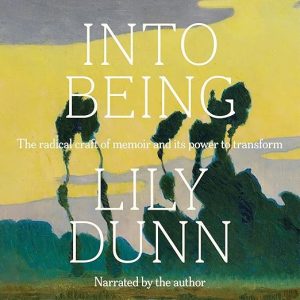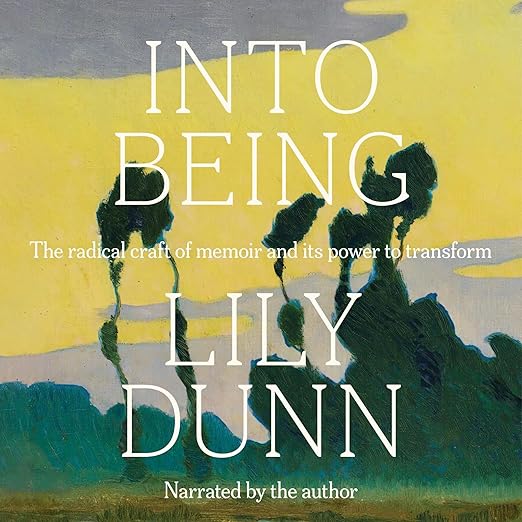
Lily Dunn's memoir Sins of My Father examined her father's involvement in a cult with the raw honesty that memoir at its best demands. Into Being, her guide to writing memoir, approaches that same commitment to truth-telling from the teaching side rather than the confessional one. As an audiobook narrated by Dunn herself, it occupies an unusual position: a book about finding your authentic voice, read aloud by the author in her own authentic voice. At 6 hours and 21 minutes, that structural self-evidence is not incidental. It is part of what makes this audiobook work.
Dunn's central argument is that memoir writing is not merely a way of recounting what happened but a form of transformation in itself. The act of finding language for experience, she argues, changes the experience - it does not simply record it. This is a less obvious claim than it might first appear. Many writing guides treat memoir as documentation with embellishment; Dunn treats it as a process of discovery that the writer does not fully control, which is both a more honest and a more useful framework for anyone who has sat down to write their own life and found the draft going somewhere they didn't expect. A reviewer describes this book as revelatory, noting that it creates the feeling of having glimpsed the alchemy and skill that turns raw experience into literature - and that response suggests Dunn is landing on something that print writing guides often miss.
The Ethics of Writing People Who Didn't Consent
What distinguishes this audiobook from the crowded field of writing guides is Dunn's willingness to treat the hard questions of memoir as genuinely hard rather than as obstacles to be managed with technique. The ethics of writing about real people - family members, former partners, friends who did not consent to being characters in someone else's life story - receive serious, sustained attention rather than a brief chapter followed by permission-slip recommendations. Dunn's treatment of how writers can write honestly without intruding too far into the lives of loved ones is one of the most thoughtful available in accessible form, drawing on her own practice and on the wider tradition of writers who have navigated those boundaries.
She also covers the hybrid and experimental forms that memoir has been extending into - the intersection with essay, with poetry, with documentary and found text. This material will be most useful to writers who already have a working relationship with conventional memoir and want to understand where the form is going, but it is handled accessibly enough that beginners won't be lost. The book assumes intelligence without assuming prior craft knowledge, which is the right calibration for a guide that wants to be both introductory and substantial.
Dunn's Warm, Exacting Voice Teaches by Example
Dunn's self-narration is the primary reason to choose the audiobook over print. She reads with the authority of someone who has taught these ideas in rooms full of writers for years, and that means the abstract concepts - transformation through writing, the relationship between memory and meaning, the ethics of representation - arrive with examples and inflections that feel pre-tested on actual students. When she describes why certain memories take on greater significance than others, the passage has the feeling of a live lecture where the teacher knows exactly where to pause, where to repeat, where to slow down.
There is also something fitting about receiving instruction on voice - finding your own as a writer - through the medium of someone else's voice read aloud. Dunn's voice is warm but precise, the voice of a teacher who holds high standards without weaponizing them against her students. Listeners who have found writing guides dry or mechanical will discover that this one, in audio, has a quality of conversation that the print version approximates but cannot fully replicate. One reviewer describes it as clear, insightful and encouraging - which is an accurate summary of the register Dunn sustains across the full runtime.
Questions Dunn Asks You to Sit With
This is an audiobook that rewards active listening rather than passive absorption. Dunn frequently poses questions directly to the listener - about their own experience, their own relationship to memory, their own ethical concerns about the people they might write about. Those questions work differently in audio than in print, where a reader can stop and write in the margin. Listeners who want to get the full benefit of Into Being should plan to pause and respond to those prompts in some form, whether through a notebook alongside the listening or by returning to sections that prompted significant reflection.
The book is also specifically about memoir rather than fiction or other forms of creative nonfiction. Writers primarily interested in personal essay, journalism, or other adjacent forms will find significant overlap but will also encounter sections that don't map directly onto their work. Dunn is a memoirist teaching from her own practice, and the depth of the memoir-specific material is part of what makes this guide valuable rather than generic.
Memoirists and Teachers Get the Most Here
Writers working on memoir projects, whether in early stages or mid-draft, will find Dunn's guidance practically and philosophically useful. Writing teachers and workshop leaders will discover material that enriches their own teaching of life writing. Readers interested in the relationship between personal experience and literary form - not necessarily writing themselves - will find Dunn's thinking about why memoir matters and what it can do at its best a genuinely stimulating listen.
Writers looking primarily for plot structure templates, word count targets, or query-letter advice will not find that material here - this is a guide to the transformative and ethical dimensions of memoir writing rather than a commercial publishing manual. Listeners who want a quick reference guide they can dip in and out of will benefit more from the print version, where they can navigate directly to relevant sections. The audiobook rewards linear listening from beginning to end.
Key Details
- Voice: Lily Dunn reads her own work with the precision of a teacher who has delivered these ideas aloud many times, giving each chapter a classroom-ready clarity that suits the instructional material.
- Big ideas: Memoir as transformation, the ethics of writing other people's lives, hybrid and experimental life writing
- Atmosphere: Intellectually intimate and encouraging, like a private tutorial with a generous mentor
- Worth it?: Dunn's self-narrated guide to memoir writing is one of the more substantive writing instructionals available in audio, combining personal vulnerability with craft precision in a way that earns its genre.
How does Lily Dunn's self-narration affect the listening experience of this writing guide audiobook?
Significantly and positively. Dunn reads with the authority of a teacher who has tested these ideas in live workshops, and her voice carries the warmth and precision you'd want from a mentor. There is something particularly appropriate about receiving instruction on finding your authentic written voice through the medium of the author's own voice read aloud.
Does this audiobook cover the ethics of writing about family members and other real people?
Yes, and more substantively than most writing guides. Dunn treats this as a genuinely difficult question rather than offering a quick checklist of permissions and disclaimers. She draws on her own experience as the author of Sins of My Father - a memoir about her father's cult involvement - to address the specific tensions of writing honestly about people who did not choose to be characters in your story.
Can I use the Into Being audiobook as an active writing workshop tool, pausing to respond to prompts?
Yes, and that is arguably the best way to use it. Dunn poses direct questions to listeners throughout, inviting reflection on their own experience and writing practice. The audiobook rewards pausing to write responses rather than treating it as passive background listening. Listeners who engage actively with the prompts will get considerably more from the 6-plus hours than those who listen straight through without stopping.