Quick Take
- Narration: Mirron Willis brings controlled gravity to Kayihura’s testimony, keeping the emotional weight of the survivor account present without allowing it to tip into melodrama.
- Themes: Genocide testimony and historical truth, the politics of celebrity heroism, Hollywood’s relationship to real atrocity
- Mood: Controlled outrage, the tone of someone who has waited years to say something important and is determined to say it precisely
- Verdict: A genuinely essential counter-account that dismantles one of the most celebrated historical fabrications in recent Hollywood history, delivered with documentary rigor by someone who was there.
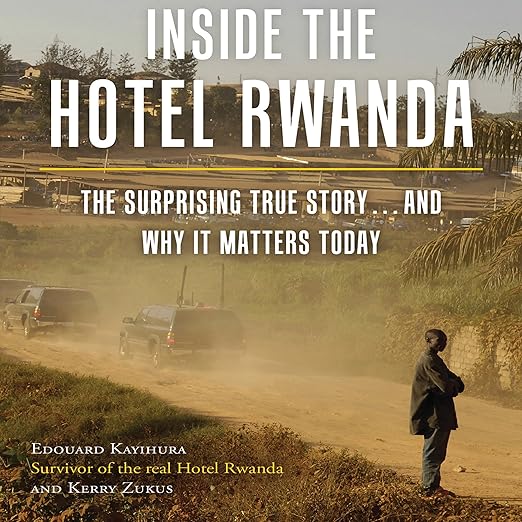
I watched Hotel Rwanda when it came out and filed it in the part of my mind reserved for films that made me feel educated. It was only years later, following a thread through academic critiques of humanitarian cinema, that I began to understand what the film had done to the actual survivors of the Hotel des Mille Collines. Inside the Hotel Rwanda arrived during a period when I was already skeptical of the genre, but nothing quite prepared me for the systematic precision with which Edouard Kayihura dismantles the Paul Rusesabagina legend.
Kayihura was inside the hotel during Rwanda’s 1994 genocide against the Tutsi. He is not writing from a distance or from archives. He is writing as someone who was there, who saw what Rusesabagina did to the people sheltering under the hotel’s fragile protection, and who has spent years watching the man tour the world as a humanitarian hero while the survivors knew a different story. The book is part memoir, part investigative deconstruction, and part political analysis, and it holds all three modes together with an unusual discipline.
What Paul Rusesabagina Actually Did
The factual core of Inside the Hotel Rwanda is an account of how the real hotel manager behaved during those weeks in 1994. Kayihura documents, with supporting testimony from other survivors including Hutu and Tutsi residents and UN peacekeepers, that Rusesabagina threatened to turn away or hand over to the génocidaires those refugees who could not pay him. He extorted money from people who had arrived at the hotel with nothing. He defied the corporate ownership of the hotel, which was repeatedly urging him to stop. The contrast between this conduct and the Schindler comparison the film invited is not a matter of interpretation but of documented fact.
This is not Kayihura’s account alone. He incorporates testimonies from multiple people who were inside the hotel, creating an evidentiary structure that makes the book more than one person’s word against another’s. The political analysis section, which examines Rusesabagina’s subsequent career as a genocide negationist and the Rwandan prosecutor general’s accusations that he funded the terrorist group FDLR, extends the argument beyond the hotel itself into a broader claim about what the Hollywood hero narrative enabled politically.
The Ethics of Historical Myth-Making
One of the book’s most important contributions is its analysis of how the Hotel Rwanda film was received internationally and what that reception meant for Rwandan survivors. One reviewer’s response, anger that American audiences were given a false hero rather than the truth, captures something the book documents in detail: the Rusesabagina myth was not a harmless feel-good story. It actively undermined the testimony of survivors who tried to tell a different account, and it provided Rusesabagina himself with a platform and credibility that he has used for purposes his supposed admirers would find deeply troubling.
Kayihura is writing from inside a divided society, as he describes it, and he does not pretend that the genocide can be understood without engaging with the political history of ethnic division in Rwanda. This context-setting, which some readers might find slow in the early chapters, is essential to understanding why Rusesabagina’s subsequent political positioning is not incidental to his conduct in 1994 but continuous with it.
Mirron Willis and the Demands of Survivor Testimony
Survivor testimony in audio form requires a narrator who can maintain the emotional truth of the account without either flattening it into reportage or over-dramatizing it into something the listener can aestheticize at a safe distance. Willis navigates this well. He gives Kayihura’s direct testimony sections a quiet intimacy, while the investigative and analytical passages are delivered with a steadier, more declarative energy. The performance does not call attention to itself, which is exactly right for material where the content should be the focus.
Who Should Listen and Who Should Skip
Inside the Hotel Rwanda is essential for anyone who saw the film and took it at face value, which describes most people who saw it. The book does not require prior knowledge of Rwandan history to follow, though some background on the genocide’s causes and context enriches the political analysis sections. Listeners who find accounts of genocide psychologically difficult should approach with care; Kayihura’s personal chapters are specific about the conditions inside the hotel. For listeners willing to engage with the material on its own terms, this is one of the most important acts of historical correction to come out of the genocide’s aftermath, and Kayihura’s composure in the telling makes it more powerful, not less.
Frequently Asked Questions
Does Inside the Hotel Rwanda explain what happened to Paul Rusesabagina after the film made him famous?
Yes. Kayihura documents Rusesabagina’s subsequent career as a genocide negationist and his alleged funding of the FDLR terrorist group, showing how the Hollywood hero narrative provided him a platform he used for purposes deeply at odds with his celebrated image.
Is this primarily a memoir of Kayihura’s personal experience, or does it incorporate other survivor testimonies?
Both. Kayihura’s personal account provides the emotional and experiential core, but the book incorporates testimonies from other survivors across ethnic lines, including Hutu and Tutsi refugees and UN peacekeepers, establishing a broader evidentiary record.
Do I need to have seen the film Hotel Rwanda to understand the book?
Not strictly, but familiarity with the film significantly sharpens the impact of the argument. Kayihura writes with full awareness that most readers will have encountered the Rusesabagina legend through the film, and the book is structured partly as a direct response to that specific narrative.
How does Mirron Willis’s narration handle the emotional weight of survivor testimony?
Willis maintains controlled gravity throughout, keeping the emotional weight present without melodrama. He distinguishes effectively between the personal testimony sections and the more analytical passages, which helps the listener track the book’s multiple modes.