Quick Take
- Narration: Frazer Blaxland delivers a clear, journalistic read that suits the anthropological tone, he doesn’t editorialize, which lets McManus’s sometimes pointed analysis speak for itself.
- Themes: Extreme inequality and its human cost, rapid modernization and its discontents, the invisible labor that funds visible wealth
- Mood: Probing and occasionally unsettling, with genuine warmth for the individuals McManus encounters
- Verdict: A rigorous, readable portrait of a country that most of its visitors never actually see, honest about its limits and important for its subject matter.
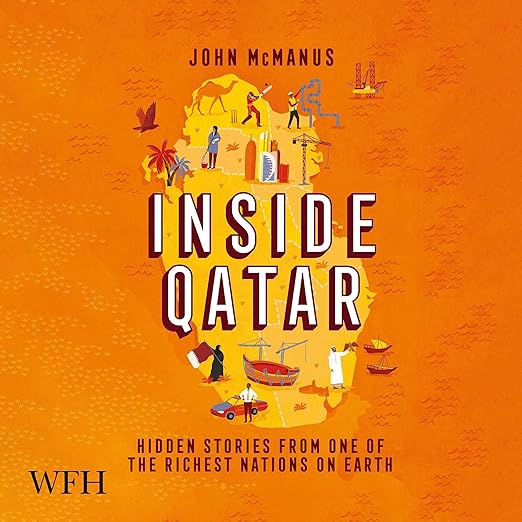
I picked up Inside Qatar in 2022, before the World Cup, when I wanted something that would give me a more honest picture of the country that was about to host the world’s most-watched sporting event. John McManus’s book had just been released, its timing was deliberate, and Frazer Blaxland’s narration made the eight-hour listen feel more like a long, well-reported dispatch than a policy document. I came back to it recently in the light of how the Cup coverage played out, and found it holds up.
McManus is an anthropologist who spent considerable time in Qatar, and the book reflects that methodological orientation. He is interested in how real people live in a place where the conventional categories of citizen, worker, and resident don’t map cleanly onto the population. In a country where nationals are a small fraction of the people living there, the word ‘Qatari’ carries a specific weight that most coverage flattens.
Our Take on Inside Qatar
The book’s great strength is its willingness to sit with contradictions rather than resolve them. Qatar is crushingly unequal and also, in ways McManus documents carefully, genuinely diverse and pulsing with a particular kind of provisional energy. The gilded princes and the Ferraris exist alongside migrant workers earning risible amounts, and McManus shows you both not to create false balance but because both are genuinely true of the same place.
His chapters on domestic workers and manual laborers are the most urgent material in the book. The conditions McManus describes have been reported elsewhere, but the anthropological approach gives individual faces to structural problems in a way that political reporting often doesn’t. He names people. He follows their movements. He records their own assessments of their situations, which are more complicated than straightforward victimhood narratives allow.
Why Listen to Inside Qatar
Frazer Blaxland has a journalistic steadiness that serves this material well. He reads McManus’s more critical passages without emphasis that would tip into advocacy, which is the right call, the material speaks clearly enough without inflection doing the editorializing. His handling of names and places in Arabic shows appropriate care without self-consciousness about the phonetics.
The audiobook format suits this as travel writing and cultural analysis. You’re being taken somewhere, and a narrator who moves through the material with authority and pace makes the journey feel purposeful. At just over eight hours, the length matches the scope of the subject without padding.
What to Watch For in Inside Qatar
A dissatisfied reader noted that they wanted more access to actual Qatari citizens and found McManus’s coverage tilted toward migrant workers and expats. That’s a fair observation. The Qatari national population is small, roughly 300,000 people, and McManus acknowledges the difficulty of access. But readers who come expecting an intimate portrait of Qatari family and cultural life specifically will find the book less satisfying than those interested in the full ecosystem of people living within Qatar’s borders.
Another reviewer criticized McManus for letting his socio-political views shape the presentation. I think that critique conflates having a perspective with lacking objectivity. McManus is clearly bothered by the treatment of migrant workers, and he says so. But he also records his own limitations, acknowledges when his access was constrained, and gives space to people who have positive things to say about the country. That’s honest journalism, not advocacy.
Who Should Listen to Inside Qatar
Essential listening for anyone who watched the 2022 World Cup and wanted to understand what was happening outside the stadiums. Also strongly recommended for readers interested in Gulf state politics, globalization’s human costs, or the specific sociology of countries built on petrodollars and migrant labor. Listeners who want pure travel writing, beautiful places, cultural tourism, food and landscape, will find this more challenging and politically engaged than they may want. And readers who prefer strict separation of fact and opinion in nonfiction will find McManus’s perspective more present than they’d like, though it’s a presence worth engaging with rather than avoiding.
Frequently Asked Questions
Does Inside Qatar cover the labor abuses associated with World Cup stadium construction in detail?
Yes, the working conditions of migrant laborers, including those involved in construction, are a central thread. McManus approaches this as an anthropologist who has spoken to workers directly, which gives the coverage more texture than pure investigative reporting. He documents conditions, wages, and the legal framework that structures migrant workers’ vulnerability.
How does the book handle the tension between Qatar’s modernization and its human rights record?
McManus holds both simultaneously rather than resolving the tension. He documents the genuine innovation and ambition visible in Qatar while being clear-eyed about what sustains it. He’s not writing apologia, but he’s also not writing a polemic, the book’s value is in showing how contradictory realities coexist in the same place.
Is the book still relevant given it was written ahead of the 2022 World Cup and some content may be dated?
The structural conditions McManus documents, the kafala system, the inequality between nationals and migrant workers, the pace of construction, are ongoing features of Qatari society rather than event-specific observations. One reviewer noted hoping for a 2025 updated edition, which suggests the core material remains relevant even if some specific details have shifted.
Does Frazer Blaxland’s narration suit the anthropological and journalistic style of the book?
Well-matched. Blaxland is a steady, clear reader who doesn’t impose emotional emphasis on the material, which lets McManus’s reportage land on its own terms. For readers who want a narrator to guide them through a serious subject without theatrical interpretation, this is a comfortable pairing.