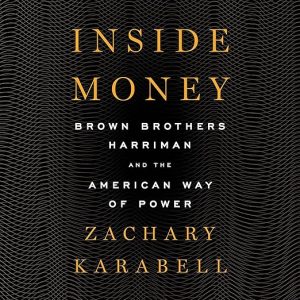
At a Glance
- Narrator: Zachary Karabell reads his own book, and the effect is unusually good, he speaks with the ease of someone explaining a story he loves rather than performing a text, though the pace occasionally favors the academic over the dramatic.
- Subjects: American financial power and its limits, the virtue of restraint in a culture of excess, the entanglement of private capital and foreign policy
- Tone: Dense and authoritative, with unexpected narrative momentum
- Bottom line: One of the more substantive financial histories available in audio, worth the 17-hour commitment for anyone who wants to understand how American capital actually built the modern world.
I started listening to Inside Money on a Sunday afternoon, expecting something competent but dry, another institutional history that would tax my attention before the first hour was done. By Monday morning I had burned through six hours and rearranged my week to make time for more. Zachary Karabell has done something genuinely difficult here: he has made a 200-year institutional history feel like a thriller without sacrificing the intellectual weight that makes it worth reading.
Brown Brothers Harriman is not a household name. That anonymity is, as Karabell shows throughout, a deliberate feature of the firm's identity and a large part of why it has survived every financial catastrophe from the panics of the 19th century through the 2008 financial crisis. While competitors scaled up, leveraged recklessly, and periodically imploded, Brown Brothers grew quietly, anchored by a culture that Karabell traces back to Alexander Brown's arrival in Baltimore from Belfast at the turn of the 19th century. The firm's history becomes, in Karabell's hands, a lens for the entire arc of American financial and political power.
Brown Brothers and the Nicaragua Chapter's Moral Weight
The structural insight that makes this book work is the decision to follow a single institution rather than offer a panoramic survey of American finance. As one reviewer notes, it "describes the evolution of the American finance industry" by staying tightly focused. That constraint generates genuine narrative coherence: the same family name recurs across cotton trading, steamship investment, railroad financing, and ultimately Cold War foreign policy, and the through-line reveals patterns that a broader history would dissolve into background noise.
The Nicaragua chapter is particularly striking. By the early 20th century, Brown Brothers had moved so deeply into the country's financial infrastructure that the firm was, in practical terms, administering its economy in collaboration with the State Department. Karabell handles this history with appropriate moral complexity, the firm's partners genuinely believed they were exporting civilization, and the book traces exactly how that belief was constructed by class, religion, and the specific institutional culture of Groton and Yale, without either excusing the imperial project or turning the book into a prosecution.
Karabell's Self-Narration Avoids the Usual Traps
Karabell was granted complete access to Brown Brothers Harriman's archives, which means this is not a history assembled from secondary sources and speculation. The portrait of the firm's internal culture, its decision-making processes, and its deliberate choices to forgo speculative upsides is built on primary materials, and that foundation gives the narrative a confidence that biographical sketches of more famous institutions can rarely match.
The performance dimension is unusual and mostly successful. Authors reading their own material can go badly wrong, there's a tendency toward monotony or, worse, self-conscious performance, but Karabell navigates this well. He reads as if in conversation rather than recitation, and the 17 hours carry far less fatigue than the runtime would suggest. A reviewer described the book as reading more like a mystery novel than a history, and while I wouldn't go quite that far, the structural engine of the book is real: you keep listening because each chapter deepens the question of how this institution managed to be simultaneously central to American power and invisible to most Americans.
Two Books in One, and a Thesis on Restraint
The deeper you go into the 20th century, the more the book's center of gravity shifts from financial history toward political history, and some listeners may find the transition feels like two different books pressed together. The early chapters, the Brown family's rise, the firm's role in cotton and steamship financing, the succession of 19th-century financial panics it survived, are the most narratively vivid. The World War II and Cold War sections are important but cover more familiar ground, and the analysis occasionally becomes denser than the narrative can carry.
The book's conclusion, which argues that Brown Brothers Harriman's restraint in the post-2000 speculative years positions it as a model for sustainable capitalism, tips toward advocacy. It's a defensible argument, but listeners should recognize that the final framing is Karabell's thesis rather than a neutral summary of the evidence.
Closer to Chernow Than to Michael Lewis
Inside Money is excellent for listeners with an interest in American financial or political history who are willing to commit to the full runtime. It rewards the investment with a genuinely distinctive perspective on how private capital and state power have been intertwined since the earliest years of the republic. Fans of Ron Chernow's institutional biographies will find a natural companion here. Listeners expecting a popular finance book in the vein of Michael Lewis should calibrate their expectations: this is more rigorous and less sensationalist than that tradition, which is both its strength and its limitation.
Good to Know
Does Inside Money require prior knowledge of American financial history to follow?
No. Karabell builds context as he goes, and the book functions as an accessible introduction to American financial history as much as a history of Brown Brothers Harriman specifically. Some familiarity with figures like Alexander Hamilton or J.P. Morgan enriches the reading but is not necessary.
How does Zachary Karabell's self-narration compare to a professional narrator?
Reviewers and listeners generally find his self-narration effective, he brings the ease of deep familiarity with the material rather than the polish of professional performance. The pacing is occasionally academic, but the conversational quality compensates. For a 17-hour commitment, it holds up well.