Winnipeg is an unlikely launchpad for a comedy career that would eventually land someone on The Tonight Show 140 times, second only to Bob Hope, but that's where David Steinberg started: a rabbi's son enrolled at Hebrew Theological College in Chicago at fifteen before the rabbinate lost out to Lenny Bruce and Second City. Inside Comedy is his account of everything that happened after, and this audiobook benefits enormously from Steinberg narrating his own material, since so much of its pleasure comes from hearing him perform the voices and rhythms he's describing rather than just reading about them secondhand.
Sixty Years as Both Performer and Director
The book braids three different threads together: Steinberg's own sixty-plus years in comedy, his career directing sitcoms as recognizable as Mad About You, Seinfeld, Friends, Weeds, and Curb Your Enthusiasm, and more than seventy-five original interviews with the comedians themselves. That combination gives Inside Comedy a vantage point most comedy memoirs don't have access to: someone who has been both performer and director, watching the craft from two angles at once.
Steinberg's own stand-up run, twenty-six years by his own count, plus his role as the only comedian to have made Elie Wiesel laugh, gives him a specific kind of credibility that shows up in how he talks about other comedians' work: with real technical appreciation, not just admiration from a fan's distance.
Second City Built the Institutional Foundation Here
Second City's real significance is worth spelling out for listeners who only know the name in passing: the Chicago improvisational theater has functioned for decades as an actual pipeline into Saturday Night Live and SCTV, producing an outsized share of American comedy's most influential performers and writers. Steinberg's membership in that specific lineage isn't incidental color; it's the institutional foundation his entire career built outward from.
Those original interviews give the book a genuine reporting backbone beyond Steinberg's own recollections. Rather than relying purely on memory, which comedy memoirs often do, Steinberg went back to the source material itself, comedians discussing their own careers and craft in their own words, which adds a layer of verification and range a purely first-person account couldn't match.
One reviewer traces the book's title directly back to Inside Comedy, the Showtime interview series Steinberg hosted for several seasons before this book existed, which explains the format's documentary instinct: extended, thoughtful conversation rather than punchy anecdote. Listeners who remember the show will recognize its DNA throughout, even though the book expands well past what any television runtime could hold.
Larry David's Blurb Captures Real Insider Respect
The sweep of names alone justifies the runtime. George Burns, Lenny Bruce, Sid Caesar, Lucille Ball, Mel Brooks, and Carl Reiner give way to Carol Burnett, Steve Martin, Lily Tomlin, Billy Crystal, and Bob Newhart, who give way in turn to Chris Rock, Dave Chappelle, Julia Louis-Dreyfus, and Wanda Sykes, with Will Ferrell, Eric Idle, Whoopi Goldberg, Mike Myers, and Jonathan Winters woven throughout. Five decades of American comedy pass through one book.
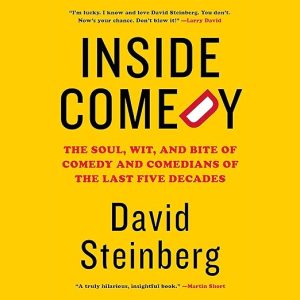
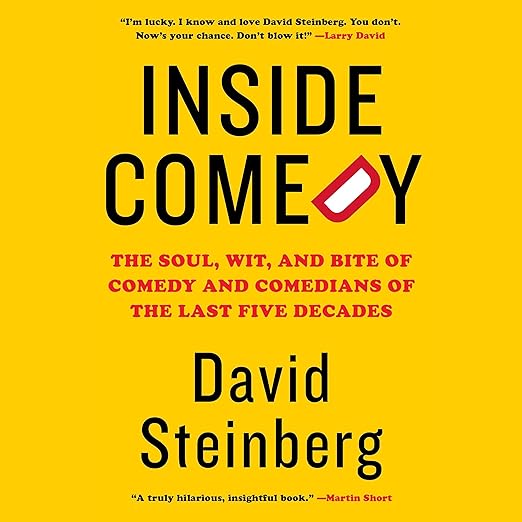
Larry David's blurb captures the insider respect Steinberg commands better than any synopsis could: 'I'm lucky. I know and love David Steinberg. You don't. Now's your chance. Don't blow it!' Martin Short adds a similar note about Steinberg's specific gift for making other funny people even funnier, a skill that comes through clearly once you hear how generously he frames every comedian he discusses.
The New York Times calling Steinberg 'a comic institution himself' is a specific, earned claim rather than generic praise, and the detail about being the only comedian to make Elie Wiesel laugh sharpens it further. Wiesel, a Holocaust survivor and Nobel laureate known for carrying enormous moral weight in public life, laughing at Steinberg's material says something real about the specific quality of his humor: precise enough to land even against a backdrop of genuine gravity.
Steinberg's own twenty-six years in stand-up, a specific number the synopsis takes care to name, matters for how much peer credibility the book carries. This isn't someone who watched comedy from a director's chair and later decided to write about it; he spent over two and a half decades actually doing the job himself first, which shows in how precisely he identifies what separates competent material from a genuinely great bit.
Thirteen Hours in a Dry, Cerebral Register
One reviewer describes this honestly as a 'wonderful sweep through baby boomer comedy,' and that's worth sitting with before you start. The comedians who get the deepest treatment skew toward Steinberg's own generational cohort, Lenny Bruce as formative idol, the Second City alumni, the SNL-adjacent circle, even though newer names appear throughout. Listeners wanting a book centered on 2020s comedy specifically will find plenty here, but not as the main course.
Thirteen hours of one man's voice, however engaging, asks listeners to enjoy his specific comic sensibility: dry, cerebral, improv-rooted rather than broad or physical. That's Steinberg's actual comedic register throughout his career, and it carries the narration well, but it's worth knowing going in if your taste runs toward louder, more manic comedy memoirs.
Few figures in American comedy have moved as fluidly between performing and directing as Steinberg has, and that dual career gives Inside Comedy a structural advantage over memoirs written purely from the performer's side. That directing career means Steinberg spent decades studying exactly what makes other people's specific comic instincts work on camera, and that analytical habit is audible throughout the book.
Editing Instinct Makes This Feel Like a Page-Turner
Thirteen hours across five decades of material means the pacing occasionally jumps between eras rather than moving in strict chronological order, following thematic threads, a particular mentor relationship, a specific comedy movement, more than a single timeline. Listeners who prefer strictly linear memoirs should adjust their expectations toward something closer to a well organized oral history.
Reviewer Dr. Gary Frieden calls it a genuine page-turner, an unusual descriptor for what is essentially an oral history built from interviews, and that pacing claim holds up specifically because Steinberg edits the interview material with a director's instinct for when a scene, or in this case a story, has run its course.
The 4.2 average, the more modest of the ratings attached to this edition though still solidly positive, tracks with the one four-star review among the three attached here, which specifically praises the content while implicitly suggesting the book asks a fairly specific kind of listener, someone who already loves comedy history, to get the full five-star experience.
Skip This for a Linear Autobiography Instead
Comedy history enthusiasts, aspiring comedians and writers, and anyone curious about the Second City lineage or the making of some of television's most enduring sitcoms will find this rewarding, particularly listeners who already have some baseline familiarity with the names involved.
Skip this one if you want a linear, chronological autobiography rather than a mosaic portrait built from stories and interviews, or if you have little interest in the comedy legends of the twentieth century specifically, since that's where the book's deepest attention lives.
In Brief
- Performance: David Steinberg narrates his own stories with a comedian's timing that a hired narrator likely couldn't replicate.
- What it covers: Comedy history, mentorship across generations, the craft of directing comedians
- Feel: Warm, name-dropping, unmistakably insider
- Our call: A rich, well-earned trip through five decades of comedy for listeners who already love the genre's history.
Questions Listeners Ask
Does David Steinberg narrate his own audiobook?
Yes, and it matters. So much of the book's pleasure comes from hearing Steinberg perform the voices and rhythms of the comedians he's describing, which a hired narrator likely couldn't replicate the same way.
Is this audiobook mostly focused on older, classic comedians?
It leans that way. One reviewer accurately calls it a sweep through baby boomer comedy, since the deepest treatment goes to Steinberg's own generational cohort, though newer names like Chris Rock, Dave Chappelle, and Wanda Sykes appear throughout as well.
Is Inside Comedy more about Steinberg's own career or about the comedians he interviews?
Both, braided together. The book combines Steinberg's own stand-up and directing career with more than seventy-five original interviews, giving it a rare dual vantage point as both performer and director.
Do I need to know Steinberg's Tonight Show and Second City history going in?
Not strictly, but some baseline familiarity with the names and eras discussed will deepen the experience considerably, since the book assumes real interest in comedy history rather than explaining every reference from scratch.