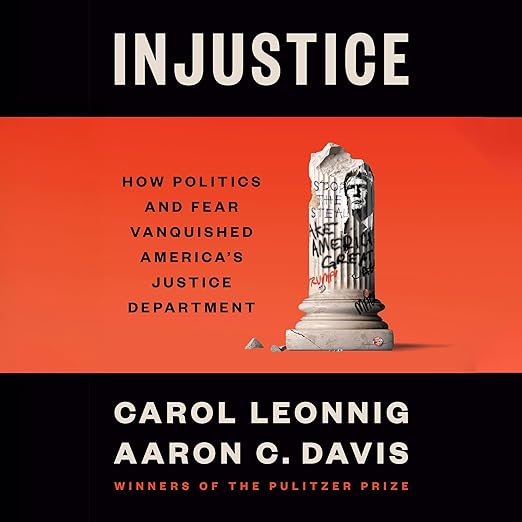
Quick Take
- Narration: January LaVoy brings journalistic authority to Leonnig and Davis’s investigative prose, maintaining the urgency of a live investigation without theatrical overstatement.
- Themes: The politicization of the Justice Department, institutional decay under political pressure, the gap between prosecution and accountability
- Mood: Urgent and deeply reported, with the pace of a breaking story and the weight of institutional history
- Verdict: Among the most important pieces of political journalism published this year, combining extraordinary inside-the-department reporting with a structural argument about American democracy that extends well beyond any single administration.
I finished the final chapters of this one on a Tuesday morning, sitting at my kitchen table with coffee going cold because I kept not wanting to put it down. That is not something I say lightly about political journalism, a genre I read constantly and find frequently both necessary and exhausting. Carol Leonnig and Aaron C. Davis have written a book that earns its sense of urgency because the reporting underneath it is genuinely extraordinary.
The Rachel Maddow pull quote in the publisher description is worth taking seriously: this is not a series of anecdotes. It is a thesis. The argument is that Donald Trump, over his first term and in the run-up to his second, broke the Justice Department in a specific and historically significant way by treating it as a tool for personal protection and political retaliation. Leonnig and Davis are not making that argument from the outside. They are making it from inside the rooms where the decisions were made, drawing on sources embedded at every level of three administrations.
The Inside-Out Architecture of the Reporting
What distinguishes this book from the many volumes of Trump-era political journalism is the depth of access to Justice Department personnel. Leonnig is a Pulitzer Prize winner whose sourcing in the national security and justice space is among the best in American journalism. The book takes you into the specific meetings where prosecutors debated how to handle Trump’s contempt for the rule of law, into the FBI’s internal deliberations about when to advance and when to retreat, and into Special Counsel Jack Smith’s team as it raced to build prosecutions against near-impossible timelines.
The section on Merrick Garland’s Justice Department is among the most politically complicated parts of the book. Leonnig and Davis argue, with evidence, that delays in investigating Trump’s effort to overturn the 2020 election helped prevent accountability and enabled his return to power. This is a genuinely difficult conclusion because it implicates not only Trump’s allies but the people who tried to prosecute him. The book does not flinch from it.
January LaVoy and the Pace of the Prose
January LaVoy narrates with the right combination of precision and forward momentum. Leonnig and Davis write in the cadence of Washington Post long-form: declarative sentences, careful qualification, strong verbs. LaVoy reads that prose as if the investigation is ongoing, which it essentially is. The fifteen-and-a-half-hour runtime does not drag. The book is structured to maintain the sense that each chapter is a door opening onto new information rather than a review of what you already know.
The consistent five-star ratings from reviewers across 548 ratings total reflect a readership that came for the reporting and found it fully delivered. Reviewers describe it as ‘outstanding,’ noting that it documents Trump’s January 6 complicity and classified documents handling with previously unreported detail.
The Structural Argument and Its Stakes
What makes this more than a political exposé is the structural argument embedded in the reporting. Leonnig and Davis are not just describing what Trump did to the Justice Department; they are arguing that he left it in a condition from which recovery will be genuinely difficult. The claim that the department, ‘pressed into a defensive crouch, has never fully recovered’ will either age well or badly depending on how the institution responds. Either way, the argument provides a framework for understanding why this history matters beyond the specific individuals involved.
This is the kind of book that people who believe American democratic institutions are resilient and people who believe they are in genuine danger will read very differently. Leonnig and Davis are not neutral; they believe the institutions matter and that what happened to the Justice Department represents a real constitutional danger. The reporting is solid enough that both sides should engage with it regardless of their priors.
Listen if: You want the deepest available account of what happened inside the Justice Department during the Trump years, told by journalists with extraordinary access and a genuine institutional thesis.
Skip if: You are fully saturated with Trump-era political journalism and cannot absorb one more volume regardless of its quality, or if you find the Washington Post’s framing of these events fundamentally untrustworthy.
Frequently Asked Questions
Does the book cover events up through Trump’s 2024 election victory and return to power, or does it end earlier?
Based on the synopsis, the book addresses Trump’s return to power as one of its central concerns, framing the failure to hold him accountable during his first term as a factor that enabled the second. The reporting extends to Jack Smith’s prosecutions and their eventual collapse, suggesting the timeline runs close to publication.
How does this compare to Leonnig’s previous work on Trump, and do I need to have read her earlier books?
Each of her major books stands alone. Previous work with Philip Rucker on Trump’s first term provides useful context, but Injustice introduces its subjects and events for readers coming to the material fresh. Prior reading adds depth but is not required.
January LaVoy has narrated many political nonfiction books. Does her delivery suit this particular subject?
LaVoy is one of the most reliable narrators for serious political journalism, and her work here follows that pattern. She handles the dense sourcing and careful qualification of Washington Post-style prose without losing momentum, and brings appropriate gravity to the material without overdramatizing it.
The book frames the Justice Department story as a threat to American democracy. Is there a counterargument presented, or is the case one-sided?
Leonnig and Davis report primarily from inside-the-department sources and are explicit about their thesis. The book is advocacy journalism in the sense that it has a clear view about what the evidence means. Readers looking for equal presentation of the view that Trump’s actions were justified will not find it here.