Quick Take
- Narration: Sean Pratt handles an almost impossible task with remarkable consistency over 64 hours, managing Wallace’s footnotes via chime cues and sustaining the novel’s tonal multiplicity without audible fatigue.
- Themes: Addiction and entertainment as parallel compulsions, family dysfunction as systemic failure, the cost of full consciousness
- Mood: Demanding, darkly comic, intermittently devastating, occasionally transcendent
- Verdict: The 30th anniversary audio edition is the most complete available recording of this novel, and its 64-hour runtime is the honest price of admission for one of American fiction’s most ambitious post-war works.
I want to be honest about the conditions under which I completed this listen. It took me eleven weeks. I did it in fragments: an hour on the treadmill here, two hours on a long flight there, forty minutes during a cooking session where I burned something because I got too absorbed in a footnote about the mathematics of tennis strategy. If you are considering this audiobook, the first thing you need to know is that it is 64 hours and 9 minutes long, and it is not the kind of 64 hours that passes quietly.
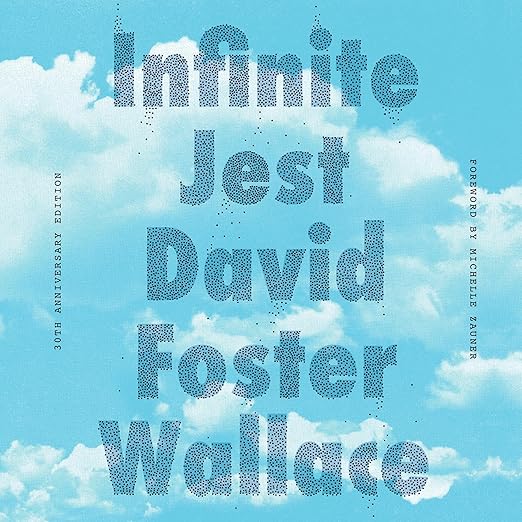
Infinite Jest was published in 1996 and has spent the decades since occupying a peculiar position in the American literary landscape: simultaneously proclaimed a masterpiece and used as shorthand for the kind of difficult novel that people claim to have read. The 30th anniversary edition includes a new foreword written and read by Michelle Zauner of Japanese Breakfast, which is a genuinely interesting pairing, someone who has made her own art about grief and compulsion introducing a novel about grief and compulsion. Her foreword is brief and worth the three minutes it costs.
What 64 Hours Actually Contains
The novel is set in a near-future North America where years are named after corporate sponsors, which is itself a joke with a half-life of decades. It moves between an addicts’ halfway house in Boston and a tennis academy on a hill above it. The Incandenza family, whose patriarch made a film so entertaining it killed anyone who watched it, anchors the tennis academy plot. Don Gately, a large man with a talent for violence and a genuine effort at sobriety, anchors the halfway house. These two narratives are circling each other across a thousand pages before they finally touch. The publisher’s note confirms that the unabridged edition includes all footnotes, signaled by a brief chime, read in sequence throughout the main text. Those footnotes are not optional material. Some of them are among the best writing in the book.
The Footnote Chimes and How Pratt Handles Them
Sean Pratt had to perform approximately two novels simultaneously. The main text and the footnote apparatus are both substantial, both stylistically distinct, and both require the same sustained attention. The chime that signals a footnote is a practical solution to an almost impossible problem, and it works better than you’d expect. What is more impressive is that Pratt doesn’t change registers dramatically between text and footnote; he treats them as continuous, which is the correct interpretive decision. Wallace wrote the footnotes as part of the reading experience, not as ancillary documentation. Pratt’s narration honors that understanding throughout all 64 hours.
One reviewer called this novel “work, going into the gym and the classroom,” and that’s not wrong, but it’s also not the whole picture. Another reviewer noted that most polarizing judgments about the book turn out to be simultaneously true, which is the most useful single observation about it. It is funny. It is also brutally sad. It is maximalist in a way that can feel like generosity or aggression depending on where you are in it. The section dealing with Gately’s overdose backstory is some of the most precise and compassionate writing about addiction I have encountered in fiction.
The Case for Audio Specifically
I was skeptical that a novel this typographically complex would translate to audio. The footnotes alone would seem to defeat the format. Having completed it, I think audio provides something the print version doesn’t: Pratt’s voice makes the tonal shifts between Wallace’s registers, the academic parody, the vernacular transcription, the lush lyrical sections, feel like a single mind moving through a range of expression rather than a collection of stylistic experiments. The novel’s accumulative emotional effect, which builds over many hours toward something that hits hard precisely because of all the difficulty it required, is actually easier to achieve on audio than in print, where you can flip ahead and undermine the pacing.
Who Should Approach This
Not everyone. That’s not a judgment on potential listeners; it’s an acknowledgment that a 64-hour commitment to a deliberately challenging text is a real ask. If you have previously spent time with Wallace’s essays, specifically Consider the Lobster or A Supposedly Fun Thing, and found his voice compelling rather than exhausting, the novel will feel like an extension of a known sensibility. If you abandoned the novel in print after 150 pages, the audio version won’t resolve whatever caused the abandonment, but it may circumvent it: having Pratt’s voice to follow through the denser passages lowers the activation energy. The listener who wrote that it couldn’t hold their interest is not wrong to feel that; this book makes demands that not every reader is positioned or inclined to meet. But for the right listener, 64 hours is not too long.
Frequently Asked Questions
How does the footnote chime system actually work in practice, and does it interrupt the narrative flow badly?
The chimes signal the transition into a footnote and back out, and Pratt reads them in sequence as part of the text. After the first few chapters the rhythm becomes natural, and many of the footnotes are substantive enough that they feel like the main text rather than interruptions.
Is the Michelle Zauner foreword in the 30th anniversary edition worth listening to if you are already familiar with the novel?
Yes. It’s brief, personal, and offers a specific perspective on the novel’s treatment of grief and compulsion from an artist who has engaged with similar themes in her own work. It adds something without overpromising.
Does Sean Pratt’s narration handle the multiple stylistic registers of Wallace’s prose consistently across 64 hours?
Consistently well, which is remarkable. His approach treats the stylistic variety as a single mind’s range of expression rather than distinct modes, which is the correct interpretive frame for this novel.
If I tried the print version and stopped after 150 pages, is the audio version likely to work better?
Possibly. Having a skilled narrator guide you through the denser passages lowers the activation energy significantly, and Pratt’s pacing helps with sections that feel impenetrable on the page. The novel’s architecture rewards patience in a way that is easier to maintain on audio.