Quick Take
- Narration: James Huff handles the ensemble of reservation and law enforcement characters with clear differentiation; the pacing suits a procedural with multiple threads running simultaneously.
- Themes: Native American sovereignty, missing and murdered Indigenous women, tribal versus modern politics
- Mood: Propulsive and culturally specific, occasionally dense with procedural detail
- Verdict: A mystery series that earns its setting through genuine research and lived experience, strongest when the cultural tensions are inseparable from the plot mechanics.
I tend to read police procedurals for the texture of place as much as the mechanics of plot. The best ones make their setting do more work than backdrop. Michael Max Darrow’s Indian Country series is explicitly attempting that in a context that most crime fiction either romanticizes or ignores entirely: the contemporary reservation and the legal, cultural, and political complexities that make law enforcement there unlike anywhere else in the United States. Darrow draws on personal experience in both law enforcement and Lakota spirituality, which is not the typical credential set for crime fiction, and the difference is legible on every page.
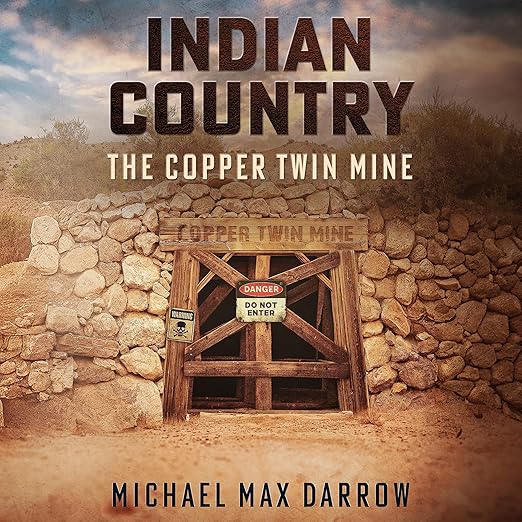
The Copper Twin Mine is the third book in the Indian Country series and the sequel to Indian Country: Missing. I came to it without having read the first two volumes, a choice that turned out to be manageable but imperfect, and I will address that tradeoff directly rather than obscuring it in recommendation language.
The Mining Company as Contemporary Antagonist
The premise positions an outside corporation moving to reopen the old Copper Twin Mine against the reservation community that would be most affected by the operation. This is not a fictional scenario invented for narrative convenience. Resource extraction disputes on Native American land are among the most persistent and consequential legal battles in contemporary American life, and Darrow frames the conflict with appropriate complexity. The mining company’s arrival does not simply split the community into obvious heroes and villains. It drives a wedge between modern tribal political actors and Traditionalist values, which is the kind of nuanced political distinction that most fiction in this space flattens into a simpler opposition.
Deputy Sergeant Mike Taylor, whose vision at sweat lodge opens the narrative and draws him into the conflict, is positioned at exactly this fault line. He respects Lakota spirituality, he works within the law enforcement system, and those two commitments pull in different directions throughout the book. That tension is the source of the series’ moral complexity rather than a problem to be resolved cleanly.
Veronica Likes Pretty Dresses and the Cold Case Weight
The introduction of newly assigned missing persons investigator Veronica Likes Pretty Dresses is one of the novel’s stronger structural choices. She arrives without institutional knowledge and has to learn on the job, which provides a naturalistic entry point into the reservation’s history of missing and murdered women without requiring exposition dumps. Her case involves several missing and murdered girls, including one connected directly to the Pine County Sheriff, and it represents the emotional center of the book even as the mining conflict drives the external plot.
The missing and murdered Indigenous women crisis is real, severe, and chronically underreported in both media and law enforcement. Darrow’s decision to center it in a series that engages with reservation life feels like a commitment rather than an opportunistic genre choice. Reviewers who engage most seriously with the series consistently identify this thread as what elevates the Indian Country books above straightforward procedurals.
Series Entry Point and What New Listeners Will Miss
Darrow and several reviewers describe The Copper Twin Mine as readable as a standalone, and technically this is accurate. The main case does not require prior series knowledge to follow. However, listeners who come to the third book cold will find that the established characters carry weight that would have meant more with the prior context of books one and two. Taylor’s relationships on the reservation, his standing in the community, and the trust he has built across earlier investigations are assumed rather than established fresh. The series is described as consistently getting better with each installment, which is the right trajectory for crime fiction built on an accumulating sense of place.
James Huff’s narration manages a cast that includes law enforcement from multiple jurisdictions, tribal council members, mining company representatives, and reservation community members with enough vocal differentiation to track a complex multi-thread plot. At under seven hours the listen is tight for the amount of material Darrow packs in, and one reviewer noted that a side plot feels underdeveloped relative to the main narrative. That critique has merit. The book is working at the limits of its length, which is a sign of ambition rather than carelessness, but listeners who want every thread fully resolved may find the pacing compressed.
Frequently Asked Questions
Can The Copper Twin Mine be listened to without having read the first two Indian Country books?
Technically yes, and Darrow structures the main case as a standalone. However, reviewers who came to the series without prior context note that the established character relationships carry more weight after the earlier books. Starting at book one is the fuller experience.
How does Darrow handle the missing and murdered Indigenous women crisis within a genre thriller format?
It is a central rather than peripheral plot thread. Veronica Likes Pretty Dresses’s cold case involves multiple missing and murdered girls on the reservation, including one connected to the Pine County Sheriff. The series treats MMIW as a structural condition rather than a single mystery to solve.
What distinguishes the Indian Country series from other crime fiction set on Native American reservations?
Darrow draws on personal experience in both law enforcement and Lakota spirituality, which informs the specificity of tribal politics and spiritual elements throughout. The mining conflict and the Traditionalist versus modern political divide reflect actual ongoing tensions rather than fictional approximations.
Does the novel resolve the mining conflict, or is it left open for future books?
The central confrontations reach resolution. The mining conflict and some character arcs are developed further than the synopsis suggests, but the series format means certain threads are positioned to continue into subsequent entries rather than closing completely here.