Quick Take
- Narration: Sam Dastor brings a measured, literary gravity to Naipaul’s prose that respects the text’s complexity, his cadence suits the essayistic rhythm without becoming monotonous over the six-hour runtime.
- Themes: Colonialism and its psychological aftermath, Hindu nationalism and the mythic past, modernity and cultural self-understanding
- Mood: Dense, searching, and uncomfortable, the kind of listening that stays with you for days
- Verdict: A challenging and still-provocative account of India in 1975 that demands active engagement and rewards it with a depth of cultural observation rarely matched in travel writing.
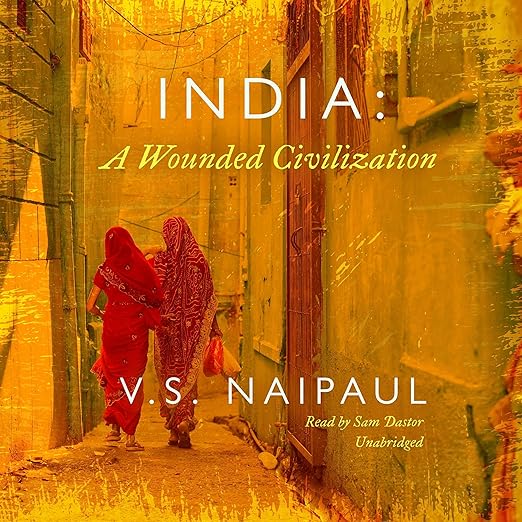
I have a particular weakness for travel writing that refuses to be comfortable, and India: A Wounded Civilization is one of the more uncompromising examples of the form I have encountered in audio. I came to it during a week of reading around postcolonial literature, Fanon, Rushdie, Achebe, and found that Naipaul’s India book sat in an awkward, generative friction with all of them. It is a book that has been argued over since its first publication in 1977, and listening to it now, narrated by Sam Dastor with appropriate gravity, that argumentative energy is still very much alive.
The context matters. V. S. Naipaul returned to India in 1975, the country his Trinidadian ancestors had left a century earlier, at the height of Indira Gandhi’s Emergency, a period of suspended civil liberties and concentrated executive power. Out of that visit he produced this book, which is simultaneously a work of political reporting, cultural criticism, and literary meditation. He drew on novels, news reports, political memoirs, and encounters with people ranging from dispossessed princes to urban engineers and Naxalite sympathizers. What he built from these materials is a portrait of a civilization that he saw as traumatized by centuries of foreign conquest and retreating into a mythic vision of its past as a way of avoiding the demands of the present.
Naipaul’s Particular Angle of Vision
It would be dishonest to review this book without acknowledging that Naipaul’s angle of vision is contested and was always contested. His position is that of an outsider with ancestral roots, not Indian-born, not Western, not simply a tourist, and he uses that liminal position to claim a kind of double perspective that allows him to see things both insiders and outsiders miss. Whether that claim holds up depends partly on what you make of his conclusions. He argues that India’s entanglement with a mythic Hindu past is not a source of cultural strength but of paralysis, that the glorying in ancient civilization functions as a substitute for honest engagement with present conditions.
This argument is made with prose that is, as one reviewer noted, among the finest contemporary English available. Naipaul’s sentences have a particular quality of superimposing his voice onto the voices of others, he quotes R. K. Narayan’s phrase “India will go on” at the opening of two different chapters, using it each time to different effect, building a kind of ironic counterpoint between the novelist’s resigned acceptance and his own more agitated diagnosis. These are not the techniques of journalism; they are the techniques of literary criticism applied to lived observation.
The Emergency as Lens
The political moment Naipaul chose to write about is significant, and the audiobook earns its listening time partly because of how well Naipaul uses the Emergency as a diagnostic tool. The suspension of civil liberties under Indira Gandhi forced certain questions about Indian political culture into the open: questions about democratic institutions, about who held actual power in feudal village structures, about the relationship between official ideology and lived reality. Naipaul uses these pressures to examine the fault lines between India’s aspirations and its practices, the space program and the mantra-chanting volunteers purifying a defiled temple exist in the same pages without the irony becoming cheap.
One reviewer suggested starting with the Gandhi chapter midway through before returning to the beginning, and I understand the impulse, the later sections of the book are more anchored in specific events and figures, while the earlier chapters operate at a higher level of abstraction. But I would not recommend that approach for first-time audio listeners. The book builds its argument sequentially, and the sense of accumulation matters to how the later observations land.
The Dating Question and What Remains Alive
One reviewer described the book as “somewhat insightful, dated,” and that assessment deserves a nuanced response. Much of the specific political commentary is indeed rooted in 1975 conditions that no longer obtain, the Emergency itself ended, Gandhi was voted out, and India’s trajectory since has included transformations Naipaul could not have anticipated. But the cultural diagnosis he offers, the tension between a civilization’s mythic self-understanding and its capacity to engage honestly with modernity, the caste system’s persistence beneath official egalitarianism, the particular psychology of a society that experienced prolonged foreign dominion, these observations remain live points of debate in discussions of contemporary India.
Sam Dastor’s narration handles the layered temporality of the text well. He does not try to update the material or signal distance from it; he reads it with the gravity it was written with, trusting the listener to supply their own historical context. At six hours and forty-one minutes, the book is concise for its ambitions, almost aggressively so. There are passages where you wish Naipaul had given himself more room, and others where the compression creates the kind of aphoristic force that only works when space is limited.
Who Will Find This Essential and Who Will Struggle
Listeners who come to this audiobook with prior knowledge of Indian history, or with a serious interest in postcolonial thought, will find it an essential and provocative document. It is not a sympathetic portrait, and it is not trying to be, Naipaul was not in the business of making his subjects feel seen and validated. Readers who have encountered his other India writing, particularly An Area of Darkness and India: A Million Mutinies Now, will want this as the middle panel of a triptych.
Listeners looking for accessible travel writing, or for a balanced or celebratory account of Indian culture, should look elsewhere. Naipaul’s India is wounded, and he keeps the wound open throughout. That is both the book’s limitation and its peculiar power.
Frequently Asked Questions
Is it necessary to read Naipaul’s other India books before listening to this one?
Not strictly necessary, but the experience is richer if you have read An Area of Darkness, which preceded this book. India: A Wounded Civilization stands on its own as a complete argument, but it is the second of Naipaul’s three India books and some of his observations assume familiarity with the complicated personal history he explored in the first.
How much has the book dated since its publication in 1977?
The specific political references to Indira Gandhi’s Emergency and the events of 1975 are clearly historical. The broader cultural diagnosis, about mythology and modernity, caste persistence, and the psychological aftermath of colonialism, remains actively debated and in many respects still pertinent. One reviewer found it largely obsolete; others treat it as foundational. Your assessment will depend on where you stand on the underlying arguments.
Is Sam Dastor’s narration a good match for Naipaul’s prose style?
Yes. Dastor reads with the literary seriousness the text demands, maintaining the essayistic rhythm of Naipaul’s sentences without becoming plodding. His voice carries authority without projection, appropriate for prose that is doing its own work and does not need performative emphasis to land.
Does the book offer any sympathy or celebration of India alongside its criticism?
Some, Naipaul is moved by specific encounters and honest about complexity, but the dominant register is diagnosis rather than celebration. He is not writing as a hostile outsider, but he is also not writing as an advocate. If you want a warmer or more embracing account of India, this is not that book.