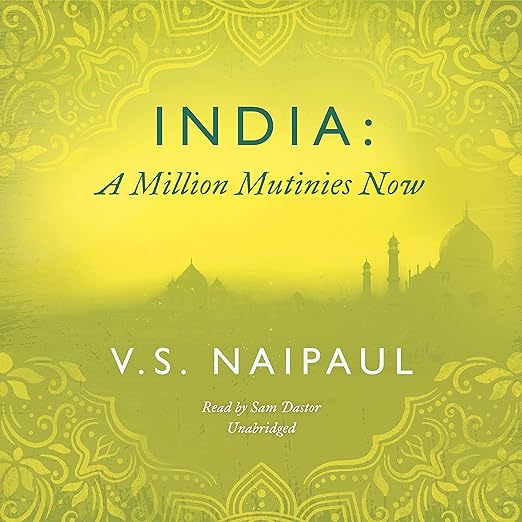
Quick Take
- Narration: Sam Dastor brings appropriate authority and nuance to Naipaul’s complex portrait of Indian society, handling a vast range of voices and registers across nearly 25 hours.
- Themes: Postcolonial identity and friction, religious and caste tensions, the paradox of modernization alongside tradition
- Mood: Dense and immersive, requiring patience and curiosity about India specifically
- Verdict: An essential listen for anyone serious about understanding contemporary India, and Dastor’s narration makes the 25-hour commitment feel earned.
I started India: A Million Mutinies Now before a research project on postcolonial South Asian literature, and I kept listening long after the research was done. V. S. Naipaul’s third India book, published in 1990, is the most generous and the most structurally complex of his three engagements with the country. It is not a travel memoir in any simple sense. It is an act of sustained listening: Naipaul traveling through Bombay, Calcutta, Kashmir, and Tamil Nadu, interviewing an extraordinary range of people, and presenting their voices with unusual care for a writer who built much of his early reputation on pitiless observation.
Naipaul completed three India books over the course of his career, and this one represents the closing of that arc. Where An Area of Darkness was a record of alienation and India: A Wounded Civilization engaged with political trauma after the Emergency, A Million Mutinies Now is an attempt to understand India as it actually was in the late 1980s: fractious, contradictory, animated by dozens of simultaneous liberation movements, each pushing for recognition against a background of received hierarchy.
Our Take on India: A Million Mutinies Now
The structure is unusual for a literary nonfiction audiobook. Rather than Naipaul holding the center as protagonist-narrator, the book gives substantial time to the people he meets: a secretary to a prominent businessman, members of the Bombay underworld, a Marxist rebel, religious leaders, caste activists, political organizers. Naipaul frames each encounter but largely stands aside, letting his subjects speak. The result is something closer to oral history than to the traditional literary travel essay.
This generosity of method has been read as a maturation of perspective from his earlier, more combative work, and also as a sign of genuine wrestling with his own complicated relationship to India. One reviewer noted that as an ethnically Indian person born outside India, Naipaul had a tendency to look down on his ancestry. That tension is not absent from this book, but it is managed more carefully here than in the earlier volumes, and the interviews are conducted with enough genuine curiosity that the subjects emerge as full individuals rather than illustrations of an argument.
Why Listen to India: A Million Mutinies Now
Sam Dastor’s narration is essential to the success of this audiobook. The book spans many voices, accents, and registers, from educated Bombay professionals to Kashmir militants to Tamil activists, and Dastor handles the transitions with intelligence. He does not do impressionistic voices or heavy accents; he modulates enough to keep the speakers distinct while maintaining the literary register that Naipaul’s framing text demands. At nearly twenty-five hours, this is a major commitment, and Dastor’s consistency across that runtime is one of its quiet achievements.
The audiobook is particularly well-suited to the material because so much of the book originated as conversation. Hearing these interviews read aloud returns them to something like their original form: you are listening to people speak, which is what Naipaul was doing when he collected them.
What to Watch For in India: A Million Mutinies Now
The book’s density is real. Naipaul moves through several cities and dozens of subjects, and the thematic threads, religious identity, caste politics, the emergence of a new assertiveness among previously subjugated groups, are woven together rather than separated by chapter structure. Listeners who need clear signposting will find the associative logic of the organization occasionally challenging. But that organization reflects the actual texture of Indian social life: overlapping, sometimes contradictory, impossible to reduce to a single narrative.
One reviewer who read the book as preparation for a trip to India found it genuinely useful for understanding group dynamics, religious complexity, and government corruption. That practical dimension is real: this is one of the best context-building texts available for anyone trying to understand how modern India became what it is.
Who Should Listen to India: A Million Mutinies Now
Serious readers of postcolonial literature and South Asian history will find this essential. Travelers preparing for extended engagement with India, rather than a surface visit, will also find it one of the most illuminating books available. Listeners familiar with Naipaul’s other India books will want the complete picture this third volume provides. Those new to Naipaul should be aware that this is his most listener-friendly India book but still demands real attention and patience. Casual listeners or those with only passing curiosity about the region may find the depth and length more than they want to commit to.
Frequently Asked Questions
Should I read Naipaul’s other two India books before listening to A Million Mutinies Now?
It is not required, and A Million Mutinies Now is the most accessible of the three. However, reading them in sequence, starting with An Area of Darkness and then India: A Wounded Civilization, provides meaningful context for understanding how Naipaul’s perspective on India evolved over three decades.
How does Sam Dastor handle the range of voices and Indian contexts in the narration?
Dastor manages the range with intelligence rather than impressionism. He differentiates speakers through modulation rather than heavy accent work, which keeps the literary tone consistent while maintaining clarity about who is speaking.
Is A Million Mutinies Now still relevant to understanding India today, given it was written in 1990?
Yes. Many of the tensions Naipaul documents, around caste politics, religious identity, regional nationalism, and the assertiveness of previously marginalized groups, have only intensified since 1990. The book functions as essential historical context for the present.
Is Naipaul’s view of India fair, or does his outsider-insider position bias the account?
This is a genuine debate about Naipaul’s work generally. His position as a person of Indian descent born in Trinidad and educated in England gives him a complicated vantage point that some readers find illuminating and others find compromised. A Million Mutinies Now is generally considered his most balanced India book, but that tension does not disappear entirely.