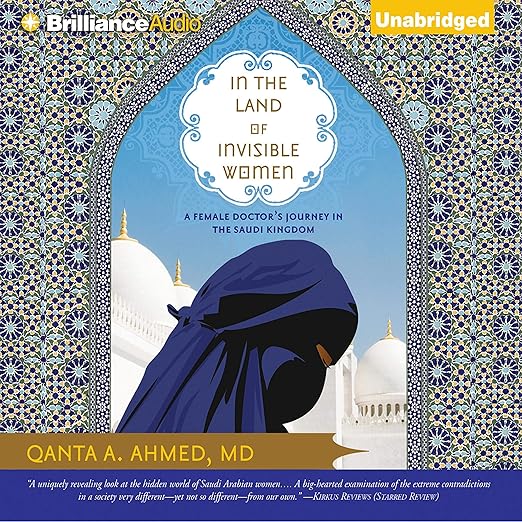
Qanta Ahmed's memoir reads, in the words of one reviewer, like 'a Victorian travel book crossed with hard-hitting investigative journalism,' and that description gets at exactly what makes this audiobook of In the Land of Invisible Women an unusual entry in the physician-memoir genre. Ahmed was a young British Muslim doctor unexpectedly denied a visa to remain in the United States, and rather than treating that setback as pure crisis, she accepted a position in Saudi Arabia expecting, given her shared faith, to find a kind of belonging. What she found instead was more complicated than either rejection or welcome.
The craft choice at the center of this memoir is refusing an easy narrative. Ahmed does not write a story of straightforward disillusionment, nor one of uncomplicated cultural immersion; she documents genuine scorn in places she expected acceptance, alongside real humor, honesty, loyalty, and even love in places she did not expect to find them. That refusal to flatten a genuinely contradictory experience into a single takeaway is what elevates this above a simple culture-shock memoir.
A Reader Who Expected Slaves and Found Agency
Reviewer AmmonArt praised the book for engaging with 'the thoughts, heart and soul' of another culture rather than settling for 'dry facts or sensationalized vignettes,' a distinction that matters enormously for a memoir covering territory this politically loaded. A second reviewer, Christine Smith, was admirably candid about arriving with preconceptions, expecting to find women 'treated much like slaves,' and described real surprise at discovering more complexity and agency than that framing allowed for. That kind of reader transformation is a strong signal of how the book actually works on someone willing to be challenged.
A third reviewer called Ahmed's writing 'introspective and poetic,' language that tracks with the physician-turned-memoirist's clinical eye paired against a genuinely literary sensibility. Ahmed is trained to observe precisely, and that training translates into a memoir attentive to small, specific detail rather than sweeping cultural generalization, even when the larger subject matter, gender, faith, and belonging, invites exactly that kind of generalization.
Closer to Cultural Memoir Than to Medical Memoir
Physician memoirs occupy a specific niche worth situating this within: writers like Atul Gawande and Paul Kalanithi built comparable credibility from clinical training applied to personal narrative, though Ahmed's book differs from both in being fundamentally about displacement and cultural immersion rather than mortality or medical ethics specifically. That distinction places In the Land of Invisible Women closer to cultural memoir with a physician's eye than to the medical-memoir subgenre those other writers represent.
Part of what makes Ahmed's disorientation so specific is the assumption she carries into the Kingdom: that shared faith would function as automatic cultural common ground between a British Muslim and a Saudi one. The memoir's real subject, in many ways, is the gap between religious identity and national or cultural identity, two things easily conflated from the outside but experienced very differently by someone moving between them in person.
Fifteen Hours Lets One Assumption Fully Unravel
Nicola Barber narrates, and the challenge built into this particular memoir is real: the material shifts constantly between clinical medical observation, cultural analysis, personal vulnerability, and dry wit, sometimes within the same chapter. A steady, precise narrating voice serves that range better than a heavily performative one would, letting Ahmed's own observational instincts carry the emotional weight rather than layering additional interpretation on top of it.
What makes this memoir specifically rewarding as a listen rather than a read is the way Ahmed's outsider-insider position develops over the runtime. She arrives assuming a kind of automatic belonging based on shared faith, and the audiobook's near fifteen-hour length gives that assumption real room to be complicated gradually, chapter by chapter, rather than resolved in one tidy early revelation, the kind of slow recalibration that a shorter book would have to rush.
The title's second half, invisible women, deserves unpacking rather than taking at face value, since the book's own content complicates it directly. Ahmed's memoir does not simply confirm the assumption embedded in that phrase; reviewers specifically pushed back against reading the title as literal confirmation of oppression, describing instead women with real agency, humor, and complexity hiding in plain sight behind a restrictive public system. The title functions more as provocation than thesis.
Personal Testimony From One Window in Saudi History
This account reflects one specific window in Saudi Arabia's recent history, and Ahmed's experience is necessarily personal and time-bound rather than a comprehensive account of the kingdom or of women's lives there more broadly. Listeners should treat this as one physician's rich, specific testimony rather than a definitive sociological survey, useful context the memoir itself does not always pause to provide.
The book also does not shy from genuinely uncomfortable material, both the rejection Ahmed faces and her own evolving assumptions about a culture she thought she understood before arriving. Listeners expecting either a uniformly critical account or a uniformly warm one should recalibrate; the book's honesty is exactly what makes it resist easy categorization in either direction, a quality reviewers specifically credited rather than found frustrating.
The memoir's emotional arc moves broadly from expectation through rejection into a more complicated, self-aware belonging, and listeners should expect that progression to unfold gradually rather than in discrete, clearly marked stages. Ahmed is working out her own changing understanding in something close to real time on the page, which is part of what gives the account its credibility, but it also means the book resists easy chapter-by-chapter summary.
Medicine as the Lens for a Larger Transformation
Listen if you are drawn to cultural-immersion memoirs written by genuine experts in another field, medicine here, rather than professional travel writers, and if you want a memoir willing to sit with contradiction rather than resolve it neatly. Listen if you have any interest in interfaith perspective, Muslim women's lived experience specifically, or medicine practiced across cultural lines.
Skip it if you want comprehensive political or academic analysis of Saudi Arabia rather than one doctor's personal account, or if memoir-length ambiguity, genuine contradiction left standing rather than resolved, frustrates you as a listener. This book asks for patience with complexity rather than delivering a single clean verdict.
Listen also if you appreciate memoir that foregrounds a woman's professional identity, medicine here, as the lens through which she processes a much larger personal and cultural transformation, since that professional grounding is what keeps Ahmed's account precise even in its most emotionally difficult passages, never letting sentiment overrun observation for long.
- Narrator: Nicola Barber navigates clinical precision, cultural analysis, and dry wit within the same chapters without losing steadiness.
- Subjects: faith and belonging across cultures, gender and autonomy in Saudi Arabia, an outsider's assumptions tested by lived experience
- Tone: Reflective and unflinching, equal parts travel memoir and investigative honesty
- Bottom line: A genuinely rich cultural memoir for listeners willing to sit with contradiction rather than a tidy conclusion.
Frequently Asked Questions
Does the In the Land of Invisible Women audiobook cover Qanta Ahmed's entire medical career?
No, it focuses specifically on her time practicing medicine in Saudi Arabia after being denied a US visa, not a comprehensive career memoir.
Is this audiobook critical of Saudi Arabia or does it offer a balanced view?
It resists a single verdict, documenting genuine rejection alongside unexpected humor, loyalty, and warmth, which reviewers specifically credited as more honest than a purely critical or purely admiring account.
How does Nicola Barber's narration handle the memoir's mix of humor and hardship?
With steady, precise delivery that lets Ahmed's own observational instincts carry the emotional weight rather than adding extra performative interpretation on top of it.
Is prior knowledge of Islam or Saudi culture needed to follow this memoir audiobook?
No. Ahmed writes as a British Muslim doctor discovering the culture herself in real time, which makes the material accessible to listeners without prior background.