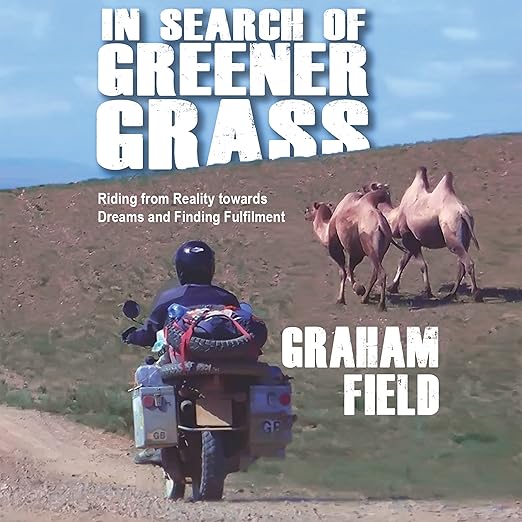
A game show audience heard him promise, on live television, that he'd ride a motorcycle to Mongolia with his winnings. Graham Field spends this audiobook making good on that promise: a $1,000 KLR 650 bought off eBay, a winter spent prepping it in the garage, and 15,000 solo miles across a continent he barely knew. In Search of Greener Grass runs 15 hours and 24 minutes, and Field narrates his own account of leaving an unremarkable life in England behind, low on cash and lower on any fixed plan.
First, the Big Picture
The premise sounds like a stunt, but Field treats it as something closer to an experiment: what breaks first, the bike, the body, or the budget? That question structures the whole trip east, and Field's twenty-five years of financial caution keep bumping up against a decision that is anything but cautious. The result reads less like a bucket-list travelogue and more like a slow-motion identity crisis conducted at highway speed, which gives the book more tension than the premise alone would suggest.
One reviewer, Michael J., placed this book against the wider Adventure Travel category, noting that most entries in the genre favor 'the travel editorial style,' 'chronologically depicting the explorers' methodical ways of getting from A-to-Z.' In Search of Greener Grass deliberately isn't that. Field's chapters wander the way an actual solo trip wanders, doubling back on doubt and second-guessing his own commitment as often as they log new miles, which is a fair trade if you want a travel memoir that resembles the messiness of actually leaving.
The 'Diaries of a journey through life' series billing suggests Field sees this less as a one-off travel stunt and more as an ongoing record of how a person reinvents themselves through movement. That framing matters for how the book actually plays out: less concerned with sightseeing highlights than with the day-to-day grind of solo travel, breakdowns, budget math, and the loneliness that comes with 15,000 miles of mostly your own company.
The 'what breaks first, bike, body, or budget' framing that opens the book turns out to be more than just a joke; Field returns to variations on that question throughout, using it as a structural device to check in on his own physical and financial state at regular intervals. It's a simple trick, but an effective one for keeping a 15-hour solo travelogue from drifting without any throughline at all.
Field narrating his own material matters more here than it would in a polished, editorially shaped guidebook. His synopsis describes a man armed with 'cynical humor' and 'no sense of proportion,' and that specific self-aware, faintly embarrassed tone is exactly the register a hired narrator would struggle to fake convincingly across 15-plus hours. You're hearing the actual voice that talked itself into this trip, doubts and all, which gives the deadpan jokes their timing.
Listeners respond to the honesty specifically. N3303J's review calls this 'a very real travel story' with 'nothing candy coated,' adding that the book reflects experiences many actual travelers recognize rather than a curated highlight reel. That's a meaningful distinction in a genre that often smooths over the boring, frightening, or humiliating stretches of long-distance travel in favor of scenery. Field keeps the unglamorous parts in.
A 4.6 rating from 328 listener ratings is a substantial, consistent base of approval for a memoir with no major publisher backing behind it, and it suggests the raw, self-narrated approach resonates well beyond a small niche audience. That's a meaningful signal for a book that could easily have stayed a personal blog rather than reaching this many listeners.
Fans of Long Way Round or The Long Way Home will recognize the genre's now-familiar shape, a mid-life pivot conducted at speed, but Field's version stays scrappier and more self-funded than the celebrity-backed television version of that same premise, which is part of its specific appeal.
The book's tone stays remarkably even-keeled given how often things could have gone wrong; Field treats mechanical breakdowns and moments of genuine danger with the same dry restraint he applies to the small daily indignities of budget travel, which keeps 15 hours of listening from tipping into either melodrama or monotony.
Weak Spots in In Search of Greener Grass
Fifteen-plus hours of one man's internal monologue, however wry, is still a serious time commitment for any listener. If you're hoping for a fast-moving plot with clear milestones, the pacing here runs closer to a long solo drive than a highlight reel; momentum comes and goes with Field's own mood on any given day of the ride. A reviewer identified only as 'You are going WHERE?' captured the book neatly: 'This book is a trip and not an ego trip,' which is both a compliment and a fair warning about how unpolished the narration voice can be.
Because Field self-narrates and this is not a professionally trained voice actor, expect the same rougher, more conversational delivery you'd get from a friend telling you about his trip rather than a studio performance. That's the point of the book, but it's worth knowing before committing to over a full day's worth of listening.
One practical gap worth flagging: a route this visual, crossing multiple countries and vastly different landscapes, would benefit from maps or photos a print or ebook edition might include. Audio alone asks you to picture unfamiliar geography from description only, which works fine given Field's descriptive instincts but is worth knowing if you're the kind of listener who likes to trace a route visually as you go.
Because the trip covers such a wide range of countries and cultures in sequence, pacing your listening to roughly match Field's own travel rhythm, rather than racing through in one sitting, tends to make the day-to-day texture of the journey land more vividly than a rushed binge would.
Is This One for You?
This is a strong pick for adventure travel and motorcycle enthusiasts, especially anyone who's enjoyed Long Way Round-style travelogues and wants a scrappier, more self-funded take on the same idea. Fans of raw, self-narrated memoirs where the writer hasn't smoothed over their own doubts will find plenty to like, and the 15,000-mile route through unfamiliar territory gives armchair travelers real destinations to picture.
It's also worth a listen for anyone contemplating their own major life pivot, whether that means a motorcycle trip or something else entirely; Field's honesty about the fear underneath the commitment, the kind he hoped might get edited out of the television broadcast that started all this, makes the book relatable well beyond motorcycle enthusiasts specifically.
Skip it if you want a polished, chronological guidebook-style travelogue; per Michael J.'s review, this book deliberately isn't that kind of Adventure Travel entry. Also skip it if 15-plus hours of one narrator's unpolished, conversational voice without much vocal variety tends to wear on you, since Field's delivery favors rambling honesty over rehearsed performance.
Questions Listeners Ask
Does Graham Field narrate the Greener Grass audiobook himself, and does that matter for a travel memoir like this?
Yes, and it matters quite a bit. His self-deprecating, cynical tone comes through in a way a hired narrator would likely flatten, since the humor depends on hearing the actual person who talked himself into a 15,000-mile trip on a $1,000 bike.
How is In Search of Greener Grass different from other adventure travel audiobooks?
Reviewers note it skips the tidy, chronological guidebook structure common in the genre. Field's account wanders and doubles back the way an actual solo trip does, favoring honesty about doubt and difficulty over a polished highlight reel.
Do I need to listen to other Graham Field audiobooks before this one?
No. It's billed as part of an ongoing 'Diaries of a journey through life' series, but In Search of Greener Grass works as a standalone account of this specific motorcycle trip.
Is In Search of Greener Grass audiobook more about the motorcycle trip or Field's personal reflections?
Both, in roughly equal measure. The mechanical and logistical details of the ride are there, but the more compelling material is Field's ongoing reckoning with why he committed to this trip in the first place.