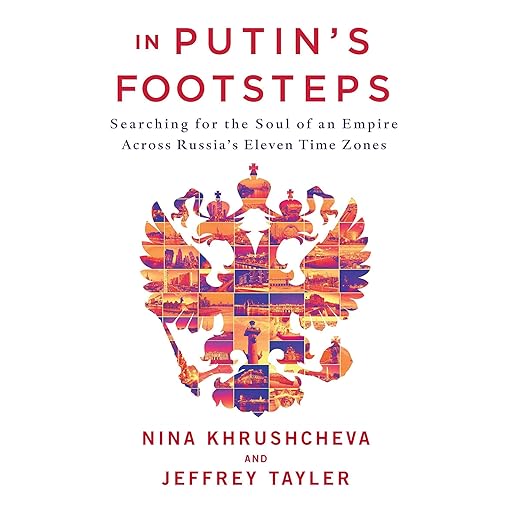
I started listening to In Putin's Footsteps on a gray February morning, the kind of day where the news feed is full of Russia again and you realize how thin most Western commentary on the country actually is. Nina Khrushcheva's biography alone would make this worth picking up. The great-granddaughter of Nikita Khrushchev, living and reporting from Russia since 1993, writing about a president who has defined the country's relationship with its own size and its own myth. It is a rare vantage point.
The conceit is clever: Khrushcheva and co-author Jeffrey Tayler retrace the logic of Putin's famous New Year's Eve address planned across all eleven time zones, the speech he designed and then abandoned as physically impossible but politically clarifying. By following that imagined itinerary, they move from European Russia out to Siberia and the Far East, and they find a country that barely resembles the one most Western readers picture when they think of Moscow.
The Verdict, Briefly
What this book does exceptionally well is resist the temptation to reduce Russia to its leadership. The eleven time zones are not a backdrop for a biography of Putin but rather an argument: that Russia's size is itself a political fact, that the distances between its regions produce wildly different relationships to power, identity, and the outside world. The writing is most alive in its regional specificity, in the way Khrushcheva describes how people in Russia's outback view their place in a country that often seems to forget they exist. That is the thread Putin understood when he designed his address, and it is the thread the authors follow with genuine curiosity.
Why Listen to In Putin's Footsteps
Kathleen Gati's narration serves the material well. She has the kind of measured, slightly formal cadence that suits a book sitting somewhere between travelogue, political analysis, and memoir. She does not impose personality on the prose, which is probably the right call for material this substantive. The book's structural strength, which one reviewer noted makes it readable in non-chronological order, translates well to audio because each region functions as something close to a self-contained essay. You can return to a section and it holds. A listener who praised the book for correctly predicting what Putin could do regarding Ukraine was responding to this analytical rigor, and it is real. Khrushcheva's insider position gives her access to the kind of contextual knowledge that most Western journalists covering Russia simply do not have.
Points to Consider
The most consistent note from critical readers is that the book is heavier going than its travelogue framing suggests. One reviewer who expected more man-on-the-street encounters found instead academics, museum guides, and bureaucrats, and that observation is fair. The human texture of the journey is filtered through an intellectual lens that prioritizes analysis over atmosphere. If you come to this wanting the sensory immersion of a travel memoir, you will find some of it but not enough. The book is fundamentally an argument about Russia dressed in the clothing of a journey, and listeners who embrace that framing will get considerably more from it than those who resist it.
The Right Listener for In Putin's Footsteps
This is a strong choice for listeners with existing curiosity about Russia who want something more rigorous than journalism but more readable than academic history. It pairs well with Timothy Snyder's work on Eastern Europe or Anne Applebaum's writing on autocracy for those building a broader reading frame. It is not an entry-level introduction, and it is not a fast-moving narrative. But for listeners willing to settle into its pace, In Putin's Footsteps is one of the more honest attempts to explain a country that most Western commentary continues to oversimplify. And given the events since its publication, the book's central argument about Russia's regional complexity and Putin's need to project national strength has only grown more relevant. It is the kind of work that ages into greater importance rather than into obsolescence.