Quick Take
- Narration: Justine Eyre delivers the investigative journalism register with precision, holding the documentary weight of Rever’s evidence without sensationalizing material that is already disturbing on its own terms.
- Themes: Genocide, power and impunity, the gap between international narrative and ground-level reality
- Mood: Cold, methodical, and deeply disturbing in the way that only rigorously sourced journalism can be
- Verdict: One of the most important and most difficult audiobooks on Rwanda available, essential for anyone who wants the full account rather than the internationally approved version.
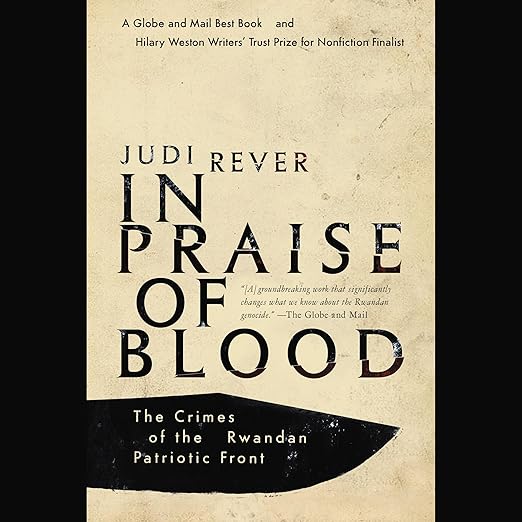
I finished In Praise of Blood on a Tuesday morning, sitting in my car in the parking lot of a grocery store, unable to immediately go inside. That kind of arrested stillness, where the implications of what you have just heard refuse to let you return to ordinary activity, is the sign of a book that has done what it set out to do. Judi Rever spent years assembling this account at considerable personal risk, and the result is one of the most disturbing and methodologically rigorous works of investigative journalism I have encountered on the African continent.
The story Rever tells is not the one most of us learned. The standard international account of the Rwandan genocide positions Paul Kagame and his Rwandan Patriotic Front as the heroes who stopped the Hutu slaughter of Tutsis. What Rever documents, through interviews with RPF defectors and former soldiers, testimony from atrocity survivors, and documents leaked from a United Nations court, is that Kagame’s forces were simultaneously conducting their own systematic killing campaign as they advanced on Kigali. The RPF shot down the presidential plane on April 6, 1994, the act that triggered the genocidal violence. And as they slowly advanced, they were ethnically cleansing the country of Hutu men, women, and children to create space for returning Tutsi settlers displaced since the early 1960s.
The Evidence Architecture That Makes This Different
What separates Rever’s account from more polemical treatments of Kagame’s Rwanda is the precision of her sourcing. She does not rely on a single defector or a politically motivated source. She builds her case through multiple independent witnesses, corroborated by documentary evidence, including leaked UN court records that the international community has consistently declined to act upon. Several reviewers with direct knowledge of the region, including people who have lived in Uganda, Rwanda, or the Congo, have described the book as confirming patterns they witnessed themselves. That confirmatory reception from regional observers is a meaningful signal about the account’s credibility.
Justine Eyre is one of the better narrators working in serious narrative nonfiction, and her performance here is exactly right. She reads with a controlled clarity that keeps the evidential structure of the argument legible across nearly ten hours. When Rever is presenting survivor testimony, Eyre’s delivery conveys the weight of that testimony without collapsing into the performative grief that would actually undercut it. When the material shifts to political analysis or documentary evidence, Eyre shifts register accordingly, maintaining the distinction between what witnesses saw and what the broader record proves.
How Kagame Managed the International Story
One of the book’s most important analytical contributions is its account of how Kagame managed the international narrative in the genocide’s aftermath. The strategy Rever reconstructs was as sophisticated as it was cynical: exploit international guilt about the failure to prevent the Tutsi genocide to position the RPF as saviours, attract reconstruction funding, suppress investigation of RPF atrocities through a combination of legal pressure and diplomatic leverage, and build a model-African-state reputation that made Western governments reluctant to question what was happening.
A reviewer describes this mechanism precisely: the international community has not recognized the truth because Kagame and his top commanders effectively covered their tracks and, post-genocide, rallied world guilt and played the heroes in order to attract funds to rebuild Rwanda. That observation, and the evidence Rever marshals to support it, is what makes this book so uncomfortable. It is not an account of a failed state or a chaotic atrocity. It is an account of a successful atrocity, systematically concealed with the assistance, witting or unwitting, of the international institutions nominally dedicated to preventing exactly this kind of killing.
The Congo Dimension
The book’s scope extends into the Democratic Republic of Congo, where Rever traces the continuation of RPF operations across the border. The killing did not stop at Rwanda’s boundaries, and Rever’s account of the Congo dimension, still an ongoing situation at the time of writing and since, gives the book a contemporary relevance that makes the historical record feel less like history and more like unfinished business. A reviewer notes: the situation continues to this day, and Africa is being held back by strong men who murder indiscriminately, kill their rivals, and cover their tracks while giving speeches to the United Nations. That framing is blunt, but it captures the book’s core argument accurately.
Who Should Listen, Who Should Skip
This audiobook is essential for anyone who wants to understand the full record of the Rwandan genocide, including the parts that international bodies have declined to fully investigate. It is also essential for understanding how powerful actors use international institutions to suppress accountability rather than enable it.
Do not come to this expecting a comfortable narrative. The evidence Rever presents is heartbreaking in the clinical way that systematic killing is always heartbreaking: the details are precise, the scale is enormous, and the impunity is nearly complete. If you have a personal connection to the region or to the communities affected, approach with appropriate care.
Frequently Asked Questions
Is Rever’s account contested by the Rwandan government or international scholars?
Yes, the Kagame government has consistently denied and sought to suppress accounts like Rever’s. Some international scholars have been cautious about specific claims. However, the book was a finalist for the Hilary Weston Writers’ Trust Prize, a major literary nonfiction award, and its sourcing has been taken seriously by journalists and scholars who have independently investigated the same period.
Does Justine Eyre’s narration handle the survivor testimony sections appropriately?
Yes, Eyre is one of the narrators most capable of handling difficult testimony material. She reads the survivor accounts with a controlled gravity that respects the weight of the testimony without over-dramatizing it, which is exactly what this material requires.
How does the book treat the Hutu genocide of Tutsis, given its focus on RPF atrocities?
Rever does not deny or minimize the Hutu genocide of Tutsi civilians, which killed approximately 800,000 people. Her argument is that both genocides happened simultaneously and that the international community’s account has treated only one of them as real. The book is not a defense of the Interahamwe or the Hutu extremists who organized the mass killing of Tutsis.
Does the book extend into events after 1994, including the Congo wars?
Yes, Rever traces RPF operations into the DRC and addresses the Congo wars, which she connects to the same pattern of Kagame’s forces operating across borders with effective impunity. This gives the book a post-1994 dimension that is relevant to ongoing events in the region.