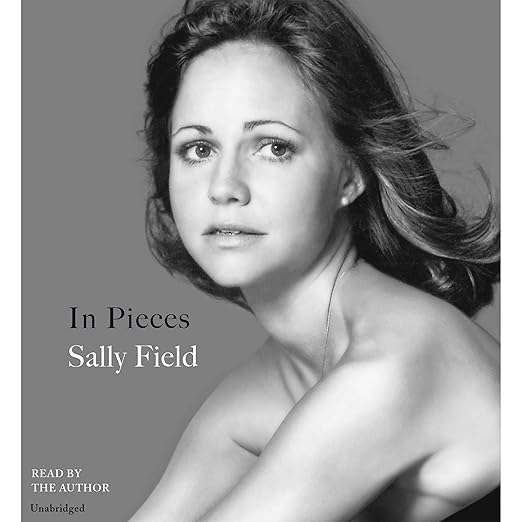
- Read by: Sally Field narrates her own memoir; no other narrator is credited.
- At its heart: mother-daughter relationships, Hollywood childhood, self-reflection through therapy
- Vibe: Intimate and searingly honest
- Short version: Field's own voice on difficult family history makes this worth choosing over the print edition, especially if you want unfiltered access rather than a highlight reel.
Sally Field narrates her own audiobook here, which means the same voice audiences know from Gidget, Sybil, and Norma Rae is the one describing what stood behind all three roles: what the synopsis calls 'the shy and anxious little girl' who never showed up on screen. In Pieces covers Field's childhood, the craft that helped her find her voice, and the decades of a public career built on top of both, and the choice to have her read it herself turns out to matter more than a passing production detail.
The synopsis moves through the touchstones any Field fan would expect: the 'dazzling complexity' of Sybil, the Academy Award-winning turns in Norma Rae and Lincoln, more than five decades of screen work. What it foregrounds instead is the daughter-and-mother relationship running underneath all of it, framed as 'an inspiring account of life as a woman in the second half of the twentieth century' rather than a straightforward career retrospective. Reviewer C Wm (Andy) Anderson opens a long, personal review with a Thomas Jefferson line about honesty being the first chapter in the book of wisdom, and lands on honesty as the word that keeps surfacing while listening, calling Gidget a personal touchstone from childhood before getting into Field's own story.
Kindle Customer Libbie Chute's review draws an even more direct line between listener and subject, describing having assumed Field's life was as tidy as her television persona and being genuinely surprised to learn otherwise. That same review credits years of therapy with giving Field the distance to look at her younger self clearly rather than defensively, which is precisely the quality a five-star review from Nicola, simply a self-described 'big Sally Field fan,' does not get into detail on but clearly responds to anyway.
One specific line in the synopsis is worth sitting with: Field carries 'an infectious charm that has captivated the nation for more than five decades,' but one character supposedly always stayed hidden underneath it, the anxious child behind the public roles. That framing sets up the entire memoir as an act of finally introducing that hidden character to an audience that only ever met the finished performances, a more specific, more interesting promise than the generic celebrity-memoir pitch of simply going behind the scenes.
The Strengths
Self-narration is the whole argument for choosing the audiobook over the print edition here. A memoir built around finding your own voice, read in the actual voice that spent decades on screen, closes a gap that a professional narrator, however skilled, could not close the same way. Reviewer Kathy Park-Dowling's account adds real family context: Field's mother worked in movies too, and her stepfather, Jock Mahoney, is a figure Park-Dowling remembers from his own Tarzan films. That review goes further, noting having read elsewhere about Mahoney's conduct toward Sally as a child, and calling it 'chilling' that Field is able to revisit those memories in her own searingly honest words rather than through someone else's paraphrase.
That is a genuine content note worth having before pressing play, not a reason to avoid the book outright. The synopsis promises 'raw honesty, humility, and authenticity,' and the family material Park-Dowling describes is exactly where that promise gets tested hardest. Listeners who want Field's own account of hard chapters, in her own voice rather than filtered through a biographer, are the ones this format serves best.
Memoir is one of the genres where self-narration earns its keep most reliably, since the whole pitch of the format is a first-person account, and a professional narrator reading someone else's life story always introduces at least a small layer of interpretation between the words and the listener. Removing that layer entirely is the specific value this particular audiobook edition offers over any narrated-by-someone-else alternative, and it is the reason a listener choosing between the print memoir and this audio version has a real, substantive decision to make rather than a purely format-based one.
What to Watch For in In Pieces
A review from Mexico, reviewer Kuis, does not appear to be describing this audiobook at all: it describes a book that arrived without its cellophane wrapping and with some dirt on the cover, intended as a gift with no time left to replace it before giving it. Nothing in that text mentions listening, narration, or audio content of any kind; it reads as a review of a physical print copy that has ended up attached to this audio listing. Factor that in before weighing it alongside the other four reviews, since it is not actually evaluating the thing you would be buying.
The listing also prices this audiobook at $25.00, notably higher than the $0.00 shown on most other titles in this catalog, which is simply a fact worth flagging for anyone comparing listings by price alone rather than evidence of anything about quality.
Recommended For
The listing shows 4.5 stars across fifteen total ratings, with five written reviews visible here, two from the United States and one each from Mexico, Spain, and Australia. That international spread is worth noting on its own; a memoir this specifically rooted in American film and television history is clearly still finding listeners well outside that context, even if, as noted above, at least one of those reviews turns out to be describing the wrong edition entirely.
Anyone who grew up watching Gidget, or carries strong memories of Sybil and Norma Rae, is exactly who wants Field's own account of what stood behind those performances. Memoir listeners more broadly, readers drawn to unvarnished accounts of mother-daughter relationships and mid-century Hollywood in particular, will likely find what the synopsis promises: an account that treats craft and family history as equally important threads.
Listeners hoping for a complete filmography-style career retrospective should adjust expectations; this centers on childhood, family, and the private person behind famous roles rather than a survey of every project Field has done. And anyone who would rather not encounter the family history Park-Dowling's review describes, including the material involving Jock Mahoney, should know that ground is part of what this memoir covers directly rather than skirting. Buyers ordering a physical copy as a gift, meanwhile, might want to read the Mexico review closely first and consider requesting a fresh-sealed copy given what it describes.