Quick Take
- Narration: Jayne Entwistle brings scholarly precision to nearly twenty hours of naval and political history, maintaining authority and clarity throughout a remarkably dense text.
- Themes: Naval power beyond landmark battles, the logistics and human cost of sustained maritime war, Britain’s strategic identity in the Napoleonic era
- Mood: Authoritative and immersive, with the patient sweep of serious academic history
- Verdict: An important corrective to the Trafalgar-as-endpoint narrative of naval history, and essential listening for anyone seriously interested in the Napoleonic Wars at sea.
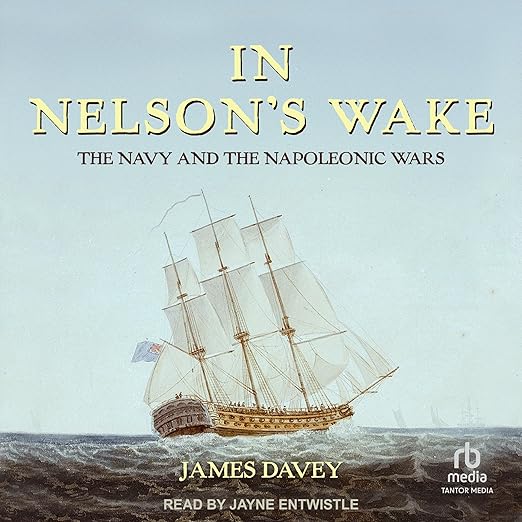
I started this one on a Sunday afternoon with no particular deadline and no other commitments, which is the only reasonable way to approach a nineteen-hour work of serious naval history. James Davey’s In Nelson’s Wake is the kind of book that assumes you are willing to follow an argument over a significant distance, and the argument it makes is worth following. The received wisdom about Trafalgar is that it ended the naval war and secured Britain’s maritime supremacy. Davey’s thesis, built from documentary evidence spanning 1803 to 1815, is that Trafalgar actually opened the next, more complex phase of the naval conflict rather than concluding it.
This is not a romantic retelling of sea battles. It is a structural history of how naval power actually functions: through blockades that lasted years, supply chains that required organizational sophistication on a scale the era could barely sustain, diplomatic and commercial warfare conducted through prize-taking and convoy protection, and the relentless work of ordinary sailors, dockyard workers, and politicians who never appear in the heroic narratives. Davey is genuinely interested in all of them, and the book’s breadth reflects that interest.
Our Take on In Nelson’s Wake
The book’s revisionist argument about Trafalgar’s significance is its most important intellectual contribution. Napoleon did not accept the battle as final. He pursued aggressive naval construction and worked to incorporate foreign navies into his strategic balance in the years following 1805. One reviewer who had spent fifty years researching Napoleon’s intervention in Iberian affairs noted surprise at discovering how actively Napoleon had pursued the naval dimension after Trafalgar, which he had not expected given the standard historiography. Davey’s archival work surfaces this complexity rather than smoothing it over.
Jayne Entwistle’s narration is exceptionally well-suited to this material. She brings a quality of scholarly precision to nearly twenty hours of dense naval and political history without losing accessibility. The names, ship designations, battles, and strategic concepts accumulate rapidly, and Entwistle’s ability to differentiate them vocally and maintain pacing momentum is a genuine achievement. She does not perform the material; she presents it with authority, which is exactly what a book this serious requires.
Why Listen to In Nelson’s Wake
For readers who have encountered Patrick O’Brian’s Master and Commander series and want to understand the actual history behind the fiction, this is the ideal companion. One reviewer who came to Davey precisely via O’Brian noted the pleasure of discovering which real events and figures had influenced the fictional accounts, including an actual British captain who served as a model for Jack Aubrey. That kind of grounding enriches both the novel and the history, and Davey’s book is written with enough narrative momentum that the dry-policy sections are offset by vivid individual portraits.
The cast of characters extends deliberately beyond admirals and captains. Davey gives sustained attention to cabin boys, dockyard workers, and civilian suppliers whose contributions shaped the war’s outcome but are typically invisible in naval history. This is one of the book’s most valuable qualities: the insistence that the Royal Navy’s performance between 1805 and 1815 was a collective achievement, not a product of individual genius alone.
What to Watch For in In Nelson’s Wake
At nearly twenty hours, the pacing is not uniform. The chapters covering food supply logistics and dockyard administration are essential to the book’s argument but are necessarily less dramatic than the operational chapters. One reviewer noted that the supply detail occasionally gets a little heavy, which is fair. Davey is a scholar first and acknowledges the full logistical picture even when it slows the narrative. Listeners who have limited interest in administrative history should be prepared for those sections.
The War of 1812 section, covering Britain’s naval conflict with the United States during this same period, is covered with somewhat less depth than the Napoleonic theater. Readers specifically interested in that conflict may find it underdeveloped relative to their expectations, though Davey provides enough coverage to integrate it into the broader strategic picture.
Who Should Listen to In Nelson’s Wake
Serious readers of Napoleonic history and maritime history will find this essential. Patrick O’Brian readers who want their fiction grounded in documented reality have an ideal companion here. Listeners with a general interest in British imperial history, naval strategy, or the mechanics of sustained early nineteenth-century conflict will find the scope rewarding. Those who want primarily battle narratives should look at more focused accounts of individual engagements; In Nelson’s Wake is interested in the war rather than any specific fight. Jayne Entwistle’s narration makes the long runtime approachable for committed listeners.
Frequently Asked Questions
Do I need extensive prior knowledge of the Napoleonic Wars to follow this book?
A basic familiarity with the period helps. Knowing who Napoleon and Nelson were, having some sense of the Peninsular War, and understanding why Trafalgar was considered significant will let you follow the argument immediately. Davey provides enough context for readers coming from adjacent interest areas, such as Patrick O’Brian fans, but he is not writing a general introduction to the Napoleonic era.
How does Jayne Entwistle handle the large volume of names, ship designations, and military terminology?
Exceptionally well. She maintains consistent identification across nearly twenty hours of material, differentiating the large cast of admirals, captains, politicians, and ordinary sailors with clarity rather than artificial characterization. Her scholarly precision keeps the dense terminology accessible without flattening the complexity of what Davey is describing. It is a genuinely strong performance for demanding material.
Is this book primarily about famous battles, or does it cover the less dramatic aspects of naval warfare?
Davey explicitly argues that the famous battle narrative misrepresents how naval power actually operated in this period. Blockades, convoy protection, prize-taking, logistics, dockyard management, and the daily work of ordinary sailors receive equal attention alongside the better-known engagements. Some reviewers found the logistical sections occasionally heavy, but they are central to the book’s revisionist argument about what the Royal Navy actually accomplished between 1805 and 1815.
How useful is this book as companion reading to Patrick O’Brian’s Master and Commander series?
Very useful. One reviewer came to Davey directly via O’Brian and found specific pleasure in discovering the real historical figures and events that influenced the fictional accounts, including an actual captain who served as a model for Jack Aubrey. Davey’s rigorous account of the real naval world gives O’Brian’s fiction a historical anchor that makes both texts richer in relation to each other.