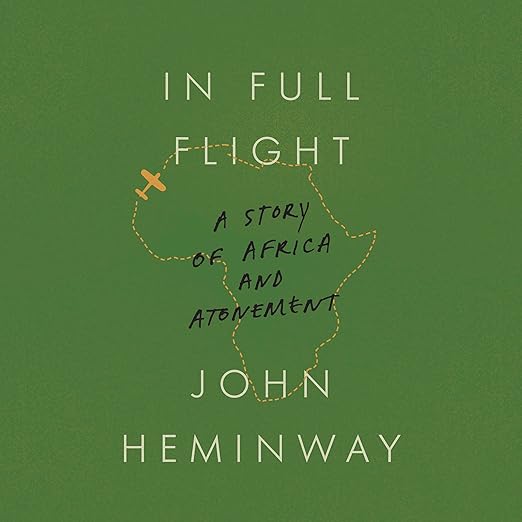
Quick Take
- Narration: John Heminway narrating his own biography brings an unusual intimacy – he was Anne Spoerry’s friend for twenty years, and that personal weight surfaces in his delivery throughout.
- Themes: Atonement and identity, moral complicity under extreme conditions, humanitarian redemption
- Mood: Quietly devastating, with the texture of a long moral reckoning
- Verdict: One of the more genuinely complicated biographical subjects in recent nonfiction audio, handled with admirable restraint by an author who knew his subject personally.
I started In Full Flight on a gray Saturday morning and finished it late that same evening, which is unusual for a ten-hour biographical listen. John Heminway’s account of Dr. Anne Spoerry has that quality of a book that does not let you set it down easily, not because the narrative is propulsive in any conventional thriller sense, but because the central moral question it poses keeps reasserting itself every time you think you have found a resting point.
The question is this: Can sustained, genuine good work in the present rewrite what a person did under duress in the past? Spoerry treated hundreds of thousands of people across rural Kenya over fifty years as a member of the Flying Doctors Service, earning the beloved nickname Mama Daktari, Mother Doctor. She was eccentric, demanding, devoted to her patients in ways that struck everyone who encountered her work as heroic. She was also, it emerged after her death, a figure who had collaborated in sinister ways with camp authorities while a prisoner at Ravensbruck, the women’s SS concentration camp, during World War II.
Our Take on In Full Flight
What distinguishes Heminway’s approach from a simpler accounting of guilt versus goodness is his refusal to adjudicate. He was Spoerry’s friend for twenty years and realized only after her death how little he had actually known her. That position of informed intimacy combined with retrospective incomprehension gives the book its particular texture. Heminway is not reconstructing a monster or rehabilitating a saint. He is trying to understand a person who contained both, and he leaves that work substantially to the reader.
The biography carries two rival threads as one reviewer puts it exactly right: Spoerry’s public life as Mama Daktari, venerated across East Africa for half a century, and her secret life in Ravensbruck, where she appears to have made decisions that benefited her personally at the expense of other prisoners. Heminway layers these threads with genuine care. The book does not reveal the darker history in a sudden disclosure designed to shock. It circles it, returns to it, lets it complicate the Mama Daktari portrait without obliterating it.
Why Listen to In Full Flight
Heminway narrating his own biography is a meaningful choice. His voice carries the weight of someone processing something he has not fully resolved, which is exactly the emotional register this material requires. A professional narrator, however skilled, would struggle to reproduce the particular quality of a man reckoning with the gap between who he thought his friend was and who she actually was. The intimacy of self-narration serves the book’s moral seriousness.
The research is extraordinary, as multiple reviewers note. Heminway does not simply draw on published sources. He has gone to Kenya, to France, to archives of the French Resistance, and into the records of Ravensbruck itself to construct a portrait that does not simplify its subject. For readers of Hannah Arendt or those who have thought seriously about moral behavior under totalitarian conditions, the Spoerry case adds a genuinely new dimension to an already complex literature.
What to Watch For in In Full Flight
The book’s structure is non-chronological, moving between Spoerry’s present in Kenya and her past in wartime Europe in a back-and-forth pattern that some reviewers find disorienting. One reader gave this four stars specifically because the structural choices interrupted what might have been a more absorbing chronological account. The non-linear approach is defensible, it mirrors the way Heminway himself pieced together knowledge about a woman who actively concealed her history, but listeners who prefer narrative momentum over thematic architecture may find it frustrating.
One reviewer also noted honestly that the pacing drags in places, that Heminway has a tendency to let scenes breathe longer than they need to. For a subject this serious and ethically complex, some of that extra breathing room feels appropriate. But it does require patience that not every listener will want to give.
Who Should Listen to In Full Flight
This is a book for readers who want biography that does not resolve tidily, who find the question of moral accountability across a lifetime genuinely interesting rather than simply troubling. Listeners who enjoyed Philip Gourevitch’s We Wish to Inform You That Tomorrow We Will Be Killed with Our Families, or who are drawn to the ethical complexity at the heart of books like The Reader, will find Heminway’s account lands in similar territory. Those looking for a straightforward humanitarian story or a clear verdict on Spoerry’s life should look elsewhere. The lack of easy answers is the book’s defining feature, and its great honesty.
Frequently Asked Questions
Does In Full Flight take a clear position on whether Anne Spoerry’s humanitarian work atones for her wartime behavior?
No, and deliberately so. Heminway explicitly leaves the moral question open. He was Spoerry’s friend for twenty years, and the book reflects genuine ambivalence rather than a prosecutorial or exculpatory argument.
Is the non-chronological structure confusing for audiobook listeners?
Some reviewers found it disorienting. The book moves between Spoerry’s life in Kenya and her wartime history in a non-linear pattern. Listeners who prefer chronological biography may find this more demanding, but the structure has a defensible thematic logic.
How does Heminway’s self-narration affect the listening experience?
It adds a layer of personal weight that a professional narrator could not replicate. Heminway was Spoerry’s friend and is genuinely reckoning with what he has learned. That emotional undercurrent is audible in his delivery and makes the ethical questions feel more alive.
Is prior knowledge of Ravensbruck or wartime France needed to follow the book?
No. Heminway provides enough historical context that listeners unfamiliar with the specific details of Ravensbruck or the French Resistance will be adequately oriented. The book prioritizes the personal story over historical exposition.