Quick Take
- Narration: Sean Runnette’s even, composed delivery suits the book’s thoughtful popular nonfiction register throughout.
- Themes: secular-religious marriage, negotiating worldview differences, raising children across belief systems
- Mood: Reassuring and measured, grounded in both personal experience and sociological research
- Verdict: The most substantive audiobook treatment of secular-religious partnerships available, genuinely useful for couples navigating this specific terrain.
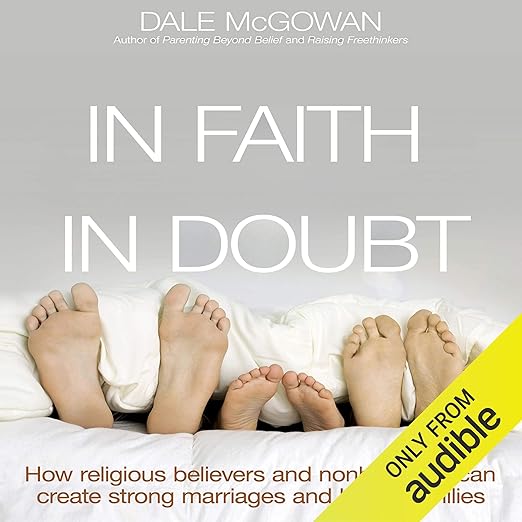
I found In Faith and in Doubt at a moment when I had been thinking about exactly the question it addresses. A close friend had recently started dating someone whose faith commitments were very different from her own, and she was asking the kinds of questions that books on interfaith marriage usually do not answer well. Most existing literature addresses two religious traditions meeting across a shared metaphysical framework. Dale McGowan’s book addresses something different: what happens when one partner has no belief at all.
McGowan is a secular humanist who has been married to a believing Christian for over twenty years and has three children. He writes from inside the experience rather than from the outside looking in, which gives the book a texture that purely sociological treatments of the subject cannot replicate. He also draws on survey data and real couples’ stories throughout, so the personal is consistently situated within a broader pattern rather than presented as exceptional or prescriptive.
Our Take on In Faith and in Doubt
The book’s organizing argument is encouraging without being falsely reassuring: secular-religious marriages do not fail at higher rates than same-faith marriages, and the factors that make them succeed or fail are the same factors that determine the success or failure of any marriage. Communication, mutual respect, negotiation of genuinely held values. McGowan unpacks those factors with considerable nuance. The negotiation tips are practical rather than theoretical, the extended family chapters address real pressure points that most couples in this situation will recognize immediately, and the sections on raising children in households with divided worldviews are among the most useful discussions of that specific challenge available in audio format.
Why Listen to In Faith and in Doubt
Sean Runnette’s narration is clear and composed throughout. The material is neither emotionally heated nor dry, sitting somewhere in the territory of thoughtful popular nonfiction, and Runnette handles that register with appropriate evenness. At just over nine hours, the book does not overstay its welcome. McGowan’s writing is readable and occasionally warm without becoming sentimental. One reviewer describes the overall effect as reassuring, and that captures what the book is trying to do. It is not making an argument for or against religious belief. It is making an argument for the possibility of durable, loving partnerships between people who see the world differently and are willing to do the work that requires.
What to Watch For in In Faith and in Doubt
One reviewer notes a significant gap: the book focuses primarily on secular-religious marriages where the religious partner is liberal or moderate. The specific challenges of a relationship where one partner holds conservative or orthodox religious views are not addressed in depth. The review mentions disagreement about birth control as one example of a tension the book does not adequately cover. That is an honest limitation worth knowing before you begin. Additionally, the book was published in 2014, which means some of the cultural and legal landscape it describes has shifted considerably since publication, particularly around how religious identity intersects with political identity.
Who Should Listen to In Faith and in Doubt
Anyone in or considering a secular-religious partnership will find this directly useful. The book is also valuable for parents of adult children navigating these relationships, and for counselors or clergy working with mixed-belief couples. It is not a book for people looking for arguments against religious belief, or for people looking for religious justifications of mixed marriages. McGowan’s humanist perspective is present throughout without being polemical. Listeners who want a frank, data-grounded, warmly human account of how these relationships actually work will find everything they came for here.
McGowan’s chapters on what he calls meeting the believers and meeting the nonbelievers are particularly valuable because they resist the impulse to caricature either group. The survey data he draws on shows how few people actually match their stated religious identity with their beliefs about specific doctrines, which means the categories of believer and nonbeliever are considerably more fluid in practice than they appear on paper. That nuance is exactly what couples in these partnerships need, and it is what most of the available literature on the subject fails to provide.
Frequently Asked Questions
Does In Faith and in Doubt address marriages where one partner holds very conservative religious beliefs?
Not extensively. One reviewer notes this as a gap. The book focuses primarily on scenarios where the religious partner is moderate or liberal. Couples where orthodoxy is central to one partner’s faith may find the advice less applicable.
Is Dale McGowan’s secular humanist perspective a problem for religious readers of this book?
McGowan is transparent about his perspective without being polemical. Religious readers who are open to hearing a humanist’s account of a loving mixed marriage should find the book accessible. Those looking for a religiously framed treatment should seek other resources.
Does In Faith and in Doubt offer specific practical advice or is it mainly research and personal stories?
Both. The book includes concrete negotiation strategies, frameworks for discussing differences with extended family, and specific guidance on holidays, children’s religious education, and lifecycle events like baptism and circumcision.
How does the book address the question of raising children in a household with different religious beliefs?
McGowan devotes significant attention to this, including how to help children develop their own beliefs rather than adopting one parent’s view by default, and how to handle religious literacy, observance, and identity questions as children grow.