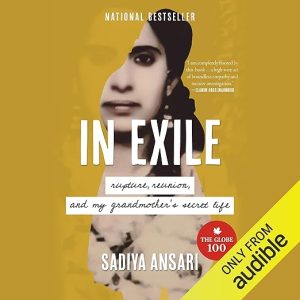
Karachi to a village in Punjab is the distance one woman covered to follow a man, leaving seven children behind her, and the century around that decision is what Sadiya Ansari spends this audiobook trying to recover. In Exile runs four hours and fifty-nine minutes, which is brief for a book that crosses three continents and a hundred years. The compression turns out to be the point. This is journalism doing the work of memoir, and it moves at the pace of an investigation rather than a reminiscence.
A Life That Was Neither Wife nor Mother
Sadiya Ansari is a journalist by trade and the book never pretends otherwise: it is built as an inquiry, with sources, gaps, and honest admissions about what could not be established. The question she starts from is simple and close to unanswerable. Why did her grandmother Tahira abandon seven children to follow a man, and who was she across the nearly two decades she then spent estranged from them? The second half of that question is the one this book actually pursues.
Tahira is not rendered as a victim or as a scandal, which is the hardest thing to pull off in a family history and most of the reason this one works. She becomes a person with a stretch of unaccounted-for years, and Ansari refuses to fill them with sentiment or with invention. What emerges instead is a portrait assembled from what the record permits: a life that was neither wife nor mother for two decades, and a granddaughter working out what such a life could possibly have contained.
Partition arrives as context and then takes over as subject. The book connects one household's rupture to the displacement of millions of families, and to the plain fact that the national freedoms won in 1947 did not extend into women's lives. That is a large claim to carry inside a personal book, and Ansari earns it by keeping the scale small: child marriage, a village, a household, and a set of choices narrowed until only one of them remained available.
Listening Makes the Personal Stake Harder to Skim
Memoir and reportage usually pull against each other, and the friction here is productive rather than awkward. Ansari is inside the story, uninterested in marriage and children herself, and she says so plainly, which turns a historical question into a live one: what space is available to women who defy cultural expectations, then and now? Hearing that asked in a sustained voice rather than caught in glances on a page is genuinely different. Audio makes the personal stake much harder to skim past.
Punjab, Karachi and the three continents this inquiry crosses supply the geography, and Ansari moves between them without the throat-clearing that usually accompanies transitions on that scale. Under five hours means no stretch outstays its use. It also means the historical passages have to be efficient, and they are: each one arrives attached to a person rather than to a period, which is the whole difference between history you follow and history you endure.
Journalism is the discipline holding all of it together. Ansari builds the case for what Tahira's life must have been rather than asserting it, and she marks the line between the two clearly enough that a listener always knows which side of it a given sentence sits on. That habit is rare in family memoir, where the temptation to novelize is enormous, and it is precisely why the emotional passages carry the weight they do when they finally arrive.
Every Response Predates This Very Recording
Chronology on this listing deserves a sentence of its own. Every written response on the page was posted before this recording existed, and the newest of them predates the release date by more than a year. That does not make them dishonest and it does not make the book worse. It does mean the star average is measuring reactions to a printed edition, and that it can tell you nothing whatsoever about the reading credited here.
Restraint Here Is Not the Same as Distance
Every buyer should also know what the book asks of them emotionally. A Canadian entry offers a word of caution before recommending it: pain runs across these pages, and the kind that spans generations does not resolve neatly at the end of a chapter. That reading is accurate. Child marriage, abandonment and the machinery of Partition are handled with restraint here, and restraint is not at all the same thing as distance.
PDF accompanies the audio, and the listing says so explicitly rather than leaving you to discover it afterward. What the supplement contains is described nowhere, so treat it as an unknown quantity that at least exists. For a book assembled out of an inquiry into records and dates, having a supplement open from the start is worth the small effort, because hitting a reference to something visual with nothing to look at is the standard frustration of nonfiction audio.
Mathan Voices an Inquiry Somebody Else Wrote
Readers who came to family history through diaspora memoir will recognize the shape and find this one sharper than most, because the journalism underneath is real rather than gestural. It rewards anyone interested in South Asian history seen from below: Partition told through a single household, and independence measured by what it conspicuously failed to change. It also rewards listeners who like being told exactly how much the author was unable to establish.
Anyone hoping for a straightforward biography of a grandmother will find something more restless and more argumentative than that. Hold off if you want a warm reminiscence, and hold off if you are not in the frame of mind for child marriage, abandonment and refugee displacement handled seriously rather than softened. The book is generous without being comforting, and it never fully resolves the question it opens with, because the surviving record does not allow it to.
Measured against the memoir shelf, this sits at the upper end for craft and the shorter end for length, and both of those work in its favor. Sneha Mathan voices an inquiry written by somebody else, which is the standard arrangement for a journalist's memoir and the one place a sample earns your ninety seconds: the book alternates between reported history and a first-person question, and the seam between those two registers is where a reading either holds or slips. Come for the family secret and stay for the century it opens onto.
Common Questions
Does the audiobook come with the PDF the listing mentions?
Yes. The copy states that when you buy the title, an accompanying PDF arrives in your library alongside the audio. What the supplement contains is not described anywhere on the page, so plan to open it at the start rather than discovering a reference to something visual partway through the recording.
How long is In Exile, and who narrates it?
Sneha Mathan reads it, at four hours and fifty-nine minutes, published under the Audible Studios imprint in February 2026. That is compact for a book crossing three continents and a century, and the brevity is deliberate: the structure here is an investigation rather than a chronological life story told end to end.
Why are the reviews older than the audiobook release date?
Because the column predates this edition. Every written response on the page went up more than a year before the recording was published, so each one answers the book in print rather than the reading. Treat the star average as a verdict on the text, and look elsewhere for anything at all about the performance.