
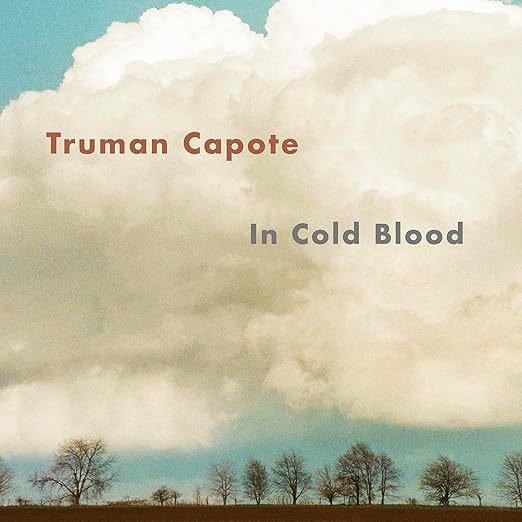
- Read by: A single reader holds Capote's long, clause-heavy sentences across fourteen hours and twenty-seven minutes, with Scott Brick the only credited voice.
- At its heart: True crime as literature, American violence, the nonfiction novel argument, small-town Kansas.
- Vibe: Patient, atmospheric, quietly bleak.
- Short version: The foundational true crime book, and its prose gains from being spoken, so long as you can give it uninterrupted attention.
Two long sentences of Kansas landscape sit inside the earliest write-up on this page, quoted in full by someone trying to explain why the book became a classic. Flat land, awesomely extensive views, grain elevators rising as gracefully as Greek temples; then a man walking toward the trees under a big sky, past the whisper of wind voices in the wind-bent wheat. Those cadences are the whole argument for hearing this audiobook rather than reading it. Truman Capote built his account of the Clutter murders out of sentences that reward being spoken, and the recording gives Scott Brick fourteen hours and twenty-seven minutes of them.
The Definitions Cancel Each Other
November 2012 produced the column's most interesting write-up, and it amounts to a lexicographical argument. Four stars, from someone arriving suspicious of the claim that Capote had created a new type of book. So both halves of the label get looked up: nonfiction, prose writing based on facts, real events and real people; novel, a fictitious prose narrative of book length. Set side by side, the definitions cancel each other, which is the same tension the description leans on when it calls this the most famous true crime novel of all time and, two paragraphs later, one of the first non-fiction novels ever written.
That unresolved category is not a flaw to be excused. It is the reason the book still generates argument. Capote reconstructs a November 1959 shotgun killing of four members of the Clutter family in Holcomb, Kansas, an investigation with almost no clues and no apparent motive, and a capture, trial and execution, and he does all of it with the interiority of fiction. Listening rather than reading sharpens the discomfort, because a voice speaking a dead person's thoughts sounds like testimony in a way printed text can hold at arm's length.
Mesmerizing Suspense and Astonishing Empathy
May 2025 delivered the most sensory account on the page, from a reader who could smell the wheat fields and describes Capote painting Holcomb's wide-open plains and cozy homes with such vividness that the family's warm routines and the killers' twisted paths sit inside the same frame. That doubling is the machinery of the book. An ordinary Kansas evening and the drive that ends it are given equal attention and equal prose, and the effect across a long listen is cumulative rather than shocking. You are not waiting for a reveal. The description states within its opening paragraphs that four people are dead, and that the killers were caught, tried and executed.
What the runtime buys is that accumulation. Fourteen hours and twenty-seven minutes is a lot of Kansas, and the book spends them all: land, weather, routines, an itinerary, a motive that never arrives. The New York Review of Books line quoted in the copy, that the book chills the blood and exercises the intelligence, gets the sequence right. The chill is atmospheric and slow. The intelligence is what Capote asks of you afterward, once the description's phrase about poignant insights into the nature of American violence stops sounding like a jacket claim and starts sounding like a summary.
Description copy also names the pairing that makes the book strange: mesmerizing suspense and astonishing empathy, generated at the same time. Suspense is easy to see in a reconstruction that states its outcome up front, because the tension migrates from what happened to how close you will be allowed to stand. Empathy is the harder half, and it is why the book was contentious on arrival and is argued over still. Capote extends the same quality of attention to the two men who did the killing as he extends to the family in the house, and a recording makes that even-handedness harder to sidestep than a page does. Skimming past the passages that humanize them stops being an option. One voice holds you at the same distance for the same duration, and that steadiness is the closest thing this listen has to an argument.
Punishes Half-Listening Across Fourteen Hours
January 2026 supplies the honest caveat, filed from France in two clauses: yes, it is a bit long winded, but the story and the people are so compelling. Both halves are true and the first is the one to plan around. Capote's method is exhaustive by design, and exhaustiveness at this length can stall. If you need forward motion every twenty minutes, the middle stretch, where the investigation goes cold and the prose stays patient, is where you will feel the drag most.
Demands on the listener are the second thing to watch. Capote's sentences run long and hold their subordinate clauses open, which is a real ask at speaking speed, because nobody can glance back to find where a clause began. A single Capote sentence can carry three separate movements before it closes, and each has to be held in memory until the last one lands. Multiplied across a fourteen-hour recording, that syntax rewards attention and punishes half-listening, which is the strongest practical reason to keep this out of a noisy room.
Subject matter is the third, and it should be stated plainly. Four members of one family were killed at close range with a shotgun, and the book goes into the crime scene, the trial and the execution without turning away. December 2025 filed a write-up from Australia calling this the original true crime story, from before the genre was really invented, and that is fair, though it also means the genre's later conventions of restraint had not been invented either.
Undivided Attention for Real Stretches
Read true crime for structure and prose rather than for the puzzle and this is the source text, which holds up. Listeners drawn to the long, patient American nonfiction tradition, who want a portrait of a place as much as an account of a crime, and who can give a recording undivided attention for real stretches, will get the most from it. So will anyone curious about the argument over what counts as reportage, because the book is that argument in practice.
Give it a miss if you want a whodunnit, since the description hands you the outcome before it has finished setting the scene. Skip it too if killings inside a family home are something you avoid, or if your listening happens in fragments between other tasks. The prose does not survive interruption well, and the payoff of these particular fourteen hours lives entirely in accumulation. Anyone in either camp is better served by something shorter and faster.







