Quick Take
- Narration: Stefan Rudnicki brings the gravity this material demands, deep-voiced and deliberate, he never lets the horror become sensational.
- Themes: Holocaust forensics, civilian complicity, the mechanics of genocide
- Mood: Haunting and methodical, difficult in all the right ways
- Verdict: Essential Holocaust history for anyone who wants to understand how mass murder was organized and enabled at the community level.
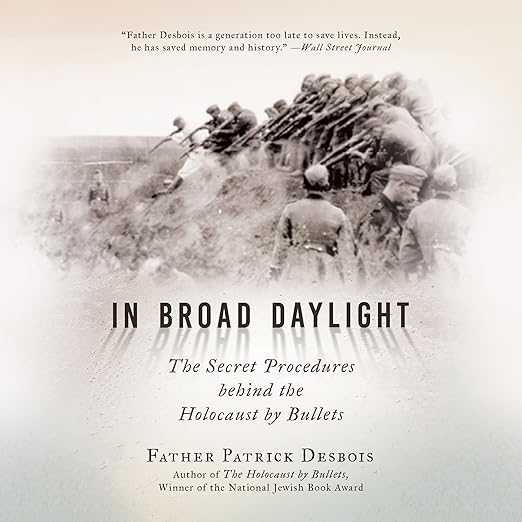
I had read Father Patrick Desbois’s earlier work, The Holocaust by Bullets, some years ago and found it unlike anything else in the Holocaust literature I’d encountered, not because of the horror, which is documented extensively elsewhere, but because of the method. Desbois works like a forensic investigator, not a memoirist or a historian in the traditional sense. In Broad Daylight is the follow-up to that earlier work, and it is, if anything, more methodically unsettling.
The book builds on nearly a decade of additional research conducted after The Holocaust by Bullets, incorporating interviews with 5,000 witnesses, not survivors, but neighbors. The people who watched, helped, cooked for the killers, dug graves, or stood at the edge of fields while their Jewish neighbors were marched into them. This is the central and deeply uncomfortable subject of In Broad Daylight: not the perpetrators as an abstract evil, but the operational infrastructure of local complicity that made the Eastern Front massacres possible village by village across seven countries. Desbois has spent his career making the invisible visible, and this book is his most comprehensive attempt at that project.
The Repeatable Script of Mass Murder
The phrase that stays with you from this book is Desbois’s description of a repeatable script, a timetable and method that the Nazi killing squads applied across hundreds of villages with the efficiency of a logistical operation. The book traces this template in forensic detail: the selection of a date, the requisitioning of local residents for specific tasks, the twenty-four-hour period in which an entire Jewish community would be murdered, and the clean-up that followed. Reviewer Eric noted that Desbois reviews events from before a massacre to the aftermath, slow and methodical, and that you live the horror of how it was perpetrated in each location. That is an accurate description of both the method and its effect on the reader.
This is not comfortable historical reading, and it is not meant to be. The discomfort is purposeful: Desbois is systematically dismantling the collective amnesia that communities in these regions have cultivated for decades. The witnesses he interviews are elderly farmers, former neighbors, people who were children during the war. They remember. The detail of their memories, which Desbois presents in lucid, crime-report prose, makes the persistent non-acknowledgment of what happened in these villages even more striking. These were not secret events. They happened in broad daylight, which is the book’s title and its thesis.
What Stefan Rudnicki Brings to the Material
Stefan Rudnicki is one of the most experienced narrators working in serious nonfiction audiobooks, and his performance here is among his best. His voice is naturally authoritative and carries a gravity that matches Desbois’s subject without amplifying it into melodrama. The forensic, report-like quality of the prose requires a narrator who can convey horror through precision rather than emotional inflation, and Rudnicki does that consistently across eight and a half hours. Reviewer JLCarcioppolo described this as demolishing the idea of collective ignorance with detailed evidence from hundreds of interviews, and hearing that evidence delivered in Rudnicki’s measured voice gives it a documentary weight that a more theatrically performed narration would undermine.
The length is appropriate. At eight hours and thirty-nine minutes, Desbois is covering seven countries, hundreds of villages, and 5,000 interviews’ worth of testimony. The material requires that space, and Rudnicki’s pacing ensures it never feels padded. For listeners accustomed to faster nonfiction, the deliberate rhythm may initially feel slow, but it reflects the seriousness of what is being documented. This is testimony, not argument, and the audiobook format honors that distinction.
Why This Belongs in the Holocaust Canon
There is a substantial body of Holocaust literature, and several reviewers acknowledged having read widely in the field before encountering Desbois’s work. What distinguishes In Broad Daylight is not scope but granularity. Desbois is showing you exactly how it happened in a specific village on a specific day, then showing you that this pattern replicated itself across seven countries. The connection to contemporary genocides, including ISIS’s adoption of similar operational logic, is made explicitly at the book’s end and is not rhetorical: it is a direct argument that understanding the mechanics matters because the mechanics recur.
Reviewer Aggieland Deb read this as a sequel to The Holocaust by Bullets and found herself compelled to continue even given the difficulty of the subject, precisely because Desbois’s work preserves testimony that would otherwise disappear as witnesses age and die. That preservation argument is the book’s moral engine. The five thousand people Desbois interviewed over nearly a decade are aging. Their memories, once gone, are gone. This audiobook is a record of what they knew and what they chose to say when someone finally came to ask.
For the Committed Listener
This audiobook is for listeners who approach Holocaust history seriously and want to understand not just what happened, but how it was organized and what made it possible at the community level. It is not an introductory text, the material assumes some familiarity with the broader history of World War II and the Eastern Front. Those who prefer narrative-driven history to forensic analysis may find the methodical pace challenging, though Desbois’s prose is never dry. Reviewer Don Gardner described the writing as tastefully thought-provoking and earnestly seeking truth, which is a phrase that captures the tone precisely. For anyone committed to understanding genocide as a human phenomenon rather than an historical abstraction, this is among the most important audiobooks available on the subject.
Frequently Asked Questions
Should In Broad Daylight be read before or after The Holocaust by Bullets?
The Holocaust by Bullets came first and introduced Desbois’s methodology and the broader finding of 1.5 million Jewish victims murdered outside concentration camps. In Broad Daylight deepens and extends that work. Reading the first book first gives you important context, though In Broad Daylight does introduce its own findings with enough background to stand alone.
How does Stefan Rudnicki’s narration handle the most graphic material in the book?
Rudnicki takes a forensic approach that matches Desbois’s prose, measured, precise, and without dramatization. The horror of the material is conveyed through specificity rather than emotional performance, which makes it, paradoxically, more affecting than a more theatrical reading might be.
Does the book address why local civilian populations participated in the killings?
Yes, extensively. Desbois explores complicity through economic incentives, community pressure, fear, and the Nazi practice of embedding locals in specific roles that created both participation and witness. The book’s most disturbing contribution is precisely its granular account of why ordinary people cooperated.
Is In Broad Daylight available as a free audiobook on Audible?
Yes, this free audiobook is available to Audible members through their subscription. Check current availability on the Audible listing, as catalog access can change.