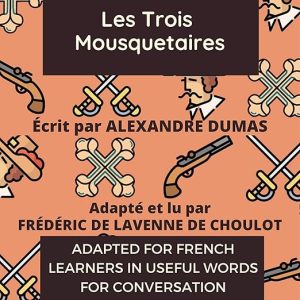
![Improve Your French by Reading: Les Trois Mousquetaires [The Three Musketeers]](https://audiobookdaily.com/wp-content/uploads/2026/03/improve-your-french-by-reading-les-trois-mousquetaires-the-three-musketeers.jpg)
French learners working through Improve Your French by Reading: Les Trois Mousquetaires [The Three Musketeers] audiobook will recognize something in the first few minutes of narration: Frédéric de Lavenne de Choulot reads the way a good teacher speaks, with measured pacing that communicates confidence in the material and patience with the learner. He adapted this Dumas text himself and narrates it himself, which means the audiobook carries a clarity of pedagogical intent throughout its 2 hours and 19 minutes. This is a language learning tool that has done serious thinking about how intermediate learners actually acquire vocabulary from connected narrative.
Calibrated Just Above Your Comfort Level
De Lavenne de Choulot's pedagogical argument is worth taking seriously: trying to learn French through unmodified classical literature is roughly equivalent to learning English through Shakespeare, and the resulting experience is more alienating than illuminating. His adaptation strips away the archaic vocabulary and complex literary syntax of Dumas's original while preserving the story's essential movement: D'Artagnan's arrival in Paris, his encounters with Athos, Porthos, and Aramis, the central conflict with Cardinal Richelieu and the villainous Milady. The resulting French is, by the author's own description, in the intermediate range, accessible to listeners who rate themselves around a 6 out of 10 in French comprehension, genuinely challenging to those below that threshold, and somewhat easy for advanced speakers who are not the intended audience.
One reviewer describes the language level as sitting in the right range: understandable but instructive, which is precisely the zone where language acquisition happens most efficiently. The distinction between comprehensible input and challenging input is well-established in language learning research, and this series applies that principle through narrative rather than through exercises. The audiobook does not ask listeners to memorize vocabulary lists or complete grammar drills; it asks them to follow a story told in French that is calibrated to sit just above their current comfort level, which is where genuine acquisition happens most effectively.
Full French Immersion, No English Safety Net
This is entirely in French, which is stated clearly in the audiobook's description but worth repeating as a practical consideration. English-speaking listeners who want a French lesson with English scaffolding should know that this audiobook provides no translations or explanatory commentary in English. It is an immersion product aimed at learners who are ready for sustained French-only listening. The speed adjustment note in the synopsis is relevant: listeners can slow the playback to match their comprehension level, and de Lavenne de Choulot designs for this; his narration pacing is measured enough that slightly slower playback still sounds natural rather than distorted.
De Choulot's Enthusiasm Is Genuinely Audible
Self-narration here is a genuine asset rather than merely an economical choice. De Lavenne de Choulot's French pronunciation is natural and educated without the exaggerated formality that can make language-learning audio feel sterile. He reads with the engagement of someone who finds the story genuinely worthwhile, and that quality, enthusiasm for the material rather than patient endurance of it, is audible. Reviewers who have used both this and the Les Misérables installment in the same series describe the narration style as consistent and reliable, building a trust in the production across the catalog that makes the series worth pursuing beyond this single title.
The audiobook's short runtime is a deliberate design choice rather than a limitation. De Lavenne de Choulot is not trying to deliver a complete abridged Dumas; he is trying to deliver a maximally useful French learning session in a format that fits into the realities of language study. Two hours and nineteen minutes is a format that supports the spaced repetition principle: listeners who replay the audiobook multiple times over weeks of study will find the vocabulary accumulating naturally rather than requiring explicit memorization exercises. The adaptation's focus on conversational rather than literary vocabulary means the French encountered here has immediate practical application beyond the narrative itself.
Modern Tenses Replace Archaic Literary French
Notice how de Lavenne de Choulot handles the verb tense patterns specifically. The adaptation privileges the tenses most useful in modern spoken and written French, which means that certain literary tenses common in classical Dumas, the passé simple in particular, are replaced or supplemented with forms that a contemporary French speaker would actually use. This is the pedagogical intervention that distinguishes this series from simple abridgments, and it operates most noticeably in the narrative passages rather than the dialogue. Learners who have struggled with the gap between literary French studied in school and conversational French encountered in real life will find this intervention directly addresses that gap.
The note about buying the print transcription to follow along is worth acting on if your French reading and listening comprehension are at different levels, which is common for self-taught learners. Following the text while listening accelerates the decoding of unfamiliar vocabulary, and the printed version confirms spellings that listening alone might leave ambiguous. The audiobook and the print edition are designed to work together, and using both doubles the sensory input per study session. For learners committed to the series, the combined approach is significantly more effective than audio alone.
B1 to B2 Learners Get the Right Challenge
Intermediate French learners who rate their own comprehension in the B1 to B2 range will find this audiobook hitting exactly the right level of productive challenge. Students who are motivated by authentic narrative rather than exercises and drills will find the Three Musketeers story a more effective engagement vehicle than purpose-built language content. Skip this if your French is genuinely advanced; the vocabulary and grammar are simplified below the level that would provide challenge for fluent speakers. Also skip this if you need English support or translation alongside the French; this is a full-immersion audio product. Prior familiarity with the Three Musketeers story in translation is not required but adds the pleasure of recognition to the learning experience.
At a Glance
- Narration: Frédéric de Lavenne de Choulot self-narrates his own adaptation, providing authentic French pronunciation and the pedagogical pacing of an experienced language instructor.
- Themes: Intermediate French acquisition through literature, conversational vocabulary in narrative context, language learning through enjoyment
- Mood: Encouraging and intellectually engaging, with the pleasure of a beloved story as motivating context
- Verdict: A well-designed language learning audiobook that threads a genuinely useful pedagogical principle through one of French literature's most entertaining narratives.
Questions Listeners Ask
Is this audiobook entirely in French, and is there any English explanation included?
Yes, the audiobook is entirely in French with no English translation or explanatory commentary. It is designed for intermediate learners ready for sustained French-only listening. The synopsis states this explicitly. Beginners or those needing English support should look for a different format.
What French proficiency level does this audiobook require to benefit from it?
The author targets roughly intermediate learners who might rate themselves around a 6 out of 10 in French comprehension. Reviewers describe the language level as achievable for B1 to B2 learners. Below that threshold the audiobook will be frustrating rather than instructive; above it the material may feel too easy.