His Insistence on Institutional Detail Over Spectacle
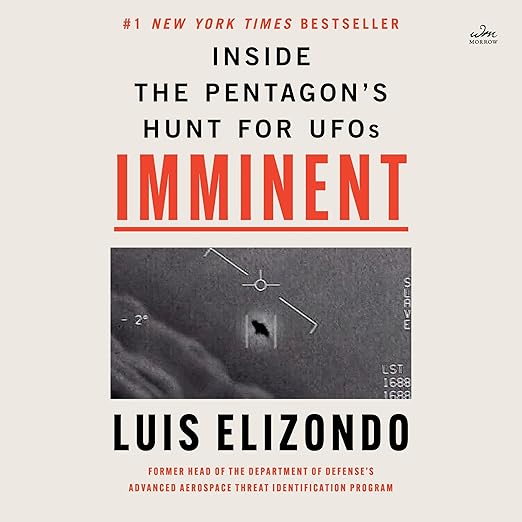
Luis Elizondo's central question is simple: did the Pentagon know more about unidentified aerial phenomena than it ever admitted publicly, and did Elizondo's own program get quietly buried once it started finding answers officials didn't want? Imminent is his first-person case for yes, told by the former head of the Advanced Aerospace Threat Identification Program, the classified initiative tasked with investigating UAP incursions into sensitive military airspace. At ten hours, this audiobook moves through Elizondo's career in intelligence work before narrowing to the specific incidents, briefings, and bureaucratic resistance that shaped his time running the program.
What separates Imminent from a lot of UFO-adjacent media is Elizondo's insistence on institutional detail over spectacle. He spends real time explaining chains of command, classification levels, and the specific mechanics of how a program like his gets funded, defended, and eventually sidelined, grounding the more extraordinary claims in a bureaucratic texture that reads as credible even when the underlying phenomena remain unresolved. Whether that grounding fully answers the skeptical listener's questions is a separate matter, but it does make Imminent feel closer to an insider memoir than a sensationalized exposé.
The broader disclosure conversation Elizondo helped ignite has only grown since AATIP became public in 2017. Congressional hearings on unidentified anomalous phenomena have since become a recurring, if still contentious, part of the national conversation, and Imminent positions itself as testimony from one of the people whose reporting helped push the issue from tabloid territory into formal government inquiry. Whether or not a listener finds the underlying phenomena convincing, that shift in how seriously the subject is treated institutionally is itself a notable part of the story.
A Ghostwriter That Strengthens the Audiobook, Says Ross
Elizondo narrates his own material, and the choice serves the book well. His delivery is flat and controlled in the way of someone used to briefing skeptical superiors rather than performing for an audience, and that register lends the more startling claims a credibility that a professional voice actor reading the same words probably couldn't replicate. One reviewer, Bruce C. Ross, points out that the prose reads as though it was heavily shaped by a ghostwriter, and argues that this actually strengthens the audiobook, since the plainspoken quality feels closer to Elizondo's real voice than a polished, professionally smoothed manuscript would.
Elizondo also spends meaningful time on his career before AATIP, including counterintelligence work that shaped how he approached the UAP assignment once it came. That background matters for how the book reads: this isn't someone encountering the paranormal for the first time and reacting with wonder, but a trained intelligence officer applying the same skeptical, evidence-first habits he used throughout his career to a subject that kept resisting easy explanation. The result is a memoir that spends as much time on institutional process as it does on anything airborne, which some listeners will find reassuringly rigorous and others may find slower than the premise promises.
The book also comes with a supplemental enhancement PDF, useful for listeners who want to cross-reference the documents and timelines Elizondo describes rather than trying to hold every acronym and date in memory. For anyone who followed the New York Times story that first brought AATIP into public view, Imminent offers the fuller account from the person who was there, connecting the dots between what became public and what Elizondo says was left out.
A Government-Disclosure Memoir Filed as Military and War
This audiobook is filed under military and war categories in some listings, but that tag undersells what it actually is: a government-disclosure memoir about a highly specific and still-contested area of defense policy, not a combat narrative. Listeners expecting a war story in the traditional sense should recalibrate before pressing play. The material is about bureaucratic secrecy and institutional friction as much as it is about anything in the sky.
It's also worth being clear-eyed about verifiability. Elizondo makes claims that rely heavily on his own testimony and on classified material that listeners can't independently check, and the book is, by its nature, one man's account of contested institutional history. That doesn't make it worthless, but it does mean Imminent works best as a starting point for further reading rather than a final word, especially for listeners who want corroboration before drawing conclusions.
Listeners who've followed other testimony-driven accounts of government secrecy, from whistleblower memoirs to congressional-hearing coverage, will recognize the genre conventions here: careful hedging around what can and can't be confirmed, frustration with classification systems, and an underlying argument that the public deserves more than it's been given. Imminent fits comfortably in that tradition rather than standing apart from it, for better or worse depending on how persuasive a listener already finds that genre.
Skeptics Finish With the Same Questions, in His Voice
Listeners already following the UAP disclosure conversation, whether from a place of genuine belief or open curiosity, are the clearest audience here, and Imminent gives them a firsthand account from one of the few people who held real institutional authority inside the relevant program. Fans of government-accountability narratives more broadly will also find plenty to engage with, even setting aside the specific subject matter.
Committed skeptics looking for hard proof will likely finish this audiobook with the same questions they started with, since Elizondo is candid that full disclosure remains blocked by classification rather than delivered here in full. But as a portrait of what it's like to work inside one of the government's most closely guarded and strange corners, Imminent succeeds, and Elizondo's own voice is a meaningful part of why.
Does Luis Elizondo narrate the Imminent audiobook himself?
Yes, Elizondo narrates his own material, giving the more startling claims a firsthand, unpolished credibility that a professional voice actor likely couldn't replicate.
Does this audiobook prove UFOs are real?
No. Imminent presents Elizondo's testimony and institutional account of investigating UAP incidents, but the underlying claims rely heavily on classified material listeners can't independently verify, so it functions more as a starting point than definitive proof.