At a Glance
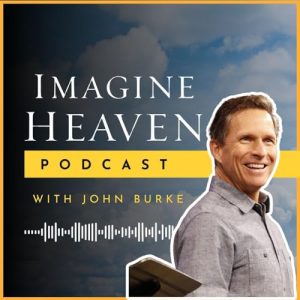
- Performance: Seth Andrews hosts this podcast-format audiobook with composed, interview-ready delivery suited to near-death experience accounts and theological framing.
- What it covers: Near-death experience, faith and science, the afterlife question
- Feel: Thoughtful and quietly compelling, with an explicit evangelical Christian framework throughout
- Our call: John Burke's Imagine Heaven podcast delivers NDE accounts examined through a biblical lens in a short, accessible format suited to listeners already within or genuinely curious about its faith perspective.
John Burke wrote the New York Times bestselling book Imagine Heaven, which has sold over a million copies and made him one of the better-known voices in the intersection of near-death experience research and Christian theology. This audiobook is the podcast companion to that work, hosted by Seth Andrews, in which Burke explores the central question of the book through real-life NDE stories and examines how those accounts align with the biblical description of heaven. The listed runtime is one hour and twenty-six minutes, which reflects the episodic podcast origin rather than a full-length audiobook treatment of the book's complete argument.
Burke's approach to near-death experiences is structured around alignment rather than open investigation. He begins from the position that the biblical description of heaven is accurate and then examines NDE accounts for points of correspondence with that description. This is a different intellectual stance from the clinical or phenomenological approach that secular NDE researchers take, and listeners should be clear about that distinction before engaging. The Gallup poll statistic Burke cites, that one in twenty-five Americans has had a near-death experience, is a real data point from published research, and the experiential accounts themselves are often genuinely affecting regardless of how one frames their metaphysical significance.
Andrews as host brings a steady, interview-ready composure to the material. His delivery does not over-dramatize the NDE accounts, which is the correct instinct; the accounts carry their own weight when presented plainly, and adding emotional amplification would undercut the sense of authenticity Burke is relying on throughout. The podcast format means each episode focuses on a specific account or question, which makes the listening experience modular in a way that suits the subject matter well. Burke is a practiced communicator, and the combination of real experiential testimony with his theological commentary produces a series that moves between the empirical and the interpretive without losing its thread.
For listeners who are already within a Christian framework or are sympathetically curious about it, the series offers a genuinely interesting examination of a phenomenon that straddles the medical, psychological, and spiritual. Burke engages with the intersection of faith and science seriously rather than dismissively, and he acknowledges that the NDE literature is broad enough to include accounts from people of many or no religious backgrounds. His argument is that Christian scripture provides the most coherent framework for interpreting what those accounts describe, and he makes that argument with care rather than with the kind of aggressive apologetics that would close the inquiry rather than open it.
The Best Parts of Imagine Heaven
The short runtime per episode also makes this an accessible entry point for listeners who want to understand Burke's argument before committing to the full-length book. If the podcast resonates, the book expands the evidence base and the theological analysis considerably beyond what this collection covers. Andrews' consistent, professional narration ensures that the listening experience is smooth across episodes, and the production quality reflects a well-resourced podcast operation rather than a low-budget audio capture. The episodic structure suits intermittent listening, and the self-contained nature of each NDE account means listeners can engage with individual episodes without needing to remember the full sequence of what came before.
Burke's willingness to engage with questions that science and faith both find difficult, what the NDE literature actually shows, where it supports and where it complicates conventional theological accounts, gives the series an intellectual honesty that distinguishes it from purely devotional content. He is not simply assembling confirmation for a position he already holds; he is examining accounts that sometimes raise questions alongside those that provide answers, and that balance is part of what makes the series credible to listeners approaching it with genuine curiosity rather than pre-formed conviction.
Weak Spots in Imagine Heaven
The evangelical Christian framing is sustained and overt throughout every episode. Burke is a pastor as well as an author, and his perspective on what NDE accounts mean is explicitly theological in a specific denominational register. Listeners who approach near-death experiences from a secular, clinical, or differently spiritual perspective will find the interpretive framework at consistent odds with their own, and that gap will affect how much of the content lands as illuminating rather than presumptive. The series is not pretending to neutrality, which is an honest approach, but it does mean the audience that will find full value here is more specific than the broad NDE-curious public.
The one-hour-and-twenty-six-minute runtime for this listing reflects a podcast collection rather than a complete audio treatment of the book's full argument. Listeners expecting the depth and breadth of the full Imagine Heaven book in audio form will need to seek a separate production of the complete text. This title is the right choice for episodic, accessible engagement with the core ideas in a format that fits into shorter listening windows.
The Right Listener for Imagine Heaven
This audiobook is most rewarding for listeners already engaged with questions of faith, afterlife, and what experiential accounts of near-death can illuminate about those questions. It will particularly suit listeners who find Burke's Christian framework credible or worth taking seriously as an interpretive lens, and who want that framework applied to the specific NDE literature rather than to scripture in isolation. Secular listeners interested in the NDE phenomenon from a psychological or neuroscientific angle will find the theological framing persistent and total enough to shape every segment, and should seek the broader NDE literature for a less faith-directed treatment of the same accounts.
Is the Imagine Heaven audiobook the full John Burke book or a podcast companion?
This audiobook is the podcast companion series to Burke's bestselling book rather than a full audio production of the book itself. It explores the same themes through individual NDE accounts and Burke's commentary, but the depth of the complete book's argument is not replicated in this shorter format.
Does this audiobook take a religious or a scientific approach to near-death experiences?
Burke's approach is explicitly theological, grounded in evangelical Christian belief and the view that the biblical description of heaven provides the most coherent framework for understanding NDE accounts. He engages with scientific and clinical NDE research but interprets it through that faith lens consistently throughout each episode.
How is the Imagine Heaven audiobook organized and how long is the total runtime?
The runtime is one hour and twenty-six minutes, organized in podcast episode format where each segment focuses on a specific NDE account or question rather than building a continuous linear argument. The modular structure suits short listening sessions and allows entry at different points.
Is Seth Andrews' narration effective for the kind of content in this audiobook?
Andrews delivers a composed, professional performance that suits both the interview sections and Burke's theological commentary. He does not over-dramatize the NDE accounts, which is the correct approach for material meant to feel credible and grounded rather than sensationalized for emotional effect.