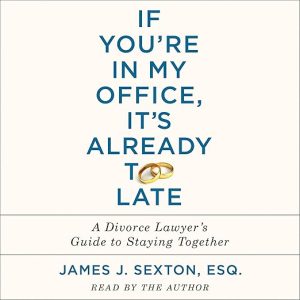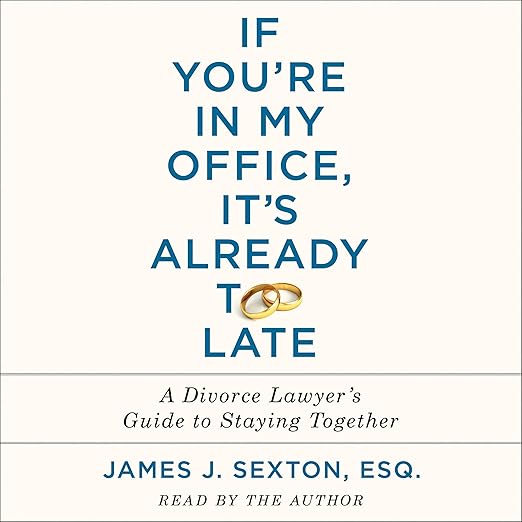
James Sexton's audiobook arrives with credentials that most relationship advisors cannot claim: over a thousand dissolved marriages, processed from the inside, as the attorney paid to end them. The premise is stated plainly in the title. By the time you need a divorce lawyer, the relationship has already failed in ways that could have been addressed earlier. Sexton's argument, made across eight hours of self-narrated audio, is that everything he has learned from watching marriages collapse backwards from their worst moments applies equally to couples who are not yet in his office and would prefer to stay that way. It is the rarest kind of relationship book: one built from failure data rather than success stories, and more honest for it.
The self-narration is the key to why this particular audiobook format works so well. Sexton, described by former clients as a courtroom gunslinger and the sociopath you want on your side, has the timing of someone who has spent years making arguments in front of hostile audiences. His pauses land. His punchlines land. When he delivers the observation about locking your spouse and your dog in a trunk for ten minutes to see who is happier to see you when you open it, the setup and the comic punctuation are exactly calibrated. A third-party narrator would flatten the effect considerably, and the book's specific value is inseparable from the performance Sexton brings to it.
Divorce Reasons Are Symptoms, Not the Cause
The book's central diagnostic is useful and non-obvious. Sexton argues that the reasons couples give for divorce, the new personal trainer, the uneven division of carpool duties, the ill-advised threesome with the nanny, are almost never the actual cause. They are the visible symptoms of communication failures that have been compounding for years. Couples confuse symptom and cause consistently, which means they address the wrong problem and the marriage continues to erode even after the presenting crisis is nominally resolved.
The Hit Send Now principle, Sexton's shorthand for not postponing difficult conversations because you cannot face the fight today, is one of several pieces of advice in the book that is simultaneously obvious and genuinely hard to follow. Sexton does not pretend the advice is easy. He is honest about the way good relationship habits are exactly the behaviors that feel most awkward to initiate, especially in relationships that have already developed unhealthy communication patterns over years. This combination of clear-eyed diagnosis and honest humility about implementation gives the book more credibility than the typical relationship guide manages to achieve.
Sexton's Courtroom Timing Makes the Jokes Land
Sexton's source material is extraordinary, and he uses it well. He draws on specific, anonymized cases across the full spectrum of marital dissolution: wealthy couples, couples in financial ruin, couples whose marriages ended over genuine betrayals and couples whose marriages ended over accumulated trivial resentments that were never named until it was too late. The diversity of his caseload lets him illustrate the same underlying patterns across wildly different surface situations, which is genuinely persuasive in a way that generic relationship advice rarely manages to be.
The humor throughout is not decorative. Sexton uses comedy as a delivery mechanism for observations that would be too harsh or too clinical without it. Several reviewers mention laughing out loud at specific moments, and one who listened to the audiobook version specifically singles out Sexton's delivery as what makes this more than the sum of its advice. That assessment is accurate. This is a performance as much as an argument, and the eight-hour runtime passes quickly because the voice is never boring and the material never stops being uncomfortable in the most productive way.
Marriages Fail in Patterns Sexton Learned to Read
The book is written from the perspective of a divorce lawyer who ultimately believes in marriage and love. That combination sounds contradictory, and Sexton addresses it directly throughout. But listeners should understand that his framework is built from the breakdown data of failed relationships rather than from research into what makes successful ones work. The advice is reverse-engineered from failure, which is a valid methodology but not the only one. Readers who want empirical relationship research alongside the practitioner perspective should supplement Sexton with something from the Gottman Institute tradition.
There is also a demographic framing to be aware of. Most of Sexton's caseload is drawn from a particular slice of New York and New Jersey professional life, and some of the examples, the nanny situations, the career competition, the social circle dynamics, are more applicable to that context than to all relationships. The underlying communication principles are universal; the texture of some examples is specific to a particular economic bracket and geographic milieu.
For Couples Who Like Their Advice Dark
This audiobook is for couples who are not in crisis but want to be better partners, people who appreciate honest, slightly dark humor and have no patience for inspirational-poster relationship advice. It is also for anyone who has been through a difficult relationship and wants a framework for understanding what went wrong without the sanitized narrative that most breakup accounts offer. The self-narration format is a genuine value-add here; this is one of the clearest cases in the relationship genre where the author's voice is irreplaceable and the audio version is the recommended starting point. Listeners who prefer their advice delivered earnestly rather than wryly may find the comedic register at odds with their needs, but everyone else will find eight hours pass very quickly indeed.
Does the If You're in My Office audiobook work for couples who are already in serious trouble, or is it primarily useful as prevention?
Sexton is explicit that the book is primarily preventive, hence the title. The material is most useful for couples who recognize early warning signs in their communication patterns. The diagnostic framework, the distinction between symptoms and root causes, also has value for couples in active difficulty who want to understand how they got there, even if Sexton's solutions require earlier intervention than crisis management provides.
Is this audiobook appropriate for both partners to listen to together?
Multiple reviewers mention recommending it to couples together. The advice is framed neutrally enough to avoid assigning fault to either party, which makes it more useful as a shared listening experience than books that address one gender primarily. The humor makes it an easier shared listen than the subject matter might initially suggest.
Does this audiobook offer practical exercises or is it mainly observational and analytical?
It leans toward observation and analysis rather than structured exercises. The advice, like the Hit Send Now communication principle, is specific and actionable but presented in narrative form rather than as a workbook. Couples looking for structured communication exercises may want to supplement with a more exercise-driven resource, but the framework Sexton provides for diagnosing communication problems is genuinely practical on its own.