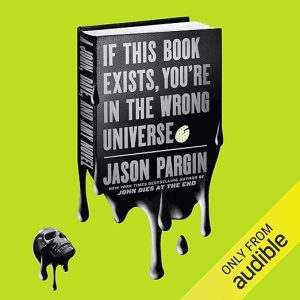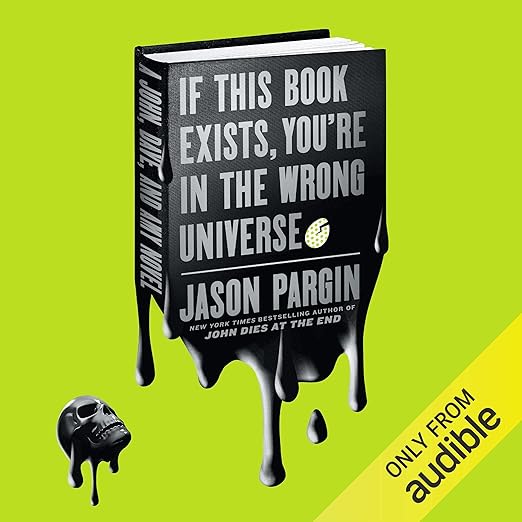
Book four of a horror comedy series is a strange place to find the most emotionally serious entry, but that is where this audiobook lands, and the one four-star reviewer on the listing says so in a review titled Less Humor, More Dread. Jason Pargin continues his John Dies at the End books here, Stephen R. Thorne holds the narrator credit, and the central threat is a possessed children's toy that persuades teenagers to feed it human remains. Fourteen hours and twenty-five minutes of that.
What Jason Pargin Delivers
Pargin's town of Undisclosed is the real character, and the description introduces it in the voice of somebody who lives there and stopped being surprised years ago. Decayed infrastructure, empty retail, and a tourist trade drawn in by the local phenomena. The inventory is offered deadpan: "Interdimensional parasites feeding on human hosts, paranormal cults worshipping demonic entities, vengeful teenage sorcerers, we’ve got it all." That register, catastrophe delivered as a municipal complaint, is the series signature and the thing that either works on you in the first ten minutes or never does.
The plot device is genuinely inspired. A plastic egg the size of a football is marketed as hatching a colorful stuffed bird once a child has fed it through a phone app. What actually lives inside is, in the copy's words, "an otherworldly monstrosity that’s enticing impressionable wayward youth into murdering folks and depositing their body parts inside the egg as if it’s a hungry piggy bank to trigger the end of the world." Read that twice. Pargin has essentially written a virtual-pet apocalypse, and the satire on app-mediated childhood is doing real work underneath the gore.
Dave, John and Amy handle it, as they always do, and the running joke about their economics survives intact: they face supernatural threats "so the rest of us don’t have to, and sometimes even earn a couple of bucks" doing it. By this instalment the trio has worked out that the current apocalypse is above their pay grade, which is the structural gag the whole series runs on. Nothing about these three is competent. Everything about them is willing, and Pargin has never confused the two.
What Jason Pargin Gets Right
Comedy and horror both live on timing, and audio is the format where timing gets decided for you rather than by you: on the page your eye outruns a punchline, while in a reading you get the beat the performance chooses. Alex G's review calls the book "great if you like horror but also dick jokes", which is a precise account of the craft problem in play. The handoff between a gore setpiece and a gag has to land inside the same breath, over and over, for the length of a novel.
The demand this material makes on Stephen R. Thorne is specific enough to be worth stating. This is storytelling in a wised-up, unbothered register, with long passages of the ridiculous delivered completely straight and then, per one reviewer, a turn inward that gets genuinely bleak. A reading that plays the comedy too hard kills the dread. One that plays the dread too hard makes the jokes look accidental. The three attached reviews argue about the book's tone and never once mention the reading, so where this recording finds that line is a question the sample answers and this page does not.
The other argument is accumulation. K. Mcculloch's review insists on it, writing "make no mistake" about this being a series rather than a shelf of interchangeable volumes, and describing a history with Pargin that predates the first book and goes back to his Cracked.com articles under the David Wong byline. Four books in, the town, the recurring cast and the running gags carry a weight no newcomer can feel, and the payoff for a returning listener is wildly disproportionate to what a first-timer takes away from the identical text.
Where Jason Pargin Loses Some Ground
Less Humor, More Dread is the most valuable thing on this listing, and it happens to be the title of the only review that withholds a star. Sarah Lumpkins argues that where the earlier books mixed Lovecraftian horror with dark, sometimes juvenile comedy, this one "focuses horrifically inward." The magic is more overt now, which retires the old running uncertainty, described in that review as a "general confusion of is it magic? Is it monsters? Is it gas?" The verdict is that the introspection does not fully deliver, and the review is cut off before the sentence finishes, so exactly what fell short never reaches the page.
Do not start here. Two of the three reviewers frame this explicitly as a series entry rather than a standalone, one calling it "another solid entry" while another measures it directly against "the first three JDATE books". The town, the trio and four volumes of accumulated in-jokes are structural rather than decorative. A first-time listener gets a possessed egg and almost none of the reason anybody cares what happens to it.
On content, the listing is candid and you should take it at its word. The description promises bloody ritual sacrifices, soul-crushing nightmares, and children manipulated into killing, all of it played for laughs. One reviewer titles their assessment Da filthy and specifies that the appeal depends on enjoying crude humor alongside genuine horror. This is not a genre blend that softens either half to make room for the other. Both run at full strength simultaneously, and anyone who wants one without the other will get both regardless.
Who Should Pick Up If This Book Exists, You're in the Wrong Universe
Come for the series, not for the premise. Anyone who has finished the first three should already be here, and the review pool is emphatic on the point. One reader reports that Pargin has managed to write their favorite book six consecutive times and fully expects a seventh. That is fandom rather than criticism, but it does describe a specific kind of reliability, and this instalment is being received as more of the same with a considerably heavier heart.
Beyond the existing readership, the listener this suits is one who likes horror that refuses to be dignified. Pargin writes cosmic dread in the tone of a group chat, and the copy quotes Publishers Weekly calling the book "scathing social commentary thinly disguised as an outrageous action novel." If satire delivered through a murderous virtual pet strikes you as an efficient way to write about handing children screens, the machinery here is built for you.
Two clear exclusions. New listeners belong at the start of the series, where the town gets built and the jokes get their setup. And anyone who loved the earlier books for being funny first and frightening second should weigh that four-star review carefully, since it argues the balance has tipped. If that shift is what you have been waiting for, it is the strongest reason to buy. If it is what you feared, the same review is your warning.
Before You Press Play
- Narration: Stephen R. Thorne is credited on a book that swings from gore to gag inside a single paragraph, so the handoff between registers is the whole job, and no attached review evaluates it.
- Themes: Cosmic horror as municipal nuisance, app-mediated childhood, friendship among the wholly unqualified, apocalypse on a budget.
- Mood: Filthy, funny, and by one reviewer's account darker than the three books before it.
- Verdict: The right fourth instalment for series readers and entirely the wrong entry point for everybody else.
Do I need the earlier books before this audiobook?
Yes. Two reviewers here treat the sequence as sequential rather than interchangeable, and one measures this volume directly against its three predecessors. The town, the recurring trio and years of running jokes are structural. Start here and you get a possessed toy without any of the accumulated context that makes it funny.
Is this instalment funnier or darker than the earlier ones?
Darker, on the evidence of the only reviewer who withheld a star. That assessment argues the earlier volumes balanced cosmic horror against juvenile comedy while this one turns inward, trading the old is-it-real ambiguity for explicit magic. The review is truncated before it explains why the introspection fell short.
How graphic is the audiobook?
Very. The publisher's own copy advertises ritual killing, body parts collected inside a toy, and nightmares treated as a workplace hazard, all delivered as comedy. One reviewer warns bluntly that the book only lands if crude jokes and real horror can share a sentence without either one embarrassing you.
Why does this listing carry so few ratings?
The pool is unusually thin for an author with an established readership, which reflects this particular listing rather than the novel's reception. Three reviews cannot be averaged into anything meaningful. Read them individually instead: two are substantive, and the dissenting one is the most useful criticism available anywhere on the page.