Quick Take
- Narration: Kate Reading brings measured authority and genuine warmth to Carla Power’s text, finding the right register for a book that alternates between reportage, personal reflection, and theological dialogue.
- Themes: interfaith dialogue, Quranic interpretation, East-West identity and belonging
- Mood: Thoughtful and generous, occasionally urgent
- Verdict: One of the most intelligent and humanizing accounts of the Quran and its living context available in audio form.
I listened to this over the course of three evenings, which is not my typical pattern. I tend to divide longer nonfiction across morning commutes. But there was something about Carla Power’s voice, refracted through Kate Reading’s narration, that made me reluctant to put it down for the night. I would finish a chapter and find myself thinking about the conversation that had just unfolded, then reaching for the earbuds again.
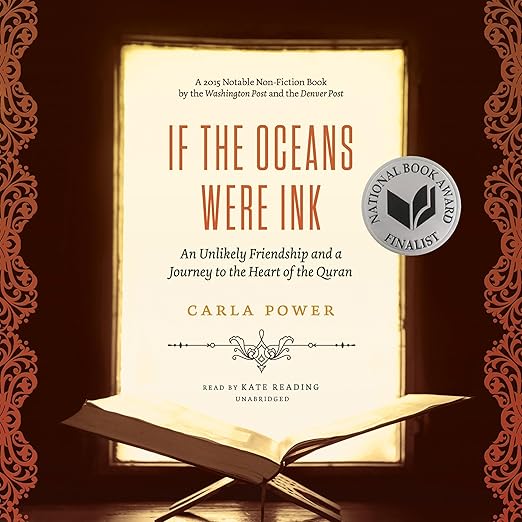
The premise of If the Oceans Were Ink is deceptively simple. Power, a secular American journalist who grew up across the Midwest and the Middle East, undertakes a yearlong study of the Quran alongside Sheikh Mohammad Akram Nadwi, a madrasa-trained Islamic scholar and longtime friend. Together they read, debate, travel to madrasas in India and pilgrimage sites in Mecca, and encounter a cast of characters ranging from feminist activists to conservative scholars to jihadis. What Power has written is not a book about Islam in the abstract. It is a book about what happens when two people who trust each other sit down with a difficult text and refuse to look away from what it says, or what others claim it says.
The Friendship That Makes the Argument Possible
Any book premised on an unlikely friendship lives or dies on whether that friendship feels real rather than convenient. Power’s relationship with Akram Nadwi predates the book and carries genuine history. Their debates happen in cafes and family gatherings and packed lecture halls, and the texture of those settings, the humor, the tangents, the moments where they clearly frustrate each other, prevents the dialogue from feeling staged. One reviewer described it as a book that offers a sane and sober view of Islam without trying to convert you or condemn, and that balance is maintained through Akram’s character specifically. He is not a vehicle for Power’s questions. He is a full person with his own complexities, his own stances on gender that Power does not sanitize, and a commitment to the Quran’s text that challenges her secular assumptions as much as she challenges his.
The Washington Post called this mandatory reading. Fareed Zakaria described it as intelligent, compassionate, and revealing. Both assessments hold up across twelve-plus hours of listening. The conversations documented here, at cafes, in packed lecture halls, across international travel, achieve the particular quality of dialogue between people who genuinely respect each other and genuinely disagree, which is rarer in writing about religious difference than it should be.
Kate Reading and the Challenge of Theological Dialogue in Audio
Narrating a book that shifts between memoir, travelogue, and theological analysis requires range that not all audiobook performers manage. Kate Reading, long associated with epic fantasy narration, including the Wheel of Time series, turns out to be quietly well-suited to this material. She reads Power’s prose with an intimacy that suits the memoir sections and shifts to something more measured and deliberate for the passages of Quranic analysis. The Arabic words and phrases scattered throughout are handled with care rather than avoidance.
There are moments in the Mecca sequences where the narration achieves a genuine stillness that the text calls for. This is not a showy performance, which is exactly what the material needs. A more theatrical narrator would throw the tonal balance off; Reading understands that the subject does the emotional work and her job is to carry the listener without distraction. At twelve hours and thirty-five minutes, sustaining that discipline is its own achievement.
What the Book Does With Its Most Difficult Questions
Power does not write a defense of Islam, and she does not write a critique of it. She writes something harder and more valuable: an account of what the text actually says, read alongside someone who has spent decades with it, measured against what is done in its name by various actors. The book confronts the verses most cited by critics, those related to gender, to violence, to non-believers, without either dismissing the citations or accepting the simplified readings.
One reviewer noted that Power draws a necessary distinction between extremists who use religion as an excuse for violence and everyday practitioners who do not. That distinction is explored throughout with genuine complexity rather than false equivalence. Another reviewer, who has recommended the book widely, described it as gently written, with great compassion and yet without losing a point of view. That compression of qualities, compassionate but not soft, clear-eyed but not polemical, is what makes this book worth the investment of twelve hours.
Who Will Find This Indispensable and Who May Struggle
Listeners looking for a clear verdict, Islam is this, the Quran means that, will be frustrated. Power has written a book that refuses to flatten its subject, which means it demands sustained attention across a long runtime. Listeners who are non-Muslim but curious about Islamic thought, listeners engaged with interfaith dialogue in their own communities, and readers who have appreciated works like Reza Aslan’s No God But God or Karen Armstrong’s A History of God will find this a rich companion. Those already deeply familiar with Quranic scholarship from inside the tradition may find Power’s outsider position limiting, but several Muslim reviewers have cited the book as valuable precisely because of the vantage point it brings. At 4.4 stars across 450 ratings, the audience response is broadly positive, with the strongest readers citing not just information gained but perspective genuinely shifted by the encounter.
Frequently Asked Questions
Does the book require prior knowledge of the Quran or Islamic history to follow along?
No. Power writes as a secular journalist coming to the text with curiosity rather than expertise, and she explains concepts as she encounters them. Listeners with no background in Islam will find this accessible. Those with existing knowledge will find additional layers but won’t be bored by the explanatory context.
How does Kate Reading’s narration handle the Arabic Quranic quotations throughout the text?
With care and apparent preparation. She does not avoid the Arabic or anglicize it aggressively, and the pronunciation is consistent throughout. Listeners who know Arabic may have minor quibbles, but the approach is respectful and the words are integrated smoothly into the narration’s flow.
Does the book address the Quran’s verses on women and gender roles, given how frequently those are cited in Western discussions of Islam?
Directly and at length. This is one of the book’s central subjects. Power and Akram engage with these verses seriously, and the book presents both traditionalist and reformist readings while Power reflects on her own discomfort and the limits of her outsider perspective. It is one of the most substantive sections in the book.
Is this book sympathetic to Islam in a way that might feel like advocacy, or does it maintain journalistic distance?
Power is clearly moved by what she discovers and openly critical of certain Western misconceptions, but the book is not uncritical advocacy. She documents disagreements with Akram, presents voices across the spectrum of Islamic thought, and maintains the journalist’s habit of asking what the evidence actually shows rather than what she might wish it would show.