Chaet Holds the Weight Without Sentiment
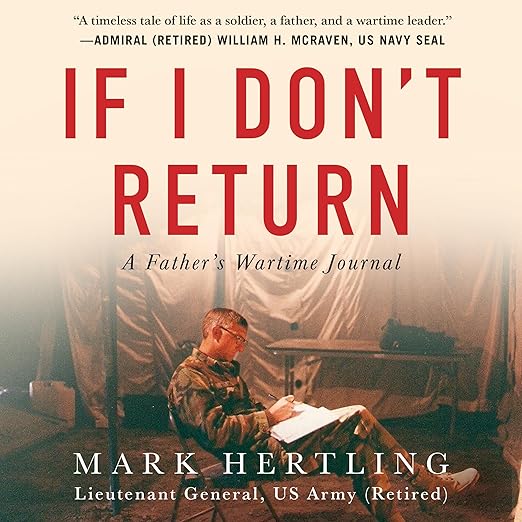
Before the ground campaign of Operation Desert Storm began in 1991, Major Mark Hertling's armored cavalry squadron was briefed on expected casualty rates: fifty percent. Hertling had two young sons at home. He began writing in an army-issued green notebook, not a letter to a spouse or a formal document, but a running journal addressed to his boys, with the knowledge that he might not return to deliver it in person. That premise grounds this audiobook from its first pages, and Mark Chaet's narration holds the weight of it without sentiment or performance. The journal was a private act of fatherly love under extreme contingency. The audiobook it eventually became is something broader: a document about what character looks like under sustained pressure.
This is not a conventional military memoir. It does not follow the arc of combat heroism, though combat features in it. It does not organize itself around Hertling's rise through the ranks, though that rise is part of the context. What the book gives you instead is a direct line into the moral and emotional interior of a man who has decided to leave a record of who he was in case he does not survive to tell his sons himself. The format, a journal written for children who would read it in an unknown future, produces a specific quality of honesty that memoir written retrospectively for publication rarely achieves.
The Crucible of Battle, Read Two Ways
Hertling's journal entries from 1990 cover the waiting and the missions, the chaos and the quieter moments, the brotherhood among soldiers, and the particular grief of watching people die. But they also cover leadership philosophy as it is actually practiced under pressure, not as it is theorized in classrooms. One reviewer describes the book as 'a rare chronicle of leadership and life in preparation for the crucible of battle,' and that framing captures the dual nature of the material well.
What distinguishes this audiobook from other military memoirs is the addition of Hertling's reflective commentary, written decades later after he survived, after his sons became combat veterans themselves, after one of them typed the original handwritten pages as a gift to his father. The layering of the original journal and the retrospective reflection creates a structure that allows readers to see what the thirty-year-old major understood and what the retired general understood looking back. Those two perspectives do not always agree, and the tension between them is more instructive than either voice alone would be.
Hertling's post-military career took him through positions as a cable news analyst, healthcare executive, and leadership professor. The reflective commentary draws on all of those roles, and the result is that the later sections of the audiobook function as a leadership text that happens to be grounded in combat experience rather than consulting case studies. Reviewers respond to this practical dimension consistently: the book presents leadership lessons through lived experience rather than theoretical framework.
A Circularity the Audiobook Names Explicitly
Mark Chaet narrates the audiobook, and his work is appropriate for the material. The journal passages require a different register than the retrospective commentary, and Chaet differentiates them without overdramatizing the distinction. The handwritten intimacy of the original journal, a father writing to children who might never know him, requires restraint, and Chaet provides it. At eleven hours, the audiobook moves through a substantial amount of Hertling's career arc, and the pacing reflects that scope.
Listeners who come to this audiobook expecting primarily a Desert Storm combat account may find the scope broader than expected. The retrospective additions extend the material across Hertling's career through multiple Iraqi deployments over the following decades, and the book's concerns are ultimately less about any specific operation than about what character, leadership, and service actually mean when tested over a long military career and a longer life. That broader frame is a strength, but it reconfigures reader expectations set by the Desert Storm framing of the opening.
The journal's texture as a written artifact is something Hertling and his collaborators preserve carefully. The handwritten entries were typed by his son as a gift decades after they were written, and that act of transmission is itself part of the story. A father writes to children who may never read what he is writing. A son, who has by then become a combat veteran himself, types those pages as a gift back to the father who survived. The circularity of that gesture, which the audiobook names explicitly, gives the material a quality of generational witness that most military memoirs lack. The journal was not originally written for publication, and that origin shows in the best possible way.
Hertling's post-military career is unusual enough to merit specific comment. The transition from four-star-adjacent general to CNN military analyst to healthcare executive to university professor of leadership represents a range of institutional contexts that most military memoirs do not cover. His reflective additions draw on all of these experiences, and the result is that the later sections of the audiobook offer a perspective on leadership and character that is genuinely multi-institutional rather than purely military. Listeners who come to the book for Desert Storm and stay for the leadership material will find the late-career sections as rich as the combat ones.
Chaet's Measured Narration Across Eleven Hours
This audiobook is for listeners who are drawn to military experience as a lens for understanding leadership, character, and family obligation under extreme circumstance. The specific vehicle is a father's journal, and listeners with their own connections to military deployment, as veterans, as parents of veterans, or as people who have thought seriously about what they would leave behind, will find the material reaching them in the places where it is designed to land.
Leadership readers outside the military context will also find substantial value in the retrospective sections, where Hertling draws connections between combat decision-making and civilian leadership explicitly. And anyone interested in the Gulf War specifically will find Hertling's ground-level operational perspective to be a valuable complement to the historical accounts that focus on strategy and command rather than the experience of those executing the mission. Mark Chaet's measured narration across eleven hours serves this layered document well, delivering a book that deserves to be read in the order it was meant: from the first uncertain pages of that green notebook to the final reflections of a man who survived to understand what he had written.