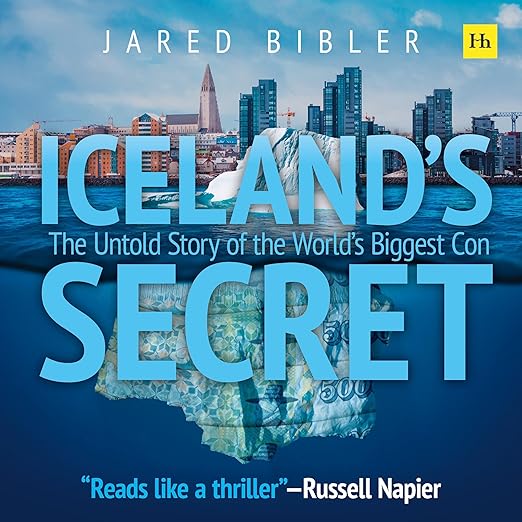
Quick Take
- Narration: Bibler narrates his own book, and that self-performance is essential – his lived proximity to the events gives the reading an urgency that no hired narrator could replicate, and his voice carries the incredulity of someone who watched it happen from the inside.
- Themes: financial crime and impunity, the lone investigator against institutional inertia, the particular vulnerability of small nations to Wild West capitalism
- Mood: Propulsive and infuriating, with the structure of a detective procedural
- Verdict: One of the more absorbing financial crisis accounts you’ll find, anchored by the specific human cost of Iceland’s collapse and the unusual fact that someone actually went to jail.
I put on Iceland’s Secret during a run of reading about the 2008 financial crisis, trying to understand why Iceland’s response to it felt so different from everywhere else’s. The headline version, the only country to jail its bank CEOs, is pithy enough to stick in memory, but it flattens something important: the actual work of making those jails happen, and the specific human cost of the years before anyone was held accountable. Jared Bibler’s audiobook is the account of that work from the inside, and it’s considerably more interesting than the headline suggests.
Bibler is an American from Massachusetts who relocated to Iceland in 2004, worked briefly at one of the banks that would later collapse catastrophically, and then found himself, somewhat accidentally, as a lead investigator into some of the largest financial crimes in the world when that collapse came. His account has two registers running simultaneously: the investigative procedural of documenting fraud, and the personal memoir of someone whose adopted country was being destroyed by the people who were supposed to be managing it. Both registers work, and the combination produces something more compelling than a strictly institutional account would.
Our Take on Iceland’s Secret
The financial crimes themselves were, as one reviewer puts it, “unsophisticated” in a way that makes them more chilling rather than less. This was not the exotic financial engineering of the American crisis. This was straightforward fraud enabled by cultural factors: the small-country intimacy that made accountability feel like an attack on friends, the institutional deference to people in suits who seemed to know what they were doing, and the particular vulnerability of a country that transformed its fishing-based economy into a leveraged financial powerhouse in less than a decade. The “Ponzi scheme” description one reviewer uses is accurate, and Bibler traces its mechanics with the clarity of someone who had to understand them well enough to prosecute.
What makes Iceland’s Secret unusual in the financial crisis memoir genre is the resolution. Most accounts of the 2008 crisis end in frustration: the crimes were committed, the regulators were late, and no one went to prison. Bibler’s account ends differently, because Iceland ends differently. The section on convincing skeptical colleagues that the data actually showed criminal conduct, building a case that could withstand legal scrutiny, and watching prosecutors take it forward, is the book at its most procedurally satisfying. It’s also, as Bibler implies, the section that required the most time and the most institutional courage.
Why Listen to Iceland’s Secret
The self-narration is not merely appropriate here; it’s the audiobook’s defining asset. Bibler reads with the quality of someone recounting something that still bothers him a decade later, which it clearly does. His voice carries disbelief in the right places, the moments when the fraud is so brazen that explaining it requires a tone that conveys genuine incredulity rather than clinical analysis. One reviewer described the book as a “wild ride” and the narration supports that reading: this is not a dispassionate account. It’s a furious one, carefully controlled enough to be credible.
The personal memoir thread, including the shopping binges on trips to America when the exchange rate was fantastic, and then the collapse of that same exchange rate into something catastrophic, gives the book texture beyond the investigative procedural. Bibler writes about becoming Icelandic, about investing his own savings in a country he loved, and about watching those savings disappear along with everyone else’s. That skin in the game is part of what makes the investigative work feel morally urgent rather than professionally routine.
What to Watch For in Iceland’s Secret
The book has a structural limitation that one thoughtful reviewer flagged: it is a single first-person perspective from one investigator, without interviews of other bank employees, fellow investigators, or prosecutors. That’s a deliberate choice, not an oversight, but it means the account is necessarily partial. Readers who want a comprehensive, multi-perspective history of the Icelandic financial crisis will need to supplement this with other sources. What Bibler offers is depth rather than breadth: the specific experience of someone who did the work, not an institutional history of how the work got done.
The ten-hour runtime is appropriate for the material, but the book’s density varies. The sections describing the technical mechanics of market manipulation are necessarily slower than the memoir passages, and listeners without financial sector background may find some of those sections demanding. Bibler explains the concepts clearly, but the mechanics of how the banks inflated their own stock prices through circular transactions, for example, require careful attention. The audiobook format, which doesn’t allow you to flip back to a diagram, makes those sections the most challenging.
Who Should Listen to Iceland’s Secret
Ideal for listeners who followed the 2008 financial crisis and always wanted the Iceland story told fully. Financial professionals who remember the crisis from the inside will find Bibler’s investigative methodology particularly interesting. Listeners drawn to financial true crime in the tradition of Michael Lewis will find this book operates in a similar register, though with more procedural detail and less pop-economics gloss. Anyone who wants to understand why Iceland’s response to the crisis was genuinely different from every other country’s should start here. Listeners primarily interested in Iceland’s culture or geography rather than its financial history will find the book focused almost entirely on the crisis rather than the country more broadly.
Frequently Asked Questions
Does Iceland’s Secret require financial literacy to follow, or can non-specialist listeners keep up?
The book is written for a general audience rather than for financial professionals, and Bibler explains the mechanics of the fraud clearly enough that the essential story is accessible to non-specialists. The most technically demanding sections involve the specific mechanisms of stock price inflation and market manipulation, which benefit from some familiarity with how financial markets work. But the core narrative, what happened, who did it, and what it cost, is followable without that background.
How does Iceland’s Secret compare to Michael Lewis’s accounts of the financial crisis, like The Big Short or Boomerang?
Bibler’s account is more procedurally focused and less pop-economics in register than Lewis. The Big Short uses colorful protagonists and accessible metaphors to explain complex instruments. Iceland’s Secret is closer to a first-person investigative account, more like a detective story than an economics explainer. Lewis is smoother and more cinematic. Bibler is grittier and more specific. Both approaches have merit, and they complement each other.
Bibler was personally financially wiped out by the crisis – does that personal stake affect the book’s objectivity?
Inevitably, and Bibler doesn’t pretend otherwise. His personal losses are part of the memoir thread and part of his motivation for the investigation. Whether that undermines the book’s reliability depends on what you’re looking for: as a comprehensive institutional history, the perspective is partial. As a first-person account of what it felt like to investigate crimes that had destroyed your own savings and your adopted country’s economy, the personal stake is precisely what makes it compelling.
The synopsis mentions the next global financial meltdown being ‘just around the corner’ – does the book make a substantive argument about lessons learned, or is that framing just marketing?
The cautionary-tale framing is substantive rather than purely rhetorical. Bibler’s argument is that the specific cultural and institutional conditions that enabled Iceland’s crisis, deference to financial elites, regulatory capture, the normalizing of Wild West capitalism, are not unique to Iceland. The lesson he draws is structural rather than specific: that financial fraud of this scale is enabled by systems, not just bad actors, and that those systems persist. Whether that rises to a predictive argument about the next crisis is debatable, but the historical analysis supporting it is carefully made.