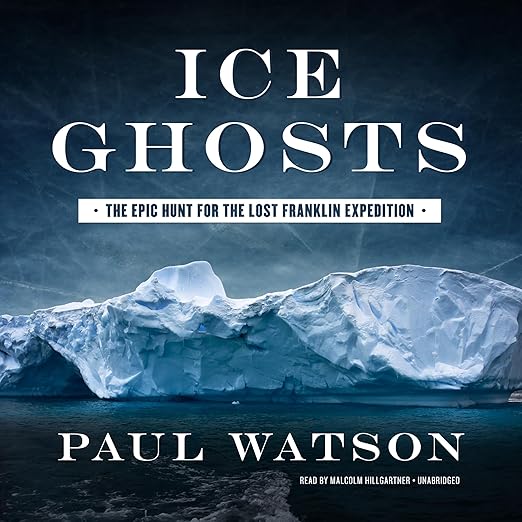
Quick Take
- Narration: Malcolm Hillgartner brings a measured, journalistic gravity to Watson’s dual-timeline narrative, distinguishing the Victorian past from the modern search without heavy-handedness.
- Themes: Arctic exploration and catastrophe, the long reach of Inuit oral history, the intersection of science and Indigenous knowledge
- Mood: Cold, haunting, and compulsively readable, like a mystery where you already know the body was found but not how it got there
- Verdict: A rich, dual-timeline account of the Franklin Expedition and its discovery that earns its scope through sustained narrative intelligence.
I came to this book already knowing the broad outlines: Sir John Franklin, 1845, two ships, 129 men, none returning. The Northwest Passage swallowed them whole and the Victorian public spent decades trying to figure out what had happened. I had read the footnotes to this story in other histories and figured I knew enough. What Paul Watson’s Ice Ghosts does, across twelve hours of listening, is demonstrate that I knew almost nothing about the details, and that the details are where the story actually lives.
Watson is a Pulitzer Prize-winning journalist, and he was on the Canadian icebreaker that led the expedition that found the wreck of HMS Erebus in 2014. That combination of credentials matters enormously here. He is not an academic writing from archives. He was present. He knows the scientists and divers. He also spent years reporting in difficult conditions, which means he knows how to sustain a narrative across time without losing the reader.
The Two Stories Running in Parallel
The book’s structure is its most interesting formal decision. Watson weaves between 1845 and the decades-long modern search, and he does this more successfully than most books that attempt parallel timelines. The Victorian chapters cover Franklin’s departure, the crew’s background, the progressive deterioration of the expedition as recorded in fragments found later, and the extraordinary campaigns of Lady Franklin, who essentially willed the search for her husband into existence through pure social force for years after any reasonable person would have given up.
The modern chapters are where Watson’s journalism really shines. The 2014 discovery was not a single heroic moment. It was the culmination of years of underfunded, sometimes dysfunctional, occasionally brilliant search work, and at the center of that search was something that institutional archaeology was reluctant to credit: Inuit oral tradition. Communities in the Canadian Arctic had been telling stories about the fate of the Franklin ships for generations. They knew roughly where the ships were. Watson is rigorous about making this point without sentimentalizing it. The Inuit knowledge was not mysticism. It was observation, passed down carefully, and it was more accurate than a century of Western searching.
What the Academic Critics Missed
A reviewer flagged that academic voices have been harsh about this book, and a five-star reviewer responded that the academic egos were jealous or mean. That binary is probably too clean, but there is something real underneath it. Watson is a journalist, not a Franklin scholar, and specialists will find things to quibble with. But the book’s strength is not forensic granularity. It is the integration of the historical adventure with the modern search, and the centering of Inuit knowledge as a genuine epistemological contribution rather than an anecdote.
Reviewers have also noted that the book has weaknesses in its middle sections, where the decades of fruitless nineteenth-century searching can become repetitive. That is a fair critique. The years between Lady Franklin’s campaigns and the modern search require some compression that does not always land cleanly. But this is a book that earns its occasional slack through the quality of its best passages.
Malcolm Hillgartner and the Dual Register
Malcolm Hillgartner is a narrator with experience in nonfiction journalism, and it shows. He modulates between the Victorian material, which carries a different emotional register, and the contemporary reporting with enough distinction to orient the listener without overdoing it. The audiobook handles Watson’s transitions well, which matters in a twelve-hour listen across two timelines.
One detail worth flagging for listeners who come to Watson after reading other Franklin accounts: he is unusually good at making the long decades of searching feel like something other than an extended prologue to the 2014 discovery. The Victorian searching had its own dramas, its own obsessives, and its own near-misses, and Watson treats those decades as a substantive part of the story rather than as filler between Franklin’s departure and the modern resolution. Lady Franklin’s campaigns in particular receive attention that most accounts underweight. She is one of the most remarkable figures in the entire story, and Watson gives her the space to be formidable rather than merely grief-stricken.
At 4.2 stars across 438 ratings, this is a book that has built a genuine readership rather than a marketing moment. The spread of reviews suggests it is reaching both Franklin obsessives who already know the story and complete newcomers who are encountering it for the first time. Both groups seem to find what they need.
Who Should Listen and Who Should Skip
This is a strong choice for anyone interested in the Franklin Expedition who has not yet found a single account that tells the full story from departure to discovery. It is also specifically valuable for listeners interested in the role of Indigenous knowledge in scientific research, which is handled with more nuance here than in most popular histories.
Those who have read Ken McGoogan’s detailed accounts of Franklin searchers may find some of the historical ground familiar. And listeners primarily interested in the underwater discovery itself may find the Victorian chapters too extensive. But as a complete narrative, this delivers what it promises.
Frequently Asked Questions
Does Ice Ghosts cover the cannibalism evidence from the Franklin Expedition?
Yes, Watson addresses the forensic evidence of cannibalism that emerged from remains found on King William Island, including cut marks on bones consistent with butchery. He handles it straightforwardly and with appropriate sobriety rather than sensationalism.
How central is the Inuit oral tradition to the book’s argument?
It is the book’s most distinctive contribution. Watson argues that Inuit testimony about the ships’ locations was more accurate than a century of Western searching, and that institutional resistance to crediting Indigenous knowledge delayed the discovery. This thread runs throughout the modern chapters.
Is the 2014 discovery of HMS Erebus the climax of the book, or does Watson continue past it?
Watson covers the discovery and its immediate aftermath, including the politics around which government and institutions could claim credit. The book does not end at the moment of discovery but follows the story through to the broader implications of what the wreck revealed.
How does this compare to other Franklin Expedition accounts as an audiobook?
It is one of the most complete single-volume treatments available in audio format. It is broader in scope than accounts focused purely on the 1845 expedition because it includes the modern discovery, and it is more readable than strictly academic treatments. For a listener wanting one book on the subject, this is a strong starting point.