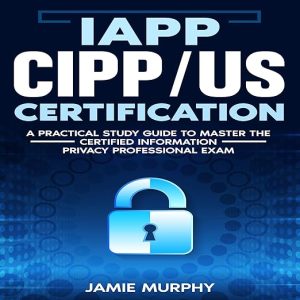
Certification prep is a genre with one job, and an audiobook attempting it begins at a disadvantage nobody can design around: you cannot look at anything. This one addresses the IAPP CIPP/US credential, the Certified Information Privacy Professional qualification for the United States, in five hours and six minutes, with a companion PDF supplied alongside the audio. Two people have rated it and both went to the bottom of the scale, which is where any honest assessment of this listing has to begin.
Two One-Star Votes With No Explanation Given
Two one-star votes and no written explanation make a signal that is difficult to interpret and impossible to ignore. At a count of two, a displayed 1.0 admits exactly one arrangement: both voters selected the floor. Neither said why. On a discretionary purchase that ambiguity would be tolerable, but a candidate preparing for a professional credential is buying against a deadline and an examination fee, and an unexplained floor is the wrong kind of unknown to carry.
Nothing in the description tells you what the book contains. Read it closely and it turns out to be selling the certification rather than the title: the credential is described as a passport to a career, the program is called comprehensive, a badge of honor is promised, and you are asked whether you are ready to begin the journey. What never appears is a chapter count, a mention of practice questions, or the version of the exam outline the material follows.
HIPAA, GLBA and the California Consumer Privacy Act are the only specifics the copy commits to, alongside a general promise to cover various aspects of the United States privacy landscape. That is an enormous subject: federal sectoral regulation, state statutes that differ from one another, enforcement practice, and the ethical framing the copy also mentions. A recording of this length is a survey of the territory rather than mastery of it, and the page never claims otherwise.
Tom Brooks Keeps the Acronyms Consistent Throughout
Five hours and six minutes is one working day of review, and that is the strongest practical argument for the format. Privacy work has a conceptual half and a citational half. The conceptual half, why a regulation exists, what a principle is protecting, how a sectoral approach differs from an omnibus one, transfers to listening well and rewards repetition. A candidate who has already worked through a primary text can use a recording like this as a second pass.
Tom Brooks is credited as the reader, which matters more here than a reader credit usually does. Privacy material is built out of acronyms, and a person reading it makes one decision per term and then holds to it: whether CIPP/US is spoken as letters or as a word, how the slash is handled, whether GLBA gets expanded on first use. Consistency across an entire recording is a genuine production choice rather than an afterthought.
A companion PDF ships with the audio, and on this kind of title the PDF is carrying more weight than the recording. Anything a candidate needs to see, comparison tables, statutory citations, a taxonomy of enforcement bodies, has to live there, because none of it survives being spoken aloud. Download it before the first session rather than afterward, and treat the two files as one product rather than as a recording with an attachment.
Recorded Before the Next Round of Privacy Law
Currency is the risk nobody mentions on this page. The recording dates from March 2024, privacy statutes are amended on legislative timetables nobody controls, and a certification syllabus is revised on a schedule of its own. The description never says which version of the exam outline the material was written against, and for a credential-focused purchase that omission matters considerably more than the price does.
Both ratings sit at the floor, and precision matters here about what that does and does not establish. Two votes are not a sample. They cannot tell you whether the objection was to the coverage, the currency, the reading, the PDF, or a mismatch between the description and the contents. What they do establish is that nobody who has rated this title found anything worth a second star, and that is a fact rather than an impression.
Slashes travel badly through a catalog, and this title carries one. IAPP CIPP/US Certification is awkward to search for, awkward to display and easy to mistype, which is a practical problem for a product whose buyers look for it by credential name. The publisher line repeats the author's name, marking this as a self-release, so no editorial apparatus stands behind the coverage claims either.
A Supplement for Candidates, Never a Primary Source
Candidates taking the CIPP/US exam are the only real audience, and the honest advice is that this cannot serve as primary preparation. The official body of knowledge, practice examinations and a written text you can search through are what a credential actually requires. What a recording adds is repetition in the gaps: reviewing concepts while doing something else, during the weeks when reading time has run out and attention has not.
Do not make it your only source, and do not buy it on the description alone. Anyone wanting a general introduction to United States privacy law, without an exam attached, will find the framing pulling constantly toward a credential they have no intention of pursuing. Anyone who needs statutory text, or anything that has to be read rather than heard, is choosing the wrong format outright.
Supplementary use is where this earns its keep, if it earns anything at all. The subject is genuinely important, the conceptual material suits listening, and one working day is a modest commitment against a professional qualification. Set against that: no account of the actual contents, no stated syllabus version, a self-published imprint, and two ratings both resting on the bottom of the scale. Open the PDF, run the sample, and treat the recording as a supplement to something written.