In Brief
- Voice: Tom Campbell carries the whole memoir alone, with no cast list and no second credited voice anywhere on the recording.
- Big ideas: Spinal cord injury and adaptation, family caregiving, endurance athletics, nature and community as recovery.
- Atmosphere: Plainspoken and physically specific, warmer in its second half than the opening pages suggest.
- Worth it?: Worth the six hours if you want the logistics of a rebuilt life rather than the highlight reel of one.
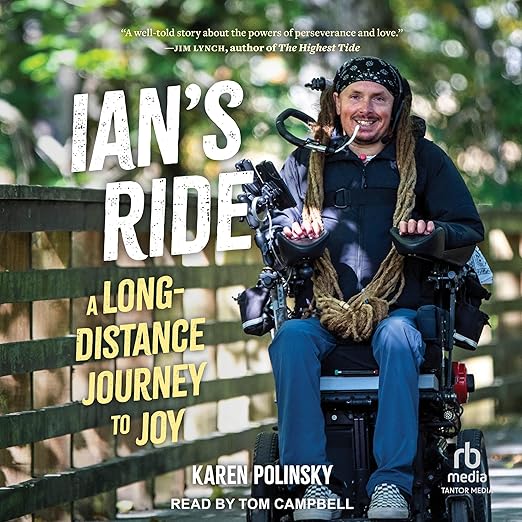
A hundred hours of interview tape sits underneath this memoir, and none of it is what reaches you on the audiobook. Ian Mackay's story got to the page through a second writer, Karen Polinsky, who built it out of those interviews and out of his journal entries. It gets to your ears through a third person again, narrator Tom Campbell. That is two removes from the man who lived it, and the credits admit to only one of them: the byline on this listing reads Ian Mackay alone, while the publisher copy states outright that Polinsky recounts the story with him. Six hours and twenty-three minutes in, the arrangement mostly earns itself.
Logistics as Much as Courage
Bare facts, almost too tidy for nonfiction. A biology undergraduate at UC Santa Cruz rides a bike into a tree on campus and is paralyzed from the shoulders down. Years of despair follow. Then the same man becomes an innovator with Apple and a world-record-breaking athlete, with his mother Teena Woodward and a group of friends the copy calls quirky doing the unglamorous work in the middle. Told badly, that shape collapses into a poster. Mackay and Polinsky keep it upright by refusing to rush the section nobody wants to sit in: the despair gets real duration, the records arrive late, and the interview provenance shows itself in small domestic detail that a triumph narrative usually sands away. What comes out is a book about logistics as much as about courage, which is the rarer and the more useful thing.
One account on this page is worth attention for what it accidentally documents about the edition history. It tracks a preorder, a physical copy landing on the second of the month, and a decision to hold the book back for a few days so it could have undivided attention. Filed in April 2025, that account names an April 1 publication, which falls a week after the March 25 date this recording carries. Audio arrived first here, which is unusual for a memoir from a small list, and the ordering explains why the earliest responses under the listing are describing an object with pages.
A Body That Has Stopped Cooperating
Audio does something specific for this particular subject, and the point is structural rather than sentimental. The publisher copy puts paralysis from the shoulders down in its opening sentence. A memoir about adapting to a body that has stopped cooperating is unusually well matched to an edition nobody has to hold open, and the match is not decorative, because it changes what the book feels like to receive rather than merely to read. The runtime is also right for this material, long enough to sit inside the years of despair the description admits to, short enough that the recovery never starts to play as a montage. Memoirs built on this arc routinely run three hours longer and lose the thread doing it.
Outdoor material supplies the second argument. One account filed in May 2025 names the two things the book does best, saying it gives a reader a working sense of what daily life as a quadriplegic actually involves and that it demonstrates what being outside does to a person. The publisher pitch is dual on purpose, addressed to nature lovers and endurance athletes as much as to memoir readers, and the book honors both halves instead of picking one. Record-breaking is treated as an athletic project with the discipline that implies, and it sits directly beside a quieter argument about nature and community functioning as medicine. Those two registers could easily have fought each other. Instead they take turns, and the alternation is most of what keeps the back half moving.
Campbell's Narrative Changes Distance Mid-Chapter
Small, and unusually close to its subject: that is the response column here, and it matters before you read 4.9 across twenty-five logged ratings as a consensus. One five-star account is a gift purchase relaying a friend's reaction rather than a reading of its own, and the same entry places Mackay as one of our local town boys. Another states plainly that the person writing it knows him personally. Neither of those makes the praise dishonest, and both are exactly what a hometown book attracts, but the visible sample is not a neutral instrument. Read the column as a portrait of how one community answered the book, which is genuinely part of this story, rather than as an independent audit of it.
Seams are the second thing to listen for. A memoir assembled by a second writer out of interview transcripts and journals carries a characteristic texture, and audio strips out the visual cues that normally disguise it. On the page, a shift from a reconstructed conversation to a dated journal entry gets signposted by white space and a change of type. Delivered in one continuous voice, those shifts arrive without warning, and the effect is a narrative that sometimes seems to change its distance from you mid-chapter. That is less a flaw than a property of the interview archive meeting the format. Once you hear it you will keep hearing it, which for some listeners deepens the book and for others loosens its grip by a degree.
Two Strands Braided Too Tightly to Pull Apart
Anyone in the aftermath of a diagnosis, an injury, or a sudden loss is the audience the publisher names, and the naming is accurate rather than opportunistic. The less obvious audience is the endurance crowd: listeners who understand a record attempt as a planning problem will find the athletic chapters more interesting than the inspirational ones, and the book gives them enough to work with. The account filed in January 2026 lands the tone precisely, calling Mackay a trailblazer both literally and figuratively and crediting the book with authentic honesty and humor. The humor is the part worth underlining. Without it the middle third of this memoir would sit very close to unbearable, and with it the hard material stays survivable.
Skip it if you came for either a clean sports book or a clean disability memoir, because the two strands here are braided too tightly to pull apart and the alternation will frustrate anybody who came for only one of them. Walk away too if uncredited collaboration is a principle for you, since Polinsky's role is spelled out in the description and missing from the byline, and nothing in the recording closes that gap. Everyone else, and especially anyone who has watched a family reorganize itself around one person's injury, will find the middle section difficult in a way that repays the discomfort.
A Few Questions About Ian's Ride
What is the runtime on the Ian's Ride audiobook?
Six hours and twenty-three minutes, credited to one narrator, Tom Campbell, with Tantor Media issuing it on March 25, 2025. That fits comfortably into two or three sittings, and it counts as brief by the standards of a memoir covering an entire life.
What genres is the Ian's Ride audiobook filed under?
It sits in two categories at once, biographies and memoirs alongside sports and outdoors, and carries the Adventurers, Explorers and Survival tag. The double filing is accurate rather than a scattergun move, because the athletic record attempts and the medical recovery occupy roughly equal space.
Is it only for people who follow endurance sports?
No. The publisher aims it at nature lovers, endurance athletes, and anyone dealing with a life-changing loss or diagnosis, which is three distinct audiences. The sports material is concrete enough to reward specialists without becoming a barrier for listeners who have never followed a record attempt.