
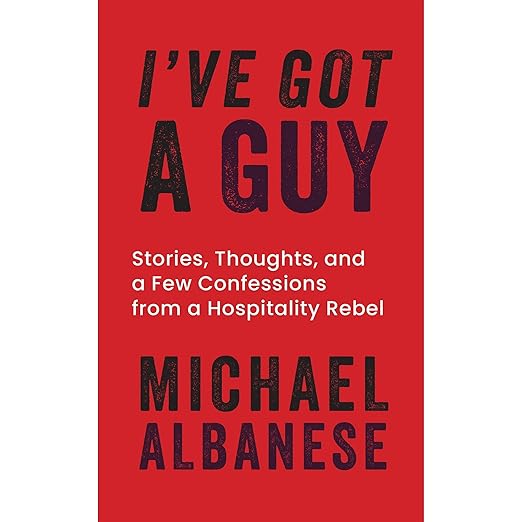
Filed under sports and outdoors, carrying a tag that reads Adventurers, Explorers and Survival, this audiobook is a memoir about working in hotels. The genre array also lists biographies and memoirs, which is correct, and business and careers, which is defensible. The third listing and the tag are not defensible at all, and they matter more than a filing error usually would, because a reader who would love this book is browsing an entirely different aisle and will never see it.
A Confessing Voice That Belongs to Nothing
What Michael Albanese has actually written is an account of decades spent inside what the copy calls the experience economy, which in practice means hotels and the people who keep them running. The range advertised runs from post-9/11 hotel chaos at one end to requests that defy logic at the other, and the framing is that hospitality is a strange kind of rebellion where you give everything away and somehow end up more yourself for it.
One four-star entry corroborates the category problem without meaning to, calling it one of that reader's favorite memoirs of the year and praising the mix of humor and wisdom. Nobody reaches for the word memoir about a survival guide. A buyer hunting for a book about hotel work will not find this listing through its genre, and a buyer who lands on it expecting explorers will bounce immediately, which is a lot of friction for a short book to absorb.
Where a reader's name belongs, this listing carries the words Virtual Voice. On most books that is a straightforward buyer fact, and it is here too, but the stakes are peculiar for this one. The copy sells these chapters as confessions, raw and revealing, told in the first person by somebody who was in the room. A synthesized reading means the confessing voice belongs to nothing, and the intimacy the book is built to trade on has to survive that.
Rooted in Humanity, in Bite-Sized Morsels
One reader arrived knowing, in that reader's own phrasing, less than nothing about the hospitality industry, and left with material that transferred to other fields. The mechanism described is worth quoting from the same entry: the book works in bite sized morsels, building a foundation that anyone can absorb and apply. It opens on a line lifted straight from the text, that hospitality in any form is rooted in humanity, which tells you the register and tells you the argument in one move.
Short chapters and a running time a shade under five hours make this an unusually low-commitment book for the shelf it sits on. Business memoirs routinely run twice as long and say less, and the anecdote-plus-reflection structure means the value does not depend on reaching the end. You can stop after any story and keep what it gave you, which is exactly the wrong quality in a novel and exactly the right one here.
The copy also makes a promise that most trade memoirs would not risk. It states outright that insiders are not the intended audience, and then defines the audience as anyone who has stayed in a hotel, led a team, worked a thankless shift, or wondered whether their work could mean something more. That is a wide net and a slightly desperate one, and what makes it plausible is the shape of the book rather than the confidence of the claim. An anecdote needs no prior knowledge to land, and a reflection bolted onto an anecdote inherits that accessibility whether or not you have ever stood behind a desk at two in the morning. The risk runs the other way instead: a working hospitality professional may find the explanations unnecessary and the revelations familiar, which is the tax any trade book pays for writing outward to a general audience.
A Quote the Page Cuts Off Mid-Word
One entry sets out to be useful in an unusual way, announcing that it will simply reproduce the book's best lines and let them do the persuading. It gets through two of them, full hands in and full hands out as a principle that works as well in life as in hospitality, and hospitality as the luxury of humanity, before the third begins and the page cuts it off three letters in. That truncation is the record's fault rather than the reader's, and it removes the most concrete evidence on the page.
Register moves around more than the pitch admits. Some of this is anecdote, funny and specific and told against the teller; some of it is a leadership argument about the tension between performance and purpose, philosophy and execution, humility and leadership. Those are two different books sharing a spine. A listener who came for the stories will sit through the sermons, and a listener who came for a framework will find it arriving in fragments between them.
Practical gaps round it out. Weight of Ink released this in January 2026 with no series attached, no earlier volume to judge the writer by, and no supplementary document named anywhere on the record. For a book that trades this heavily in quotable maxims, a list of them is exactly what a print edition would supply in the back and what an audio release would need a companion file to match. Neither is mentioned anywhere. On a release this recent that silence probably reflects a small press moving fast rather than anything held back, but it still leaves the quotable half of the book locked inside the audio.
Shelved as If About Mountaineering
Clearest of all is a reader who waited tables through college and afterward, now runs an interior design business, and found the book both deeply familiar and encouraging. That is the shape of the audience: anyone whose working life passed through service at some point and who has since gone somewhere else with it. Managers of any kind of front-facing team are the second constituency, and the copy knows it.
Operational manuals are a different product, so anyone wanting systems rather than stories should look elsewhere; the specifics here are anecdotes and the copy never pretends otherwise. The second group to steer clear is anyone for whom a machine reading a personal confession is a contradiction they cannot get past, which is a reasonable position and one the sample will settle in about ninety seconds. Everyone else is looking at a short, warm, quotable book that has been shelved as if it were about mountaineering.
In Brief
- Themes: Hospitality as vocation, service and self-erasure, post-9/11 hotel work, the price of being asked for the impossible
- Mood: Wry, confessional, and quietly evangelical about service
- Verdict: Short, funny and genuinely transferable outside the trade, provided a machine reading of a first-person confession does not bother you.







