Quick Take
- Narration: Lauren Fortgang brings a measured, empathetic quality to Brown’s research-grounded prose that keeps the material from becoming either clinical or saccharine.
- Themes: Shame resilience, perfectionism and its cultural roots, vulnerability as connection rather than weakness
- Mood: Careful and compassionate, with the quality of a well-structured conversation rather than a lecture
- Verdict: Brown’s most research-grounded early work holds up as a thoughtful, evidence-based framework for understanding shame, distinct from her later more popular titles.
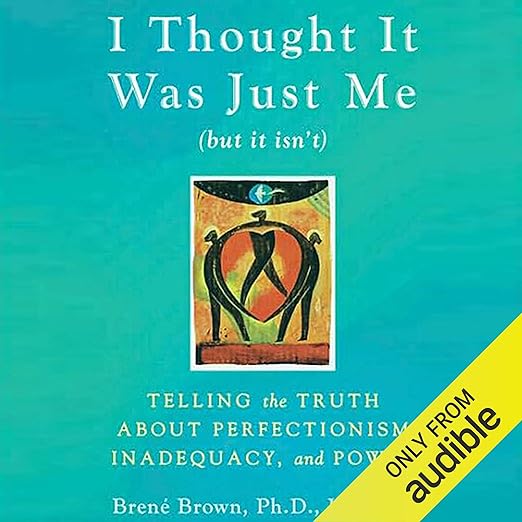
I want to make a small distinction that I think matters when approaching I Thought It Was Just Me (but it isn’t): this is Brene Brown’s 2007 book, not her later Daring Greatly or The Gifts of Imperfection. Those books emerged after her TED talk made her a cultural phenomenon and are shaped by the demands of that larger platform. This one comes from before all of that, from the period when Brown was a researcher publishing for a professional and general audience rather than a global one. That origin gives it a different texture: more methodological, more careful with claims, more grounded in the seven years of qualitative research she conducted with hundreds of women.
The book’s central argument is that shame, the intensely painful feeling of believing we are flawed and therefore unworthy of love and belonging, is epidemic and systematically underaddressed. Brown distinguishes shame from guilt, from embarrassment, from humiliation, and the distinctions are not academic. They map onto real differences in how people respond, heal, and protect themselves. The clarity of those distinctions is one of the book’s genuine contributions.
Our Take on I Thought It Was Just Me (but it isn’t)
What Brown calls “shame resilience” is the skill this book teaches: the capacity to recognize shame, move through it, and emerge with empathy for yourself and others intact. The framework is built from research rather than intuition, which gives it a more durable quality than self-help titles built on personal anecdote. One reviewer who had been living with depression and came to the book as a “last resort” described it as clarifying something she had suspected but couldn’t articulate: that shame was a primary driver of her experience. That kind of reader feedback is not unusual for this book, and it reflects the framework’s applicability beyond its original audience.
The book’s primary focus in Brown’s original research was women and their experience of shame, which is worth noting for listeners coming to it without that context. The material applies more broadly, but the examples and interview subjects are centered on women’s experiences specifically. Brown has addressed shame’s operation in men in later work, but that expansion isn’t part of this volume.
Why Listen to I Thought It Was Just Me (but it isn’t)
Lauren Fortgang’s narration is a good match for Brown’s writing. Brown’s prose is warm but also careful, and Fortgang doesn’t push it toward either excessive emotion or flat delivery. The listening experience has the quality of a thoughtful conversation rather than a lecture, which suits a book that is fundamentally about human connection and the way shame disrupts it. At nearly eleven hours, the book is longer than many self-help titles, but the depth of the research base justifies the investment.
Listeners who arrived at this book through Brown’s TED talk and later, more accessible titles will find this one requires more active engagement. The research methodology and case study structure demand a different kind of attention than the more narrative-forward later work. That’s not a weakness, but it is a difference worth preparing for.
What to Watch For in I Thought It Was Just Me (but it isn’t)
The original research was conducted with women, and the examples throughout reflect that. The framework is transferable, but the listening experience is most immediately resonant for women navigating societal shame expectations. Listeners who want coverage of how shame operates differently across gender lines, or who want the research extended to men explicitly, will need to turn to Brown’s later work for that expansion.
One reviewer who came to the book via a therapist’s recommendation and has an anxiety or panic disorder noted that the section on shame and comparison was particularly illuminating in ways they hadn’t expected. This is a common pattern in the reviews: the book tends to surface insights that feel personal and specific even though they’re built on broad research, which is the mark of good social science writing.
Who Should Listen to I Thought It Was Just Me (but it isn’t)
This works for anyone who has felt isolated by their own sense of inadequacy and wants a research-grounded framework for understanding that experience rather than a list of affirmations. Therapists and educators have found it useful as a reference text. Listeners already familiar with Brown’s later work will encounter an earlier, more methodologically explicit version of the ideas she later distilled into shorter forms. Those who want Brown’s most accessible entry point should start with Daring Greatly, but those who want the research foundation should start here.
Frequently Asked Questions
How does this book differ from Brene Brown’s more famous later works like Daring Greatly?
This book was written before Brown’s TED talk made her a mainstream figure and is grounded in seven years of formal qualitative research. It is more methodologically explicit and research-forward than her later, more narrative-driven titles. The core concepts are related but the treatment is more rigorous.
Is the book primarily for women, given Brown’s original research subjects?
The original research focused on women’s experiences of shame, and the examples reflect that. Brown has expanded the framework to cover men in later work, but this volume is most immediately applicable to women navigating the specific societal shame expectations her research mapped.
Does Lauren Fortgang’s narration suit Brown’s voice and style?
Yes. Fortgang brings warmth without sentimentality and handles the research-grounded sections with the same care as the more personal or emotional passages. The narration doesn’t flatten the book’s tonal variation.
At nearly 11 hours, is the length justified given the subject matter?
Reviewers generally find the length appropriate to the depth of material. Brown covers the research basis for shame resilience, the framework itself, and substantial application across multiple life contexts. The pace is steady rather than padded.