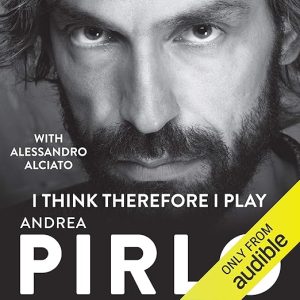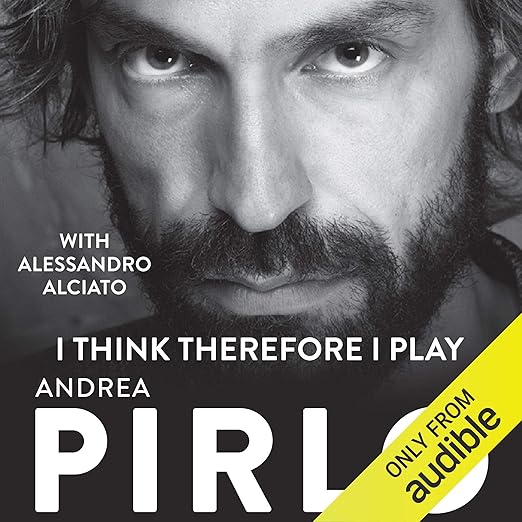
Andrea Pirlo spent his playing career being called cold, distant, almost expressionless, the deadeye penalty taker who never seemed to feel anything as the ball found the top corner. I Think, Therefore I Play spends its entire runtime dismantling that image, and the audiobook version, narrated by Ric Jerrom rather than Pirlo himself, still manages to carry real warmth and mischief through translation. This is a footballer's memoir built almost entirely out of anecdotes rather than tactics, and it wears that choice well.
Jerrom Underplays the Deadpan on Purpose
Jerrom's job here is a strange one: give voice to one of European football's most famously unreadable playmakers, in English, filtered through a co-writer's prose, and somehow preserve the dry Italian humor that reviewers keep singling out as the book's real discovery. He manages it by underplaying rather than overplaying, letting Pirlo's deadpan one-liners land without extra vocal emphasis, which suits a subject whose entire on-field reputation was built on doing the spectacular while looking bored. A more theatrical reading would have worked against the book's central joke: that the man everyone assumed had no personality was hiding one of the driest senses of humor in the dressing room.
At four hours and twenty-seven minutes, this is a brisk listen by memoir standards, closer to an extended conversation than an exhaustive career document, and that brevity is a deliberate choice rather than a shortcoming. Pirlo and his collaborators clearly prioritized the anecdotes worth telling over a chronological account of every match and trophy, and the book is better for the edit. Listeners expecting a tactical breakdown of his famous deep-lying playmaker role will need to look elsewhere; this is a locker-room memoir first and a football memoir second.
The title itself is worth pausing on: 'I Think, Therefore I Play' riffs on Descartes' cogito ergo sum, and that is not just a marketing pun. Pirlo positions himself throughout as football's philosopher-playmaker, someone who reads a match several passes ahead rather than reacting to it, and the book's funniest and most insightful passages both come from that same unhurried, observational temperament. It is a rare sports memoir where the title's cleverness actually pays off in the content rather than just on the cover.
The Panenka Against Hart That Explains Everything
The specific stories carry the book, and enough of them are packed into a short runtime that the pacing rarely sags. Silvio Berlusconi turns up playing piano and telling off-color jokes at Milan's training ground. Pirlo and Daniele De Rossi take Alessandro Nesta on an unplanned detour through the German countryside in a rental car days before a World Cup semifinal, apparently just to unsettle him. Filippo Inzaghi's pre-match routine gets described in enough detail that one reviewer politely calls it something a listener can practically smell through the headphones.
The supporting cast reads like a who's who of two decades of Italian and European football: Marcello Lippi, Carlo Ancelotti, Antonio Conte, Paolo Maldini, Andriy Shevchenko, Clarence Seedorf, Gianluigi Buffon, Kaka, Nesta, Mario Balotelli, Alessandro Costacurta, Gennaro Gattuso, and a running joke involving a teammate nicknamed after Ronaldo, distinguished in the text as 'the real one.' Pirlo treats every one of these names with the same wry affection, which keeps the book from reading like a highlight reel of famous acquaintances and more like genuine shared history.
Reviewers consistently describe the gap between Pirlo's public reputation and the person who emerges here, one calling him 'funny, simple, likeable' in contrast to the masterful, efficient figure fans watched play. That contrast is the book's real subject, more than any specific trophy or tournament, and it comes through clearly even with a narrator standing in for the author's own voice.
The audiobook also captures a specific football moment worth knowing before diving in: Pirlo's ice-cold panenka penalty against England's Joe Hart in the Euro 2012 quarterfinal shootout, chipped dead center while the goalkeeper dove to the side, remains one of the most audacious moments in recent international football. The book's account of that tournament, and the mental state that produces a decision that bold under maximum pressure, is one of the more genuinely revealing passages for listeners wanting insight into how Pirlo actually thinks under stress rather than just funny locker-room stories.
A 2014 Snapshot That Stops Short of Coaching
This book was written and published around Pirlo's final international tournament in 2014, which means it stops well short of his later career, including his move to Major League Soccer and his subsequent shift into coaching. Anyone hoping for a full-career account, or reflections on his life after playing, should know upfront that this is a snapshot from a specific, earlier moment rather than a complete retrospective.
Because the book leans on inside jokes and specific matches from Serie A and the Italian and European international scene, listeners without at least a passing familiarity with 2000s and early 2010s football will miss some of the payoff. It rewards existing football knowledge rather than building it from scratch, and it is not structured as an introduction to the sport or to Pirlo's technical style of play.
Best Suited to a Single Long Commute
Fans of Italian football, Serie A followers, and anyone who watched Pirlo control midfield for Milan, Juventus, or the Italian national team will get the most out of this. It also works well for readers who enjoyed self-narrated football comedy memoirs and want a European, more Italian-flavored variation on the same idea, even without the self-narration.
Skip it if you want tactical analysis of Pirlo's playing style or a comprehensive career biography covering his coaching years. This is best approached as a quick, funny, anecdote-driven companion listen, ideal for a single long commute rather than a multi-week project, and it delivers exactly what it promises within that scope.
Key Details
- Narration: Ric Jerrom voices Pirlo's dry, understated humor without overplaying it, a smart choice for a subject whose reputation was built on looking bored while doing the spectacular.
- Themes: Italian football culture, hidden personality behind a stoic public image, camaraderie
- Mood: Wry, anecdotal, brisk
- Verdict: A fast, funny football memoir for fans who already know the names, not a tactical deep dive or a full-career account.
Questions Listeners Ask
Does Andrea Pirlo narrate the I Think, Therefore I Play audiobook himself?
No. The audiobook is narrated by Ric Jerrom rather than Pirlo, though reviewers note the translated humor and voice still come through clearly.
How long is the I Think, Therefore I Play audiobook?
It runs 4 hours and 27 minutes, a brisk, anecdote-driven listen rather than an exhaustive career biography.