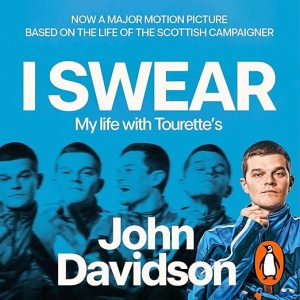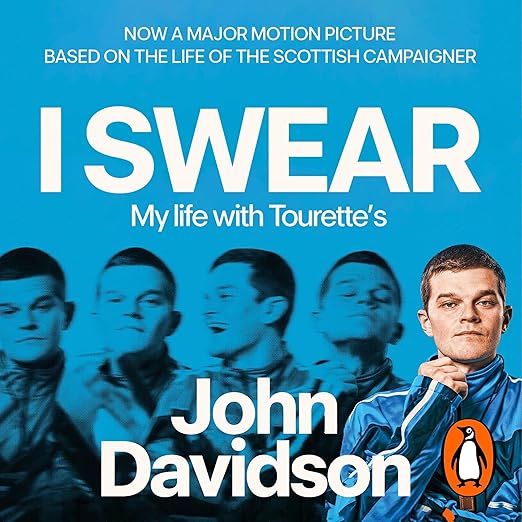
Memoir has a default shape when the subject is a diagnosis, and it runs symptom, struggle, breakthrough, wisdom. What makes this audiobook worth its seven hours and forty-three minutes is that John Davidson's life declines to sit inside that shape. Tourette's syndrome does not resolve. It arrived when he was twelve, in the Scottish Borders in the 1970s, and it stayed. The publisher's copy makes a point of the numbers: roughly one in a hundred schoolchildren live with the condition, and it remains, in the copy's own word, "chronically misunderstood". David Monteath reads the audio edition, and the book behind it is the one that inspired the film of the same name.
An Extraordinary Friendship Outperformed the Clinical
The arc the copy sets out is brutal in its ordinariness. A happy, football-mad boy starts blinking and jerking at twelve. The tics escalate into involuntary obscene shouting. He is, in the publisher's phrasing, "labelled disruptive, rude, and even mad", bullied and rejected, alienated from his family and from a society with no framework for him. Then come months of hospitalization and medication. What turns the story is not treatment but an extraordinary friendship and what the copy calls his "dogged optimism", and that ordering matters, because the human intervention outperformed the clinical one.
Where the audience came from is unusually visible here. One reviewer explains the purchase directly: a broadcast moment at an awards ceremony and the online argument that followed pushed them toward a book they would otherwise have ignored, adding "I ordinarily don't bother with biographies otherwise." That is a rare thing to see stated so plainly, and it says something about how a life like Davidson's reaches people. The attention arrives through a controversy about the condition rather than through curiosity about the man.
The other two comments come from the opposite direction. One reader with Tourette's writes that the book "felt like finally being seen" and describes the story as "raw, funny, and painfully honest", before the comment breaks off mid-sentence. Another, who makes no claim to the condition, reaches for almost the same adjective, calling the insight "raw and honest" and saying the book is "written straight from the heart". Two very different readers converging on one word is the most useful signal in the pool.
A Voice Its Owner Cannot Govern
The audio edition raises a question the printed page cannot. This is a memoir about a voice its owner cannot govern, about sounds that arrive without permission and land in rooms that punish them. Hearing it read aloud puts you in a position the page never quite manages. It also means a decision was made, since Davidson does not narrate his own story and David Monteath does. That is defensible for a book whose subject is the difficulty of controlled speech, and it is the first thing worth testing in a sample.
What the book delivers for listeners who share the diagnosis appears to be recognition, and recognition is not a small thing when a condition gets misrepresented this consistently. What it offers everyone else is closer to a corrective. Most people's idea of Tourette's comes from a punchline. Davidson's account replaces the punchline with a childhood: friendships that closed, a family that struggled, an institution that answered with sedation, and a stubbornness that outlasted all of it.
The framing in the publisher's copy is more ambitious than the usual illness-memoir pitch. It presents Tourette's "not just as a medical condition, but as a lens through which we can all better understand the importance of human connection", which could easily have stayed an empty gesture. The structure of Davidson's story earns it, because the turning point in the account is a relationship rather than a prescription. That is the argument, and the book puts its own life behind it.
The Casting Decision Cuts Both Ways
The casting decision cuts both ways. A professional reader brings control to material about the absence of control, and some listeners will want the voice itself, tics included, rather than a rendering of it. None of the three posted comments addresses the audio at all, and two of them describe the experience in reading language rather than listening language, which suggests the pool formed around the text. If the performance is your deciding factor, the evidence is not in the reviews.
The content is heavy in specific ways worth naming. Involuntary obscene shouting gets described rather than avoided. So do bullying, family breakdown, and a stretch of hospitalization with medication that reads as containment more than care. Anyone who finds institutional-psychiatry material difficult should know it is in here. The inspirational framing in the publisher's copy, triumph over adversity and never giving up, will also feel tidier than the life it summarizes, and some readers dislike that gap.
One practical note on identification. This listing carries the bare title while at least one reviewer gives the book as "I Swear: Life with Tourette's", which helps if you are searching for it or checking whether you already own an edition. The publisher's stamp on the copy is Penguin and the material is dated 2025, so this is a recent release rather than a reissue of an older account.
One in a Hundred, in Most Classrooms
Anyone who has been told their child's tics are a behavior problem should hear this, and so should the teachers and clinicians who told them. Adults living with Tourette's have an obvious claim on it. Beyond that, a 4.8 average across two hundred and seventy-eight ratings suggests a book that has traveled well past its immediate community, and the reason is legible: it works as a story about being written off and refusing the verdict.
Skip it if you want clinical explanation. This is no guide to the neurology, the treatment options or the research, and a reader who needs that will find the medical content thin. Skip it too if the inspirational register grates, because the copy leans on triumph and perseverance and the book does not apologize for that. Anyone who came looking for the film's story in more detail will find the source material rather than a novelization of the screenplay.
The one-in-a-hundred figure in the publisher's copy is the number to sit with. That is one child in most classrooms, carrying a condition that arrives as a joke to everyone else. Davidson spent decades being that child and then being that adult, and seven and a half hours of his account is a reasonable price for understanding what it cost him.
Common Questions
Is this audiobook connected to the film I Swear?
Yes. The publisher's copy describes Davidson as the man whose life inspired the film of the same name, so this is the source account rather than a tie-in written afterwards. Anyone who saw the film and wants the fuller version of the childhood, the hospitalization and the friendship that changed things will find it here at length.
Does John Davidson narrate the audiobook himself?
No. David Monteath reads the audio edition. Given that the memoir is about speech Davidson cannot control, the decision to cast a professional reader is worth thinking about before you buy. None of the posted comments discusses the performance, so a sample is the only way to judge whether the voice suits the material for you.
Is it suitable for a teenager who has just been diagnosed?
For many, yes, and one reviewer who lives with Tourette's describes the recognition it gave them. Set expectations first though. The account covers bullying, family alienation and months of hospitalization with medication, so a newly diagnosed teenager may want an adult listening alongside them for the earlier stretches.