Key Details
- Narration: Virtual Voice AI narration delivers Zelechower's translated testimony without embellishment, a real limitation for material this personal but not a barrier to the words themselves.
- Themes: Holocaust survival testimony, family loss, translated memoir
- Mood: Unsparing, raw, and quietly devastating
- Verdict: Essential firsthand testimony for readers of Holocaust memoir, delivered through a synthetic voice worth knowing about before you start.
A Title That Anticipates Its Own Transmission
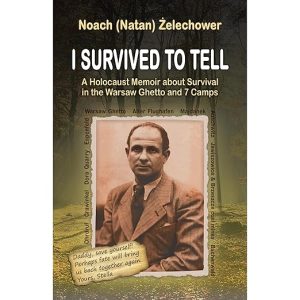
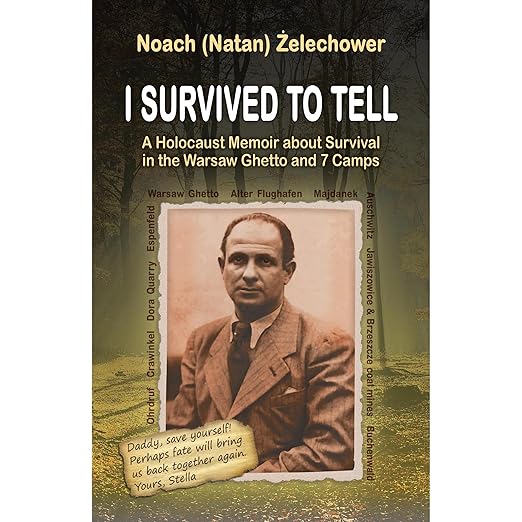
Two translations separate this English-language audiobook from Noach Zelechower's original words, Polish to Hebrew by his own daughter and her husband in 2020, then on to this English edition, and knowing that lineage changes how you listen to a survivor's memoir like I Survived to Tell, written in 1946 while the losses it describes were still raw enough to reopen with every sentence.
The book's very title carries a survivor's dark practicality. I Survived to Tell is not a triumphant framing so much as a statement of duty, the sense that living through seven camps only mattered if the account eventually reached someone. That framing shapes the entire memoir; Zelechower is not writing to process trauma for his own sake so much as to leave a record, and the audiobook format, someone else's voice carrying his words forward eighty years later, is in a strange way exactly the kind of transmission the title anticipates.
The facts alone carry enormous weight. Zelechower passed through seven separate concentration and extermination camps during the war, survived forced labor and death marches, and returned to Warsaw in 1946 only after confirming that his first wife and their young daughter had been transported from the Warsaw Ghetto to Treblinka and killed there during the Great Deportation of the summer of 1942. He wrote this memoir within months of that confirmation, which explains both its immediacy and its rawness; this is testimony written while grief was still an open wound, not a reflective account assembled decades later.
First Published by Yad Vashem as My Seventh Camp
His daughter's last note to him, telling him to save himself because fate might reunite them someday, becomes the memoir's emotional anchor, repeated as a private mantra he held onto through years of hunger and forced marches. One reviewer, quoting that same line directly in their review title, calls it evidence that the human spirit yearns for freedom even in what they describe as the deepest caverns of cruel genocide. That specific detail, a child's last words to her father, is the kind of thing that survives seventy years of translation intact precisely because it never needed embellishment.
The book's publication history is its own small story of survival. Zelechower's manuscript existed only in Polish for over seventy years until his daughter Hana, born in 1947 to Zelechower and his second wife Paulina Weinreb, herself a Holocaust survivor, translated it into Hebrew with her husband Stefan Cytron. Yad Vashem, Israel's official Holocaust remembrance institution, published that Hebrew edition in January 2020 under the title My Seventh Camp. This English translation, now available as an audiobook, is the memoir's first appearance in the language spoken by the largest surviving audience for Holocaust testimony worldwide.
Written Before He Could Soften Anything
Reviewers consistently single out the level of physical and emotional detail Zelechower includes, the specific mechanics of hunger, the methods his captors used to torment prisoners, and the way sustained deprivation dulled people's capacity to feel much of anything at all. One reviewer calls it a dark period in human history rendered in great detail, and that specificity is exactly what separates individual survivor testimony from the broader historical record: Zelechower is not summarizing what happened to Polish Jews generally, he is recording precisely what happened to him, in seven different camps, in his own remembered sequence.
Yad Vashem's decision to publish Zelechower's Hebrew translation as part of its own official publications arm carries institutional weight worth understanding. Yad Vashem does not publish every submitted survivor account, and its imprint functions as a form of historical vetting, situating this specific memoir within Israel's broader, decades-long project of collecting and preserving firsthand Holocaust testimony before the generation who lived it is gone. That an English edition has now followed extends that same preservation project to a new audience decades after the original telling.
Memoirs written this close to the events they describe, within a year of the war's end, occupy a different category than testimony collected decades later through oral history projects. Zelechower had not yet had years to process, reframe, or soften his account through the distance later memoirists often develop; the specific sensory details of hunger and forced labor arrive here closer to how they were actually lived than how they were later remembered, which is precisely why reviewers describe the book's detail as unusually vivid even by the demanding standards of Holocaust survivor literature.
Unfiltered by Any Narrator's Performance Choices
This edition uses Virtual Voice, Amazon's AI narration, and that fact deserves direct acknowledgment rather than a footnote. Holocaust testimony depends enormously on human vocal presence, the specific weight a trained narrator can bring to atrocity without either flattening it into monotone or overplaying it into melodrama, and a synthetic voice cannot fully replicate that interpretive judgment. What the AI narration does preserve is the actual text, word for word, unfiltered by any narrator's individual performance choices, which some listeners may even prefer for testimony this personal: nothing stands between Zelechower's own translated words and the listener's ear.
The translation layers are worth naming honestly too: this is an English rendering of a Hebrew translation of a Polish original, which means some of Zelechower's specific voice and period idiom has necessarily passed through two intermediary translators before reaching this audiobook. That is not a flaw so much as the reality of how testimony like this survives to reach a new audience at all, but listeners hoping for the author's untouched original phrasing should know exactly what layer of the text they are hearing.
The nine-hour runtime is worth noting practically: this is not a book to rush through in a single sitting regardless of format, and listeners may find, as with much serious testimonial nonfiction, that breaking it into shorter sessions allows the material's full weight to register rather than blur into a single undifferentiated account of suffering.
Two Days Against the Years Zelechower Survived
This belongs alongside the essential shelf of translated Holocaust survivor memoirs, the Primo Levi and Elie Wiesel tradition of firsthand testimony that refuses to let specific individual suffering dissolve into abstract historical statistics. Listeners drawn to that tradition, along with anyone researching the Warsaw Ghetto deportations or the broader camp system Zelechower moved through, will find genuinely rare firsthand detail here.
Skip it only if sustained, unfiltered descriptions of atrocity are more than you can take on right now, since this book offers no distance from its material and does not intend to. Listeners specifically wanting a fully human-narrated Holocaust memoir rather than AI narration have other well-known options, though few carry this particular story's firsthand detail. One reviewer admits they doubt they could have lasted two days under the conditions Zelechower survived for years, a fair measure of what this audiobook asks a listener to sit with.
Is this audiobook narrated by a human or an AI voice?
This edition uses Virtual Voice, Amazon's AI narration, which delivers the translated text directly without a human narrator's interpretive performance choices layered on top.
Is this a first-hand account, and how many translations has it passed through?
Yes, this is Noach Zelechower's own memoir, written in 1946. It has passed from his original Polish through a 2020 Hebrew translation by his daughter and her husband, published by Yad Vashem, and now into this English audiobook edition.
How graphic is the content in this audiobook?
It is unsparing. Zelechower describes hunger, torture methods, and death marches across seven camps in sustained detail, and listeners should be prepared for a genuinely difficult, unfiltered account.
Does this audiobook cover Zelechower's life after the war as well?
Briefly. The synopsis confirms he remarried fellow survivor Paulina Weinreb in 1947 and their daughter Hana was born that same year, though the bulk of the memoir focuses on the war years themselves.