Quick Take
- Narration: Sean Patrick Hopkins earns his Earphones Award, he plays Bud’s particular flavor of articulate, self-aware melancholy without ever sliding into self-pity, and his timing for the dark comedy is precise.
- Themes: Grief and reinvention after divorce, how strangers’ deaths illuminate the living, the obituary as unexpected philosophical form
- Mood: Wry and tender, with the quality of laughing at a funeral when you really mean it
- Verdict: One of the more emotionally generous comic novels to come out recently, Kenney writes with real warmth about real pain, and Hopkins makes it land beautifully in audio.
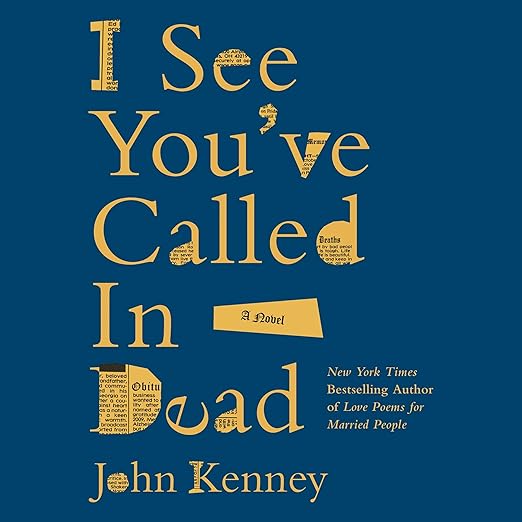
I started I See You’ve Called in Dead on a Tuesday afternoon when I was in a mood that was approximately the emotional equivalent of a minor key, not quite sad, but not interested in anything cheerful either. It was the title that got me. Something about the specificity of that phrasing, calling in dead when you’re not technically dead but may as well be, which is exactly the kind of dark precision that makes literary comedy worth seeking out. Six hours later I had forgotten to make dinner, and I was sitting in the dark thinking about Bud Stanley the way you think about people you actually know.
Bud is an obituary writer. He is recently divorced, she left him for another man, who in fairness was far more interesting, and is not handling the aftermath with particular grace. He is underperforming at work. He has given up on dating. And then, one mildly drunken evening, he accidentally publishes his own obituary in the paper. The company cannot legally fire a dead person, which is the kind of specific workplace absurdity that Kenney deploys with evident delight. While awaiting his professional fate, Bud begins attending the funerals and wakes of complete strangers to try to learn how to live again. That is the entirety of the premise, and it is everything the novel needs.
The Obituary Writer’s Particular Perspective
Kenney makes a brilliant choice in his protagonist’s occupation. An obituary writer is professionally embedded in the question of what a life means, what gets said, what gets left out, how the distillation of a person into five hundred words necessarily involves both compression and invention. Bud has spent his career writing the official versions of strangers’ endings, and the divorce has forced him to confront that his own story, were someone to write it, would currently have a very thin second act. The strangers’ funerals are his research method: what do people actually say about the people they love? What comes up consistently? What gets mourned?
The dark comedy is embedded in the gap between the official version of a life and what actually happened. Every wake Bud attends is a small drama of memory and revision and genuine feeling, and Kenney is both funny and respectful about the way people make sense of loss. One reviewer called the character development excellent and the handling of death sensitive and touching, that’s the right framing. This is not a novel that uses death as dark decoration. It is a novel that is actually about what death reveals about how we live.
Sean Patrick Hopkins and the Sound of Functional Melancholy
Hopkins won an AudioFile Earphones Award for this performance, and it’s not difficult to understand why. Bud Stanley exists in the register of intelligent, self-aware sadness, he knows exactly what’s wrong with him, can articulate it with precision, and is unable to do much about it through force of insight alone. That’s a harder register to perform than it sounds. Hopkins finds Bud’s voice without making him either pathetically hapless or boringly competent at self-deprecation. There is a quality to his reading of the interior monologue passages, the observations Bud makes at wakes, the running commentary on his own dysfunction, that gives the comedy the texture of real thought rather than constructed wit.
The novel’s comparisons to Richard Russo’s Straight Man, Andrew Sean Greer’s Less, and Fredrik Backman’s A Man Called Ove are all apt in different ways. Like Less, this is a novel about a man in the middle of his life whose grief is real but also somewhat ridiculous. Like Backman’s work, the comedy is never disconnected from genuine emotional stakes. Hopkins plays both registers with the consistency those comparisons require.
What Kenney Does With the Funeral Scenes
The strangers’ wakes and funerals are the novel’s most distinctive element, and Kenney uses them to do something structurally interesting. Each one is both comic and genuinely moving, a funeral for a ninety-three-year-old who apparently terrorized three generations of local Little League coaches, a wake for someone whose obituary only mentions professional achievements because the family ran out of other things to say. The absurdity is always specific, which keeps it from being exploitative. These are funny because they’re true, not because the dead are being mocked.
One reviewer noted that the dialogue attribution occasionally overdoes the character, using verbs like breathed and intoned instead of said, which is a real stylistic habit Kenney occasionally indulges. Hopkins handles those passages with enough confidence that the overdone moments don’t break the rhythm of the audio. The 2026 Gotham Book Prize finalist designation and the starred Booklist review are not hyperbolic, this is the real thing, a literary comedy novel that treats its subject with the seriousness it deserves while maintaining the humor that makes the seriousness bearable.
Who Should Listen / Who Should Skip
I See You’ve Called in Dead is for listeners who find comedy most satisfying when it is also sad, who appreciate dark humor that comes from a place of genuine feeling rather than mere cleverness, and who have spent any time in the particular purgatory of post-divorce identity reconstruction. Sean Patrick Hopkins’ performance is a significant reason to choose the audio version over print. If you found Less or A Man Called Ove too sentimental, you’ll likely have the same reaction here. Everyone else should start with the opening chapter and plan to miss dinner.
Frequently Asked Questions
The synopsis compares this to A Man Called Ove and Andrew Sean Greer’s Less, is that a fair comparison?
Yes, fairly. Like A Man Called Ove, it uses dark comedy and a slightly misanthropic protagonist to explore genuine grief and the possibility of reinvention. Like Less, it features a man in the middle of his life whose sadness is simultaneously absurd and real. The Russo comparison to Straight Man speaks to its specifically literary, dry-workplace-comedy dimension.
Sean Patrick Hopkins won an Earphones Award for this performance, what specifically makes his narration stand out?
Hopkins captures Bud’s register of articulate, self-aware melancholy without either making him pathetic or making his wit seem rehearsed. The interior monologue passages, Bud’s commentary at wakes, his running observations on his own dysfunction, are delivered with the quality of real thought rather than scripted comedy. His timing for the dark humor is precise throughout.
Is the premise of attending strangers’ funerals treated with sensitivity, or is it purely played for dark laughs?
Kenney treats the funeral scenes with genuine care. The comedy comes from specific, observed details about how people make sense of lives and is usually as much about the living as the dead. This is not a novel that mines grief for cheap shock laughs. The emotional register is consistently honest even when it’s funny.
Is John Kenney a debut author, and is this a standalone novel?
Kenney is not a debut author, he previously wrote Truth in Advertising, which won the Thurber Prize for American Humor. I See You’ve Called in Dead is a standalone novel with no sequel. The NPR 2025 Books We Love designation and 2026 Gotham Book Prize finalist status place it as a recent, critically recognized release.