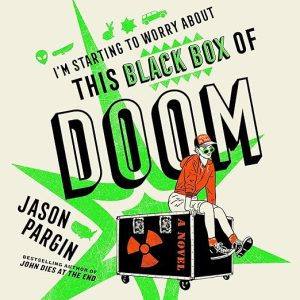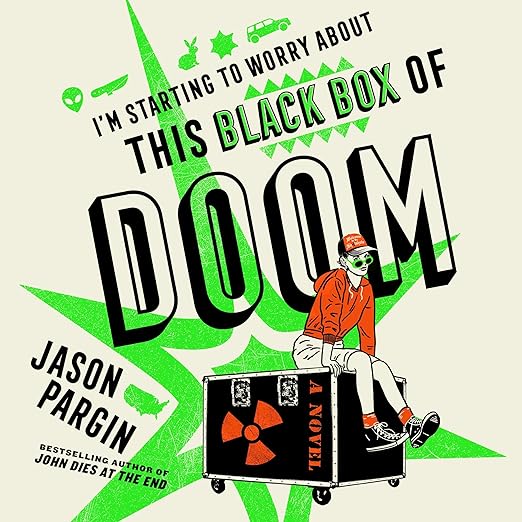
Jason Pargin built his reputation on the John and Dave novels, surreal horror-comedy hybrids that developed a devoted cult following over more than a decade. I'm Starting to Worry About This Black Box of Doom is his departure: a standalone darkly humorous thriller set entirely in contemporary America with no supernatural elements, no familiar characters, and a satirical target very different from the cosmic horror he usually deploys. This audiobook represents a genuine risk by an author with an established audience, and whether that risk pays off depends largely on what you came for.
Is I'm Starting to Worry About This Black Box of Doom Worth Your Time?
The premise is compact and effective: a driver is offered $200,000 to transport a young woman and a large black box from Los Angeles to Washington, D.C., under a strict set of rules that prohibit questions, communication, and trackable devices. Before they clear the city limits, social media has already decided what is in the box, and the theories, each more elaborate and alarming than the last, begin accumulating into something that functions as both plot engine and Pargin's primary satirical target. The novel is about the gap between what is happening in the car and what the internet has decided is happening in the car, and that gap generates both the comedy and the dread.
Reviewer Cleveland G. Oakes Jr. describes this as a bold departure and a satirical deep dive into the toxic underpinnings of modern culture, which is accurate and also helps explain why some longtime Pargin fans, as reviewer Clayton Overstreet notes, may miss the gross-out horror and magic of the Dave and John books. Pargin is doing something different here: less interested in the scary-funny cosmic indifference of his earlier work and more interested in the scary-funny human capacity to collectively construct catastrophe from ambiguous information. The novel is not a horror book with jokes; it is a social satire that happens to be structured like a thriller.
The Best Parts of I'm Starting to Worry About This Black Box of Doom
Ari Fliakos is a strong choice for this material. The audiobook format suits Pargin's prose, which has always been conversational and propulsive, in ways that make the road-trip structure feel genuinely kinetic. Fliakos keeps the pacing tight without losing the comedic timing that Pargin's dialogue requires. Reviewer Shawna Lee's observation that some moments have an 80s road trip Deus Ex Machina quality is well-taken; the novel does occasionally lean into genre conventions that feel deliberate rather than accidental, and Fliakos navigates these tonal choices without ironic distancing that would undercut them.
At twelve hours and forty-four minutes, this is a longer audiobook than the premise might suggest, and the runtime is genuinely used. Pargin builds the social media commentary gradually rather than delivering it as satire-lecture, and the extended runtime allows the novel's central argument about how stories propagate, mutate, and acquire the force of fact to accumulate with some weight. Listeners who come primarily for the comedy may find some stretches in the second half feel denser than the first; listeners who come for the satire will find those stretches the most substantive part of the book.
Before You Commit to I'm Starting to Worry About This Black Box of Doom
Pargin's long-term readers should calibrate expectations carefully. This is not a book that will deliver the pleasures of the Dave and John novels. The female protagonist in the car is not a familiar character from his catalog, and the absence of supernatural horror means the novel's dread has to be built from recognizable social reality rather than from the comforting distance of genre. Reviewer Clayton Overstreet's note that without the gross-out humor, magic, and superheroes, it was funny enough but not what they enjoy is an honest and representative response that tells you something important about audience fit.
The novel's satirical argument about mob mentality and social media is not subtle, and some readers will find it arrives at conclusions they already hold while delivering the lesson somewhat insistently. Reviewer Shawna Lee's phrase about conversations that might shake you a little out of suspension is worth noting: there are passages where the thematic concern becomes explicit in ways that may feel more like editorial than fiction. Pargin is clearly writing from conviction about his subject, and that conviction is also the source of the novel's energy. Whether you find it bracing or hectoring will probably depend on your existing relationship with the subject matter he is targeting.
The Right Listener for I'm Starting to Worry About This Black Box of Doom
Listeners who enjoy thriller structure deployed in service of cultural satire, and who are interested in a novelist they trust taking a serious swing at social media dynamics without the safety net of genre conventions, will find this audiobook rewarding. Fans of novels in the vein of Gary Shteyngart's digital-age satire or Chuck Palahniuk's more grounded social commentary will find Pargin's approach recognizable. The road-trip structure gives Fliakos's narration consistent momentum, making this well-suited to long drives or commutes where the kinetic energy of the premise matches the listening context.
Listeners who are specifically looking for the supernatural horror-comedy of the John and Dave books should be clearly aware that this book does not deliver those pleasures. Pargin is a different kind of writer here, and he appears to know it. Those who are open to following him into new territory will find a serious satirist at work underneath the comedy. Those who want what he has historically provided should return to the earlier catalog first and come to this one later, if at all.
Do I need to read Jason Pargin's John and Dave novels before this audiobook?
No prior knowledge is needed. This is a completely standalone novel with no shared characters, setting, or plot connections to the John and Dave series. It functions as a self-contained story and was designed as an entry point for new readers as much as a departure for existing fans.
Is this audiobook primarily comedy, thriller, or social satire?
All three are present but social satire is probably the load-bearing element. The thriller structure keeps the story moving and the comedy keeps it from becoming a lecture, but Pargin's primary interest is in how social media constructs collective reality from ambiguous information, and that argument shapes everything else in the book.
How does Ari Fliakos's narration handle the shifts between comedy and darker material?
Fliakos navigates the tonal range well, keeping the comedic timing sharp without allowing the darker satirical elements to feel deflated. The road-trip structure gives the narration a consistent forward energy that suits both the humor and the mounting social media commentary.
Is this audiobook suitable for listeners who are not familiar with Jason Pargin's work at all?
Yes, and arguably this is a better starting point than the John and Dave novels for readers who want contemporary satire without supernatural elements. The premise is accessible and the execution is self-explanatory, though longtime Pargin fans should be aware they are encountering a different mode of storytelling.