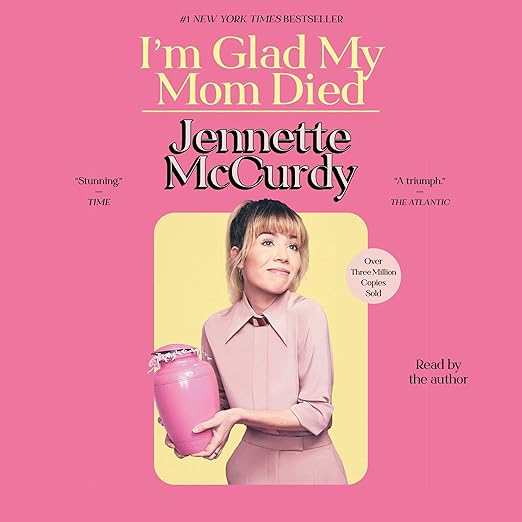
Bestsellers this large rarely stay this short. Six hours and twenty-six minutes is all Jennette McCurdy needed for a memoir that sold in the millions, and the brevity reads as a choice, not an omission. She narrates her own audiobook, which on this particular title is not a nice touch but the whole argument: a childhood spent delivering lines written by other people, followed by an account of that childhood delivered in the voice those people were managing. The copy promises unflinching detail and dark humor in the same sentence. Both are present, and the second is what makes the first survivable.
How the Audio Edition Dissolves a Title Problem
Titles rarely do this much work, and this one does most of its work before you press play. A five-star from November 2023 describes what the title costs a reader, saying it grabbed them from behind like a stage hook, then admitting to closing the laptop and trying to forget having seen it, because their own mother had died a few years earlier and the thought of being seen holding the book brought on a cold sweat. That reaction is the book's opening move. McCurdy chose a sentence nobody can carry into a waiting room, and the audio edition quietly dissolves the problem the title creates, since no one can see the cover of the thing you are listening to.
Calorie restriction is where the specifics begin, and the specifics are why this book outlasted its news cycle. Six years old at the first audition. A mother whose dream was a star daughter. Weighing five times a day under a euphemism. Showers supervised until sixteen. Diaries, email and income all shared as a matter of course. The copy lists these plainly and the effect of meeting them in sequence is cumulative in a way no summary reproduces. What keeps the whole thing clear of misery memoir is the register: McCurdy reports the terms of a managed childhood the way you would describe a job, which is precisely how it was arranged to feel.
McCurdy Performs This Rather Than Reading It
McCurdy performs this rather than reading it, and the distinction matters given the material. A former actor narrating dialogue reconstructed from memory can do her mother's voice, and doing that voice is the most loaded technical decision in the book, because impersonation is exactly what the relationship ran on. The casting is unarguable in any case. Six and a half hours in the voice of the person the story happened to closes a distance that a professional reader would first have to open and then find a way across.
Preference between the page and the recording gets settled here by one of the few people who bought both. A five-star filed in December 2025 reports owning this as an ebook and as audio, says both worked, and then recommends the listening outright, calling it an excellent reading and listening experience. That entry is unusually candid about its own position, noting that it posts under a reviewer program and would rather keep its private life private, which is a fair thing to want around a book like this. Take the recommendation for what it is: somebody who had the comparison in front of them and pointed at the audio.
A French Vote That Never Mentions the Book
Nuance is what the title hides, and buyers deserve to know that before deciding which book they are buying. A five-star filed from Singapore in July 2023 makes the point precisely: the mother is not written as a one-dimensional villain, and the book keeps insisting she was troubled in her own way, complicated and nuanced rather than simply monstrous. Anyone arriving for a demolition will meet something harder and more useful instead. The title is a provocation, and what follows it is a portrait that refuses to make the reader's judgment easy, which is a far more difficult book to write and a slightly different one from the one being marketed.
Numbers on this record do not describe the same book twice. The copy claims more than three million copies sold while the counter shows 88 grades, so what you can see is a fragment of a fragment, and the fragment has a hole in it. One of those five-star votes, filed from Canada in November 2025, is written entirely in French and never mentions a book: it praises a purchase for matching its advertisement, for being intuitive to use and for good value, and reports no particular trouble after several uses. That is a template written for merchandise, and it is currently propping up an average on a memoir about a managed childhood.
Content is flagged by the copy, which is more than most listings manage. Eating disorders, addiction and a run of unhealthy relationships are named outright, along with a mother's death from cancer, and a listener in recovery should weigh all of that before starting. The short running time works against them in one specific way, since six and a half hours means these episodes arrive close together, without the natural spacing a reader gets from setting a book down for a week. Dark humor carries a great deal of it. It does not carry all of it, and the funniest passages sit beside the worst ones by design.
Not a Backstage Memoir and No One's Punished
Survivors of controlling parents are the audience this was written for, whether or not they have ever seen a soundstage, and the celebrity frame is the least interesting thing about it. A four-star from May 2025 names the reason it works, which is the mixing of humor with genuinely hard material about eating disorders and industry pressure, and reports being unable to stop reading. Listeners who care about the machinery of child stardom will find the specifics valuable too, since the book documents a mechanism and does not merely complain about an industry in general terms.
Fans hoping for a warm backstage memoir about a favorite show should reconsider, because the television years are the setting and the eating disorder is the subject. Anyone in active recovery should approach carefully, or with support, given how specific the descriptions become. And anyone who wants the mother punished will leave unsatisfied: this book is at its best when it declines to hand over the villain its title promised, and at its most uncomfortable when it makes you understand her. Six and a half hours is a short listen and not an easy one, and the distance between those two facts is the whole point.