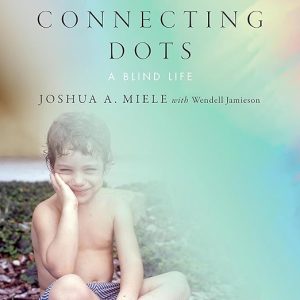
Miele was four when a neighbor poured sulfuric acid over his head. That sentence arrives in the opening paragraph of the description, and everything about how this audiobook works depends on what the following nine and a half hours choose to do with it. What they do, mostly, is decline to dwell. Connecting Dots is a memoir of engineering, activism, a rock band, a job at NASA, and a decades-long argument with the word disability, and the acid is where the story starts rather than what the story is about.
Tactile Maps and the Infrastructure Argument
Curiosity is the organizing trait, and the description names it outright: naturally curious, a born problem solver. What follows is a sequence of systems built to work around a world designed for sighted people, then rebuilt so other people could use them too. Screen readers, tactile maps, audio description. These are not marginal conveniences, they are the infrastructure through which a great many people reach everything else, and the memoir's claim is that somebody who needed them personally was in the room while they were being shaped.
Publication day brought a four-star that describes the shape accurately, noting that the attack left severe injuries, the loss of eyesight, and a series of reconstructive surgeries, and that Miele treated these not as disabilities but as obstacles to be overcome. That framing is the memoir's central move and also its most contestable one, which the book appears to know. The description is careful to say he was at first reluctant even to think of himself as blind, and only later embraced it and became a committed advocate. The distance between those two positions is the actual story being told.
The Book Arrives in a Hired Voice
Range is what lifts it clear of the inspiration shelf. A memoir about blindness that also contains a rock band and a stretch of drugs and addiction is a memoir about a person rather than a condition. A five-star response catches why that lands, describing a book filled with heart, love, and self-respect, calling Miele a riveting storyteller, and then adding the detail that convinced me more than any adjective: that response laughed, cried, and came out the other end wanting to have dinner with him.
Nine and a half hours suits a life with this much packed into it, and the pacing never turns into an obligation. Childhood and hospitals, the years of refusing the label, the work, a marriage, two children, and the technologies all get their room, delivered in what the description calls humor, adventure, and insight. Grand Central published the recording in March 2025. The book it is carrying is considerably stranger and better than the one the premise leads you to expect.
Greg D. Barnett reads it, and the casting decision deserves a paragraph of its own. Not one entry in the response column takes up the reading itself, so the performance sits unmeasured here, but the choice is worth noticing regardless. A memoir substantially concerned with how blind people gain access to information arrives in the voice of a hired reader rather than the author's own. That is an entirely standard publishing decision, and on this particular subject it is a slightly strange one.
The Byline Never Explains Who Wendell Is
Disclosures need to be in full view while you read this response column. An April 2025 five-star opens by stating plainly that the writer is related to the author and already knew the general outline of the life before opening the book, then argues that nobody could fail to find the details worth having. The honesty is admirable and the effect on the average is real. A memoir whose earliest and warmest responses come partly from inside the family is being graded by people with a prior stake in the outcome.
A second five-star from the same month goes further, identifying the writer as the author's aunt, one block from President Street at the time of the attack, and describing that position as biased but also knowledgeable. That entry happens to contain the single most useful piece of information on the page, and it has nothing to do with family. It credits Josh and Wendell with having done an amazing job of spinning a fast, funny story, which means a collaborator worked on this book. The byline carries one name. Who Wendell might be, the listing never says.
Getting the Story Instead of the Mechanism
Buyers should also know what this memoir declines to be. It is not a technical history of accessible technology, and anyone hoping for a detailed account of how screen readers or tactile maps actually function will receive the story of their making instead of their mechanism. The description sets the register honestly, promising humor and adventure, and the book is strongest as a life that happens to run alongside an engineering career. Approach it as biography rather than documentation and it will not disappoint you.
The Larger Half Is Naming Himself
September 2025 brought a five-star describing the route many listeners will take: hearing Miele interviewed on NPR, then wanting the whole story rather than the segment. That is the natural audience, along with anybody working in accessibility, product design, or assistive technology who would rather have the user's account than the vendor's. Families navigating a childhood injury or a new diagnosis will find something rarer than encouragement, which is a worked example of a life assembled afterward instead of in spite of.
Listeners who want their memoirs solemn should be warned that this one is not, since the register runs much closer to fun and funny than to reverent. The addiction material and the account of the attack are not softened, and anybody who needs to know that in advance now does. The technology-first buyer, the one who came for the invention story, should also understand that invention is the smaller half of the book. The larger half is a man deciding, slowly and entirely on his own terms, what to call himself.
Key Details
- Narration: Greg D. Barnett holds the reader credit, which puts a memoir about how blind people reach information into a voice that is not the author's
- Themes: Disability claimed rather than merely accepted, invention driven by necessity, a family and a neighborhood after violence
- Mood: Buoyant, funny, and unsentimental about hard things
- Verdict: A life story with far more range than its premise suggests, graded by a column that includes relatives.