In Brief
- Voice: Patrick Cullen has five hours and twenty minutes and two men to keep apart, since Downing quotes Lewis nearly as often as he paraphrases him.
- Big ideas: An atheism argued out of a mind, myth as a route to belief, the Oxford conversation that turned it
- Atmosphere: Measured, close-read and quietly persuasive
- Worth it?: The right companion for a Lewis reader carrying an unanswered question, and the wrong first book for anyone starting cold.
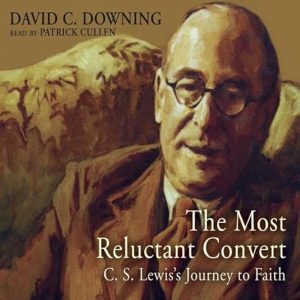
Scholarship, not storytelling, is what David C. Downing is offering here, and knowing that in advance saves a particular kind of disappointment. The book reconstructs how C. S. Lewis moved from a staunch atheism to the Christianity that made him a household name, and it does the job as argument instead of as scene. Patrick Cullen gets five hours and twenty minutes of audiobook to deliver it, in a Blackstone recording that has been on the shelf since March 2009. Downing is a professor and the author of Planets in Peril, and the record carries a series label that states the ambition plainly: secondary studies, which means a companion to Lewis and never a replacement for him.
Downing Refuses to Tell It Backward
Conversion narratives are usually told backward, with the ending quietly supplying the meaning of everything that preceded it. Downing refuses that shape. He takes the young Lewis's unbelief seriously as a position held for reasons, traces where those reasons came from, and only afterward shows what dislodged them. The books that made the name, Mere Christianity, The Screwtape Letters, The Lion, the Witch and the Wardrobe, sit at the far end of a road this study spends its whole length walking. What emerges is less the story of a man being persuaded than the account of a mind steadily running out of places to stand.
Concision earns the four-star entry on this page its main compliment. That response calls the account concise and colorful, credits Downing with leading a reader through Lewis's own thoughts instead of asking anyone to walk blindly, and settles on one word for the process: patient. Patient is right. Downing does not hurry the atheism, does not stage the conversion as a lightning strike, and does not treat the reasoning of a clever young materialist as a phase to be dispatched in a paragraph. That restraint is exactly why the ending, when it finally arrives, reads as a conclusion instead of an announcement.
Cullen Distinguishes Two Men by Pitch and Pace
Myth is where this book earns its keep. Lewis loved Norse story long before he believed anything, and the ache that certain kinds of beauty produced in him was the one experience his materialism could never explain away. Downing follows that thread all the way to the night on Addison's Walk and the long conversation with J. R. R. Tolkien and Hugo Dyson that ran into the following morning. A five-star response describes arriving with precisely that question after years of reading Lewis, finding it answered, and quoting Downing directly from page 147 to show the working. A page number is a print artifact, which tells you the written column attached to this audio edition grew up around a physical book. It also tells you the passage was worth marking.
Patrick Cullen's brief is narrow and unusually exposed. Downing's prose alternates constantly between his own analysis and quotation from Lewis's letters, diaries and published work, and a listener has to know at every moment which of the two men is talking. On the page a pair of quotation marks does that job in silence. In audio somebody has to do it with pitch, pace and a small shift of manner, several times per chapter, for five hours. Whether Cullen manages it is a question nobody on this page takes up; the written entries here have nothing at all to say about the recording.
The Description Pastes Over Its Own Sentence
Publisher copy on this record has been pasted over itself. The description reaches a sentence about Downing being a professor and the author of a critically acclaimed book, and then, in the exact spot where that book's title belongs, restarts an earlier passage word for word: for C. S. Lewis enthusiasts and students alike, this book offers a unique look at Lewis's personal journey to faith. The duplicated block lands mid-clause, so the first pass never reaches the title it was about to supply. The second pass does supply it, Planets in Peril, meaning the information survives, but only for a buyer willing to read through a paragraph that appears to stutter.
Written responses are thinner than the count implies. Two of the five grade the parcel and its condition instead of the text, one of them pleased that a secondhand copy turned up looking new, and a third answers the body of its own response by pointing back at its headline. That leaves two entries genuinely engaging with Downing, a small evidence base to sit beneath a badge of 4.6 drawn from ninety votes. The series field names the C. S. Lewis Secondary Studies Series while the number field beside it stays blank, so nothing on the page indicates whether this is the first of Downing's companions or the fourth.
A Step That Went Missing in Surprised by Joy
Lewis readers who already know the outline are the natural audience, particularly anyone who has closed Surprised by Joy with the feeling that a step went missing. Students working on Lewis get a compact secondary source they can absorb in a single afternoon. Listeners drawn to intellectual history with no stake in the theology will also do well, because Downing presents the positions Lewis held and later abandoned as positions, and never requires agreement in order to follow the argument. Five hours and twenty minutes is a modest commitment for a subject usually handled at three times that length.
Newcomers to Lewis will take less from this than they expect, for a structural reason: a companion assumes the thing it is accompanying. Anyone hoping for the later life will be disappointed as well, since Downing stops roughly where the faith begins and leaves the marriage, the grief and the late books to other writers. And listeners who want scenes, dialogue and the texture of an Oxford common room should understand that this is analysis with quotations threaded through it, delivered competently and not dramatized. Read Lewis first. Then let Downing show you the machinery you walked past.
Does the audiobook assume I have already read C. S. Lewis?
It assumes the outline, not the whole shelf. Downing writes for people who know roughly who Lewis was and what he published, and supplies context for everything else. A listener who has read nothing at all will still follow the argument and will miss the resonance, which is a real difference across five hours.
Can a non-believer get anything out of this audiobook?
Yes, and the design allows for it. Downing treats both the atheism and the Christianity as positions held for stated reasons, describes what changed and why it changed, and never asks anyone to sign anything. As intellectual history about a mind altering its own conclusions, it works independently of what a listener believes.
Does the age of this recording matter for the subject?
Barely. The recording dates from March 2009 and the study behind it is older, but the events are a century old and the primary sources have not moved since. What has grown is everything written about Lewis afterward, so a student assembling a bibliography will want more than this single companion beside it.
Is five hours and twenty minutes enough room for a subject like this?
For the question Downing actually asks, comfortably. He is not writing a life, he is reconstructing one turn inside it, and a tight scope suits the length well. Anyone wanting the full arc from childhood through the late books needs a full biography, and this sits usefully alongside one.