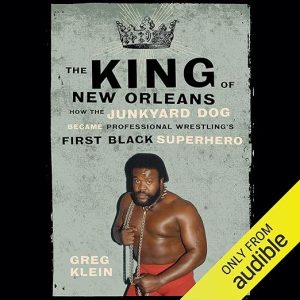
Professional wrestling keeps its own records, and most of them are promo tapes and secondhand memory. This audiobook is an attempt at a paper trail instead: six hours and twenty-nine minutes on Sylvester Ritter, the man who worked as the Junkyard Dog, and on the Mid-South territory that turned him into the biggest draw in Louisiana. Greg Klein writes it as reporting rather than tribute, which is the right call for a subject whose legend was built on purpose and then left out of most of the official histories.
Ritter's 1979 run is the fact everything else hangs on. He became the first Black wrestler named undisputed top star of his promotion, in a part of the country the publisher's copy describes, without softening it, as known for racial injustice. What lifts the book past anniversary tribute is the second half of that promise: alongside the famous feuds it takes on the business back stories, the arrangements and the bookkeeping that turned a performer into a regional institution. By 1985 Ritter was selling out the Downtown Municipal Auditorium and pulling large crowds into the Superdome, a feat the copy calls unparalleled by any other wrestler, and the reporting treats that draw as the headline achievement rather than any single match.
One thing about the reception column deserves saying before you buy. The recording was published in January 2013. The longest written response on the listing was filed in late October 2012, almost three months earlier, and it is grading a printed book: it praises the depth of the Mid-South material, names Bill Watts, and observes that the volume runs to 178 pages. That entry is genuinely useful and it is not a report on this recording. The page count field on the listing sits empty, so the only page count a buyer will find anywhere here comes from somebody who was holding the print edition before the audio existed.
J D Jackson Keeps the Promoters From Blurring
Territory wrestling is badly documented and disappearing from living memory, which is the strongest single argument for spending an evening here. A five-star entry from June 2013 makes the case better than the marketing copy does: it remembers watching Ritter under a different ring name at the Nashville Fairgrounds, in what it calls the Nick Gulas area, years before New Orleans meant anything to him. Detail like that survives almost nowhere else, and Klein's work on the promoters and the booking gives it somewhere to sit.
J D Jackson reads it. The material moves between two registers without warning, business reporting thick with promotion names, territory boundaries and ring names on one side, arena scenes on the other, and a reader who flattens both into one tone will let the promoters blur into each other. That is the standard failure mode for wrestling history in audio, where a listener cannot flip back two pages to check who ran which office. Length works in the book's favor here: under six and a half hours is a working day of listening rather than a project, and the cast never gets time to sprawl past what a listener can hold in the head.
Underneath the anecdotes sits the argument, and it is the other reason to press play. Klein is working on how a region with that history produced the sport's first Black idol, and on what the promotion took out of the arrangement. Ticket revenue turns out to matter at least as much as goodwill, and the book stays unsentimental about it. Anybody who came to wrestling later, through the national expansion, will find the economics of the territory era genuinely foreign: a business of local monopolies and borrowed talent, run city by city, with one performer carrying a building.
Not Forgotten, Says the Sharpest Review Here
The premise is the weakest part of the package, and one of the sharper entries on the listing says so directly. A four-star response accepts the reporting, calls the perspective journalistic, then objects to the framing: ask anybody who watched wrestling on national television in the mid to late eighties and the Junkyard Dog's name comes up unprompted, so treating him as a forgotten figure overstates the case. The same response wants the book to be twice the size. Both complaints land. This is a compact treatment of a subject that could carry a much larger one, and the promise of all the famous feuds and all the business back stories is doing more work than the runtime can honor.
Ninety people have graded the title and the average sits at 4.2, coherent, unremarkable, and drawn from a pool small enough to read as a sample rather than a verdict. Scale is the real caution. A career, a promotion, a city and a color barrier inside six and a half hours means every one of those threads gets less room than it wants, and the New Orleans years crowd out the rest by design. Anyone arriving for match-by-match nostalgia will meet a book more interested in the office than in the ring.
A Legend That Finally Has Paperwork Behind It
Longtime fans are the obvious audience, and the listing makes the point economically: a five-star entry filed in December 2025 consists of two words, good listen, which for this readership is probably a complete review. If you remember the Superdome shows, or you already know the promotion from the promoter's side and want the performer's, six and a half hours buys exactly that. The second audience sits one step outside wrestling entirely: listeners interested in how American sports business handled race at the end of the seventies, who get a case study with names, dates and attendance attached instead of a thesis.
Two groups should pass. Anyone who wants the complete career, everything before Mid-South and everything that came after, will find this scoped tighter than that and will feel the edges before the fourth hour. Anyone with no appetite for promoter politics will hear the middle chapters as bookkeeping, which is more or less what they are. Everybody else gets a well-reported evening about a performer whose legend finally has paperwork behind it.
- Voice: J D Jackson reads a book that switches between promoter bookkeeping and arena noise, a harder assignment than the runtime suggests.
- Big ideas: Territory wrestling economics, a 1979 color barrier, New Orleans as a fight town.
- Atmosphere: Brisk and reported, closer to a newsroom than to nostalgia.
- Worth it?: Worth the evening for anyone who remembers Mid-South or wants the business story behind a famous act, provided six and a half hours of scope is enough.