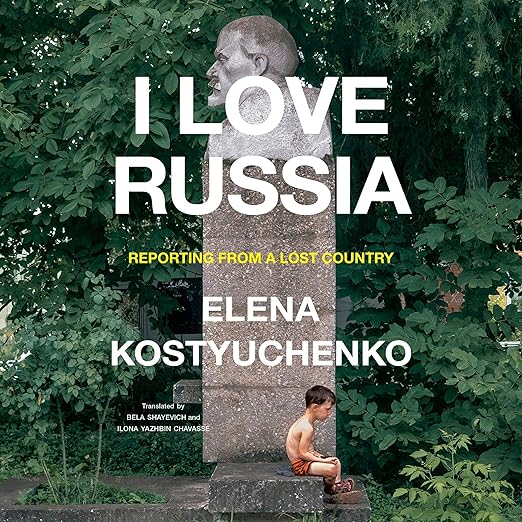
Quick Take
- Narration: Tiana Yarik brings Kostyuchenko’s first-person urgency to life with careful restraint, the performance honors the gravity of the material without theatrical overreach.
- Themes: State erasure of marginalized lives, journalism as resistance, the cost of patriotism under authoritarianism
- Mood: Heavy, unflinching, and deeply necessary, this is not comfortable listening
- Verdict: An essential document of contemporary Russia by a reporter who risked everything to write it, best approached as a series of connected portraits rather than a linear narrative.
I finished the last hour of this on a gray Saturday morning, sitting still in a way I rarely do anymore. Elena Kostyuchenko’s writing has the quality of field recordings made under duress, there is no padding, no reassuring editorializing, just the documented fact of what she witnessed. Named a Best Book of the Year by both The New Yorker and TIME, and winner of the Pushkin House Book Prize, this audiobook arrives already weighted with recognition. But awards don’t prepare you for what the listening experience actually feels like.
Kostyuchenko was a correspondent for Novaya Gazeta, Russia’s last free press, when she crossed into Ukraine in March 2022 to cover the war. She filed pieces knowing that returning home could mean fifteen years in prison. That biographical fact, which she states plainly and without self-pity, colors every chapter that precedes it in the book’s kaleidoscopic structure of reportage spanning fifteen years.
Our Take on I Love Russia
The book is not a conventional war correspondent’s memoir. It is a composite portrait assembled from fifteen years of field journalism, covering subjects that Russia’s official narrative actively erases: village girls recruited into sex work, queer people living quietly in outer provinces, patients and medical staff at a Ukrainian maternity ward, the unglamorous texture of provincial poverty. Kostyuchenko’s understanding of patriotism, that the greatest form of love for a country is the willingness to criticize it honestly, runs through every piece. The title is not ironic. It is an argument.
The structure, which stitches reportage with personal essays, is kaleidoscopic in the truest sense: each piece refracts the same underlying subject (a nation descending into fascism) from a different angle. One reviewer noted the book might be tough for readers unfamiliar with Kostyuchenko’s prior work, recommending a chapter-by-chapter approach. That is sound advice for the audiobook as well, this rewards pauses between sections rather than marathon listening sessions.
Why Listen to This Rather Than Read It
Tiana Yarik’s narration is one of the audiobook’s genuine assets. She navigates the tonal range between personal essay and reportage with real skill, keeping Kostyuchenko’s voice consistent without flattening it. One reviewer noted the translation is occasionally uneven, which is worth flagging, some passages carry the slightly asymmetrical phrasing that translation from Russian produces, and in audio that is occasionally noticeable. It does not undermine the power of the material, but listeners sensitive to language should be aware.
The 14-hour runtime is appropriate to the scope of what Kostyuchenko is attempting. This is not a book that can be compressed without loss. Each piece requires its own space to register before the cumulative effect of the whole becomes legible.
What to Watch For in the Structure
The book’s emotional center arrives in the Ukraine chapters, where Kostyuchenko documents what Putin is committing in Russian citizens’ names. But the earlier sections, on provincial sex work, on queer lives in regions where visibility is dangerous, are essential context for understanding why Ukraine matters in the way it does. The argument Kostyuchenko is making is that the violence directed outward was always being practiced inward first. The structure enacts that argument even when it does not state it directly.
Listeners expecting a straightforward war correspondent narrative will need to adjust their expectations. This is closer to literary journalism in the tradition of Anna Politkovskaya, fragmented, portrait-driven, and resistant to the kind of closure that chronological narrative offers.
Who Should Listen to This Recording
Essential for anyone trying to understand contemporary Russia beyond its geopolitical abstraction, this puts individual human costs where they belong, at the center. Also recommended for readers of war journalism and political nonfiction who want to understand how state authoritarianism operates at the level of ordinary lives. Listeners who find sustained exposure to suffering narratives difficult should be aware that several sections are genuinely harrowing. This is not a criticism of the book, it is an accurate description of what honest coverage of these subjects requires.
Frequently Asked Questions
Does this audiobook require familiarity with Russian politics to follow Kostyuchenko’s reporting?
Basic familiarity with Putin’s Russia helps, but the book builds its own context effectively. Kostyuchenko is a journalist, not an academic, so she embeds necessary background within the reporting itself. Complete newcomers to the subject may want to read a brief overview of Novaya Gazeta and recent Russian political history before starting.
How does Tiana Yarik handle the range of voices in the book, from reportage to personal essay?
Yarik navigates the tonal shifts with care, maintaining a consistent register that honors Kostyuchenko’s documentary seriousness. The performance is measured rather than dramatic, which suits material this grave. The occasional unevenness of the translation from Russian is audible in places but does not significantly impede comprehension.
Is this book structured chronologically or can chapters be listened to independently?
The book is not strictly chronological, it assembles reportage from fifteen years of field work in a thematic rather than linear order. Chapters can be approached somewhat independently, though the cumulative argument is stronger when listened to in full. Several reviewers recommend pausing between sections rather than listening in one continuous run.
How current is the material given the rapidly evolving situation in Ukraine?
Kostyuchenko’s 2022 Ukraine reporting captures a specific moment at the start of the full-scale invasion. The book is more concerned with the systemic conditions that produced the war than with operational updates, so it does not date in the way straight news reporting would. Its core analysis of how Putin’s Russia operates remains relevant.